






 Portuguese
  Spanish


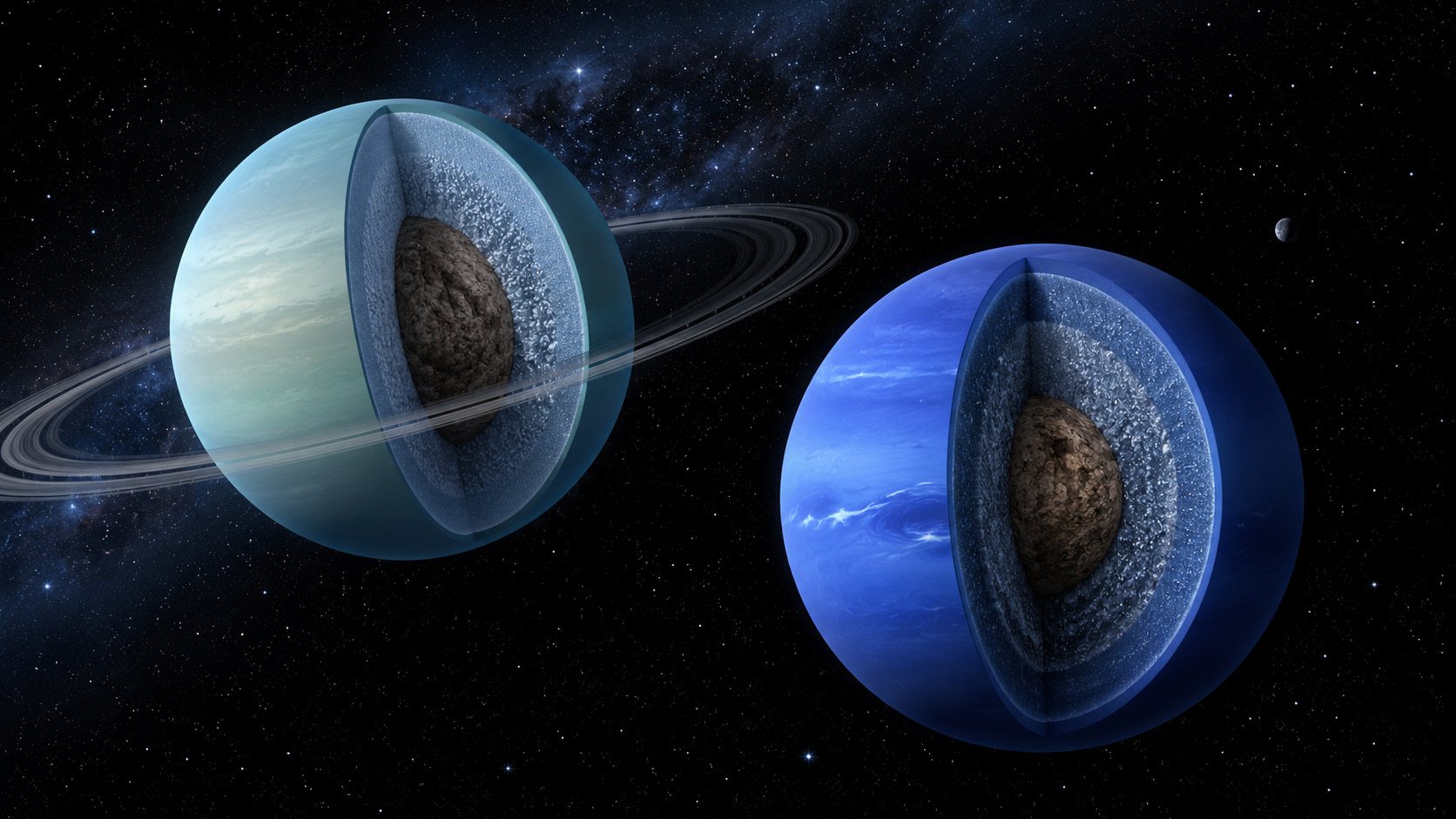
New studies suggest that Uranus and Neptune may be much more rocky than previously thought, challenging decades of planetary models.
For decades, textbooks, documentaries, and astronomical models have taught the same idea: Uranus and Neptune were “ice giants”, planets primarily composed of water, ammonia, and methane frozen under immense pressures. Now, new studies are beginning to challenge this classic view and suggest that the two worlds may be much more rocky and complex than science imagined.
The debate gained momentum after recent research indicated that the interiors of the two planets might not be dominated by ice as traditionally described. Instead, computational models point to scenarios with significantly larger amounts of rocky material mixed into the deep layers, completely changing the interpretation of the internal structure of the two giants of the Solar System.
Uranus and Neptune have been classified as ice giants for decades
Uranus and Neptune belong to a category called “ice giants,” separate from the gas giants Jupiter and Saturn.
-
Chinese R6000 Drone Combines Airplane and Helicopter Features, Carries Up to 12 People for Multiple Missions

-
In the World’s Most Densely Populated Desert, Families Dig Funnel-Shaped Underground Cisterns to Capture Rare Rainfall and Store Drinking Water for Up to Eight Months

-
Smart Glass Revolutionizes Privacy: Touch-Activated Opacity Transforms Windows into Connected Home Features with App and Voice Control
-
Young Innovators from Brazil Turn Discarded Plastic into Eco-Friendly Bricks Using Coconut Fiber, Offering a Sustainable Alternative for Construction



According to classic models, the two planets have atmospheres rich in hydrogen and helium surrounding huge mantles composed mainly of water, ammonia, and methane under extreme pressure and temperature conditions.
The scientific Wikipedia on ice giants highlights that the classification emerged in the 1990s, when scientists realized that Uranus and Neptune were structurally different from Jupiter and Saturn.
But the problem is that practically no one has ever directly seen the interior of these planets. Everything depends on physical models, density, gravitational field, magnetism, and computational simulations.
New models suggest that the interiors may be much more rocky
Recent research from the University of Zurich and the NCCR PlanetS has begun to question the traditional idea that Uranus and Neptune are primarily dominated by ice.


The latest models suggest that the two planets may have significantly larger proportions of rock in their deep interiors, perhaps much more than previously believed.
According to the study highlighted by the University of Zurich, traditional models may be “too simplistic” to explain the real composition of the ice giants.
The research uses physical modeling called “agnostic”, trying to reconstruct the planetary interiors without assuming beforehand that they are predominantly icy.
The word “ice” can be misleading even for scientists
An important detail is that “ice” does not mean exactly ice as found in a freezer. Inside Uranus and Neptune, pressure and temperature reach such extreme levels that water, ammonia, and methane cease to exist in conventional states.
The materials can become supercritical fluids, ionic water, or even superionic water, exotic states of matter that practically do not exist naturally on Earth.

According to traditional descriptions of Uranus’s internal structure, part of the planet may contain an extremely hot and compressed “ocean” of highly electrically conductive water-ammonia. This means that even the classic definition of “ice giant” was already more complicated than it seems.
Chaotic magnetic fields may be the result of this strange structure
Another reason scientists suspect that the interiors of the two planets are different from what was imagined lies in the extremely strange magnetic fields of Uranus and Neptune.
Unlike Earth, Jupiter, or Saturn, the magnetic fields of the two planets are tilted, irregular, and multipolar.

The new models suggest that this may be linked precisely to the unusual mixture of rocks, conductive fluids, and partially chaotic deep layers.
According to the cited studies, layers of ionic water and irregular convective regions could explain the unusual magnetic geometry observed by space probes.
Voyager 2 is still the only probe that visited both planets
Part of the problem is that Uranus and Neptune remain the least explored planets among the giants of the Solar System.
The Voyager 2 probe passed by Uranus in 1986 and Neptune in 1989. Since then, no orbital mission has returned to the two worlds.
This means that much of the knowledge about their interiors depends on remote observations made from Earth or space telescopes.
Researchers have been advocating for new orbital missions for years precisely because the current data is still insufficient to fully understand the composition, internal dynamics, magnetism, and evolution of these planets.
Uranus may be even stranger than Neptune
Even though they are often treated as “twins”, Uranus and Neptune have important differences.
Neptune emits much more internal heat than it receives from the Sun, while Uranus practically does not radiate significant excess thermal energy.

Uranus also has an extreme tilt, rotating practically “on its side”, which creates some of the most bizarre seasons in the Solar System.
Researchers still cannot fully explain why two seemingly similar planets evolved in such different ways.
Planetary science may need to reconsider the very definition of ice giant
The impact of this discussion goes far beyond Uranus and Neptune. Giants similar to the two planets are extremely common outside the Solar System. Many exoplanets found by modern astronomy have size and mass similar to the ice giants.
If the current models are wrong, scientists may need to reinterpret thousands of exoplanets classified based on simplified concepts of internal composition.
This means that understanding Uranus and Neptune may help redefine part of modern planetary science itself.
The Solar System still hides worlds that humanity barely understands
Despite being part of the Solar System known for centuries, Uranus and Neptune remain surrounded by enormous scientific uncertainties.
The two planets may hide partially rocky interiors, exotic oceans of supercritical fluids, chaotic convective structures, and magnetic mechanisms that still challenge current models.
In the end, the most uncomfortable discovery might be this: after decades of studying space, humanity may still not correctly understand even the giant planets that orbit our Sun.


-

1 person reacted to this.