Portuguese
  Spanish




metallic chalet without welding combines numbered pieces, metallic structure, and concrete fixation to speed up the assembly of units aimed at seasonal rental. The model reduces cutting on-site, depends on precise design, and targets compact accommodations in high-turnover tourist destinations without turning the timeline into a universal guarantee.
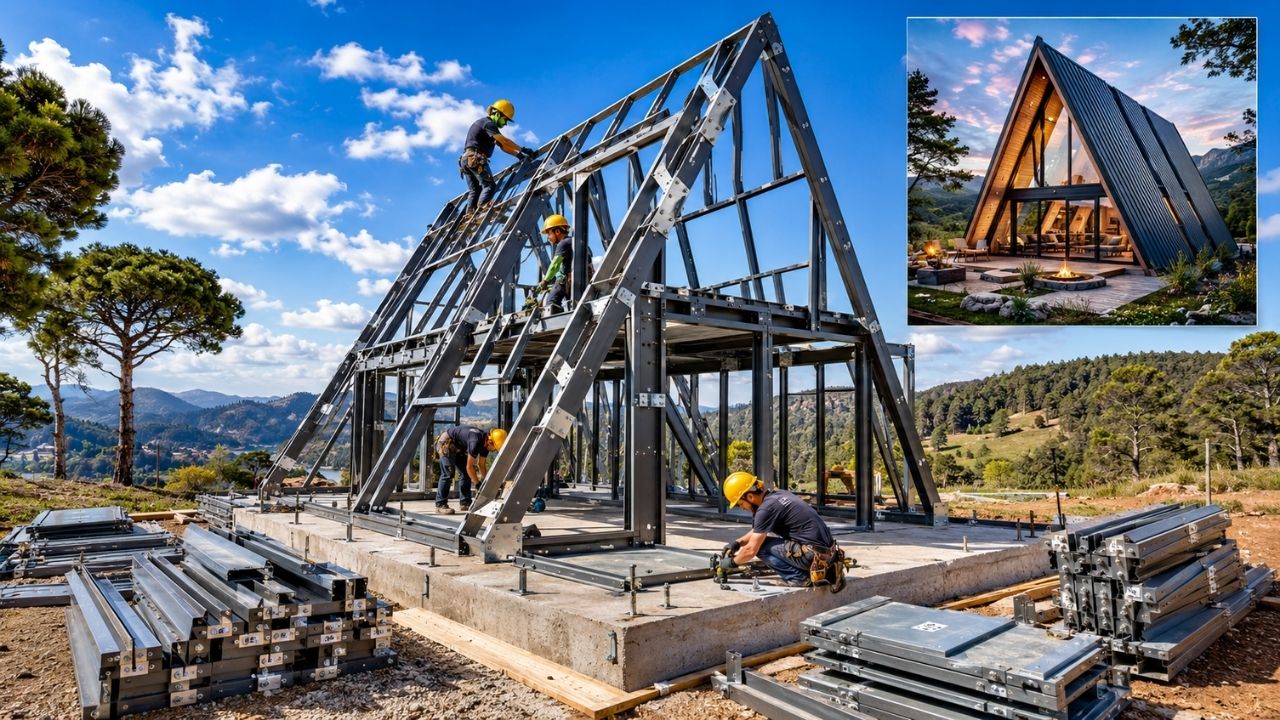
The metallic chalet was assembled like a giant Lego in a project aimed at seasonal accommodation, using numbered pieces, metal structure, screws, and direct fixation on concrete. The assembly was conducted by a small team at Bosque das Hortênsias, in Teresópolis, in the mountainous region of Rio de Janeiro.
In a video published on the VenomExtreme channel, the process, recorded on video, showed the structure being erected in two days of work, without welding and without cutting on-site. The proposal attracted attention because the project was designed to become a compact accommodation, with a mezzanine, bathroom, internal staircase, and dimensions aimed at use on Airbnb, Booking, and seasonal rental.
Metallic chalet uses numbered pieces and assembly similar to a giant Lego

The logic of the metallic chalet is based on a prefabricated structure. The pieces arrive cut, separated, packaged, and numbered, allowing the team to follow an assembly design to fit each part in the correct place. According to the account of the person responsible for the project, the process mainly depended on a screwdriver, drill, and project verification.
-
They exchanged the idea of a large house for a 35 m² warehouse, spent US$ 12,000 on the structure, and created a tiny house in Colorado with space to live and work.

-
A newly opened terminal in the middle of the Amazon has begun transporting soy and corn through Amapá, eyeing the queue of ships that is congesting the ports in the South.

-
Goodbye to old tiles: renovation technique without construction transforms bathrooms in a few hours, eliminates debris, and reduces costs with coverings using special paints, high-resistance adhesives, and modern finishes that completely renew the space.
-
Goodbye to the traditional clay brick: Indian startup transforms burnt straw into a carbon-negative brick that costs half, insulates better, and even removes CO2 from the air.


The most striking point is that the assembly does not require welding or cutting on-site. Instead of adapting the pieces during the project, precision comes from prior manufacturing. The fittings were prepared in the factory, with cuts described as laser-made, which reduces improvisation and speeds up installation.
In the structure, pillars, triangles, crossbars, angle irons, and fixation points appear to form the skeleton of the chalet. The metalon mentioned in the project includes pieces of 80 x 80 in 14-gauge sheet metal, described as thick and reinforced to support the assembly.
The comparison with Lego comes precisely from this sequence: identify the piece, fit, screw, and move on to the next stage. The construction no longer depends on sparks, welding, and manual cuts, but still requires checking, alignment, correct tightening of screws, and care with fixation in the concrete.
Structure was attached to concrete with hard bolts and almost a thousand screws

At the base of the metallic chalet, the fixation was done with screws called hard bolts, inserted directly into the concrete after drilling. The report mentions the use of 49 units of this type, measuring 10 x 75, to secure the support points to the ground.
In addition to these anchoring screws, the assembly used about 950 smaller screws throughout the structure. They appear in angle irons, crossbars, stairs, pillars, and connections between the metal modules. Nothing was described as welded on site; the union of the parts was concentrated in the screwed system.
This type of assembly changes the dynamics of the construction site. Instead of bringing cutting and welding machines to adjust the structure at the time of installation, the construction relies on pre-calculated and identified pieces. If the project is correct and the pieces arrive according to the design, the assembly tends to be cleaner and faster.
Even so, the result does not mean that any construction of this type dispenses with qualified labor. The material itself shows the participation of people with construction experience. The difference is that, in this model, the difficulty shifts from welding and cutting to reading the project, leveling, and correctly tightening the connections.
Two days of assembly drew attention, but pace depends on the team

The metallic chalet was erected in two days in the case shown. On the first day, the main triangles were raised, and part of the mezzanine was already fitted into the structure. On the second day, the construction progressed with crossbeams, sides, stairs, and the closure of the structural part.
The person responsible for the assembly highlighted that he was already familiar with the project, had studied the model for years, and had help from people in the construction industry. This detail is important to avoid turning the two-day deadline into a universal promise. A team less familiar with the design may take longer.
The report also mentions that a specialized team of three people could assemble the structure in about 10 hours. This number was presented as a reference by the supplier but should not be treated as a guaranteed standard for any terrain, team, or construction condition.
The actual deadline depends on factors such as ready foundation, access to the site, organization of the pieces, weather, experience of the assemblers, and measurement checks. Even so, the quick assembly is the great differential of the system, especially when compared to methods that require cuts, welding, and repeated adjustments on site.
Project has 59 m², mezzanine, and dimensions aimed at lodging
The described metallic chalet has an area of 59 m², with 7.5 meters in width by 6 meters in length. The total height reported is 6.32 meters, which allows for a more spacious internal volume and the inclusion of a usable mezzanine.
The mentioned mezzanine is 4.20 meters by 2.80 meters. The proposal is to use this upper space as a functional part of the lodging, without turning the chalet into a cramped structure. In compact seasonal properties, the feeling of height and circulation can weigh as much as the square footage.
The bathroom also received attention in the project. According to the report, it was designed to maintain an internal height of 2.32 meters, preventing the user from having to shower in a low area, limited by the roof slope or the mezzanine design.
The staircase was another highlighted point. The person responsible states that he sought to avoid a very steep staircase or the risk of hitting one’s head during the climb. The circulation space, step depth, and free span were presented as important parts to make the chalet viable for guests.
Metallic chalet targets Airbnb, Booking, and seasonal rental

The use of the metallic chalet was directly associated with the short-term accommodation market. The proposal targets those intending to install accommodations in tourist areas, focusing on Airbnb, Booking, and seasonal rentals.
This approach helps explain the choice for a quick assembly structure. For those investing in accommodation, reducing construction time can speed up the unit’s entry into operation. But structural speed does not eliminate steps such as finishing, electrical installations, plumbing, insulation, local approval, and regularization.
The model also attracts attention for allowing repetition. When a structure is standardized, with numbered parts and industrial cuts, the same design can be replicated on other plots, provided there is adaptation to the technical and legal requirements of each location.
The idea of a seasonal chalet suits mountainous destinations, rural areas, properties with views, and spaces aimed at accommodation experiences. However, good commercial performance depends on location, thermal comfort, privacy, access, maintenance, and differentiation, not just the metallic structure.
Weldless system reduces mess but requires precise design


The absence of welding and cutting on-site is one of the greatest advantages presented in the metallic chalet. This reduces sparks, noise, metallic debris, and rework on-site. It also facilitates the organization of assembly, as the parts arrive ready for fitting.
The system, however, heavily depends on prior precision. If a part comes with the wrong cut, incorrect drilling, or confusing numbering, the speed gain can turn into a delay. Therefore, the design and manufacturing phase is as important as the on-site assembly.
Another point is that the metallic structure needs to receive appropriate treatment and protection against corrosion, especially in humid, mountainous, or coastal regions. The transcription does not detail this aspect, so it is not possible to state which finishes or protections were used in this case.
Total construction costs, price per square meter, or final value of the ready chalet were also not presented. Therefore, the analysis must be restricted to what was shown: a screwed metallic structure, quickly assembled, with numbered parts and focused on seasonal accommodation.
At the same time, the case should not be seen as an automatic solution for any terrain. Quick assembly depends on precise design, ready foundation, organized team, and correctly manufactured parts. Do you think bolted metal chalets could become a trend in tourist areas of Brazil, or do you still prefer traditional constructions for lodging?