






 Portuguese
  Spanish





Satellites Reveal Over 1,000 Stone Structures in Saudi Arabia Dated to 7,000 Years Ago. The Discovery Rewrites History and Shows a Forgotten Civilization Beneath the Desert.
For a long time, it was believed that the Arabian Peninsula desert was just a sea of sand with no complex records of ancient human occupation. But in recent years, satellite images and scientific expeditions have been overturning this idea and completely rewriting the history of the Middle East. Researchers from the University of Oxford, in partnership with the Saudi Heritage Commission, have revealed a monumental discovery: over 1,000 stone structures scattered across the north of the country, dated to about 7,000 years ago, forming one of the oldest and most mysterious networks of Neolithic constructions on the planet.
These formations, called “mustatils” (from Arabic, “rectangles”), were mapped using high-resolution images obtained from satellites and topographical survey drones. The mustatils are rectangular constructions made with stacked stone blocks, some measuring over 600 meters in length, located deep in the AlUla, Ha’il, and Khaybar deserts, regions that today have virtually no life.
The Stone Cities That Precede the Pyramids
Carbon-14 analyses conducted on remains of bones and tools found nearby indicate that these structures were built between 5200 and 5000 BC, meaning they are older than the pyramids of Egypt and Stonehenge.
-
It’s not madness: ‘talking to yourself’ has an important function for the brain, science reveals

-
Federal Government formalizes pilgrimage route with more than 70 cities between Minas Gerais and São Paulo, and the path inspired by Santiago de Compostela ends at the Sanctuary of Aparecida.

-
A Brazilian street cleaner built a machine to recycle PET bottles in the hinterlands of Paraíba, transforming the trash he swept from the streets into threads, brooms, and equipment sold even outside Brazil, and began earning about R$ 7,500 per month with his own invention.

-
In a city where every piece of land is worth gold, he began buying plots in the 1960s and built a real estate empire with over a thousand properties.


According to archaeologist Dr. Hugh Thomas, project leader of The Aerial Archaeology in the Kingdom of Saudi Arabia, the evidence suggests that the mustatils were used for religious rituals and community ceremonies, pointing to organized and interconnected societies — something surprising in a region previously considered uninhabitable.
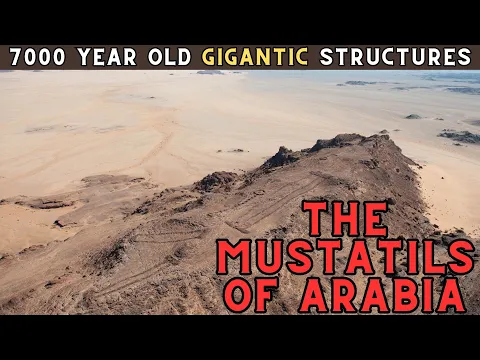

The team identified stone structures arranged in almost geometric alignments, connected by paths and dry valleys, forming true “stone cities.” In many cases, remains of horns and cattle bones were found, indicating sacrificial rituals related to animal domestication.
The pattern of repetition and symmetry is impressive: the mustatils are concentrated in areas with ancient water routes and now desertified valleys, suggesting that northern Saudi Arabia was once a wet and fertile region.
When the Desert Was Green
Parallel paleoclimatic studies published in the journal Nature Ecology & Evolution indicate that 10,000 years ago, what is now desert was a vast savanna with lakes and abundant vegetation.
The wetter climate would have favored the flourishing of these communities, which lived off livestock and local resource management. As the climate dried, these populations disappeared, leaving behind the imposing stone structures that now emerge among the dunes.
The researchers also discovered that many mustatils are aligned with geological formations and sunrises, which may indicate astronomical and symbolic functions, similar to other megalithic monuments of the ancient world.
The construction pattern and scale of these works suggest coordination among different human groups — possibly the first to occupy the northern Arabian Peninsula continuously.
The Rediscovery of a Forgotten Civilization
The discoveries were officially announced in 2021, but the mapping work continues. The Saudi government has been supporting large-scale archaeological expeditions as part of the “Vision 2030” program, which seeks to reveal the pre-Islamic cultural heritage of the region.
Archaeologist Dr. Rebecca Foote of the Saudi Heritage Commission told the BBC that “the Arabian Peninsula is proving to be one of the forgotten cradles of human civilization,” highlighting that the volume and complexity of these structures suggest a society with established beliefs, organization, and engineering.

Today, it is estimated that the total number of mustatils may exceed 1,600 structures, some so extensive that they are only visible from the air. The discovery repositioned Saudi Arabia on the global archaeological map, showing that while Mesopotamian and Egyptian civilizations flourished, another people was already erecting monuments in the heart of the desert, defying aridity and time.
The “civilization of rectangular stones,” as it has been called, is a silent testimony of a past when the Arabian desert was not a void, but a pulsating space of life, belief, and human ingenuity.


