






 Portuguese
  Spanish


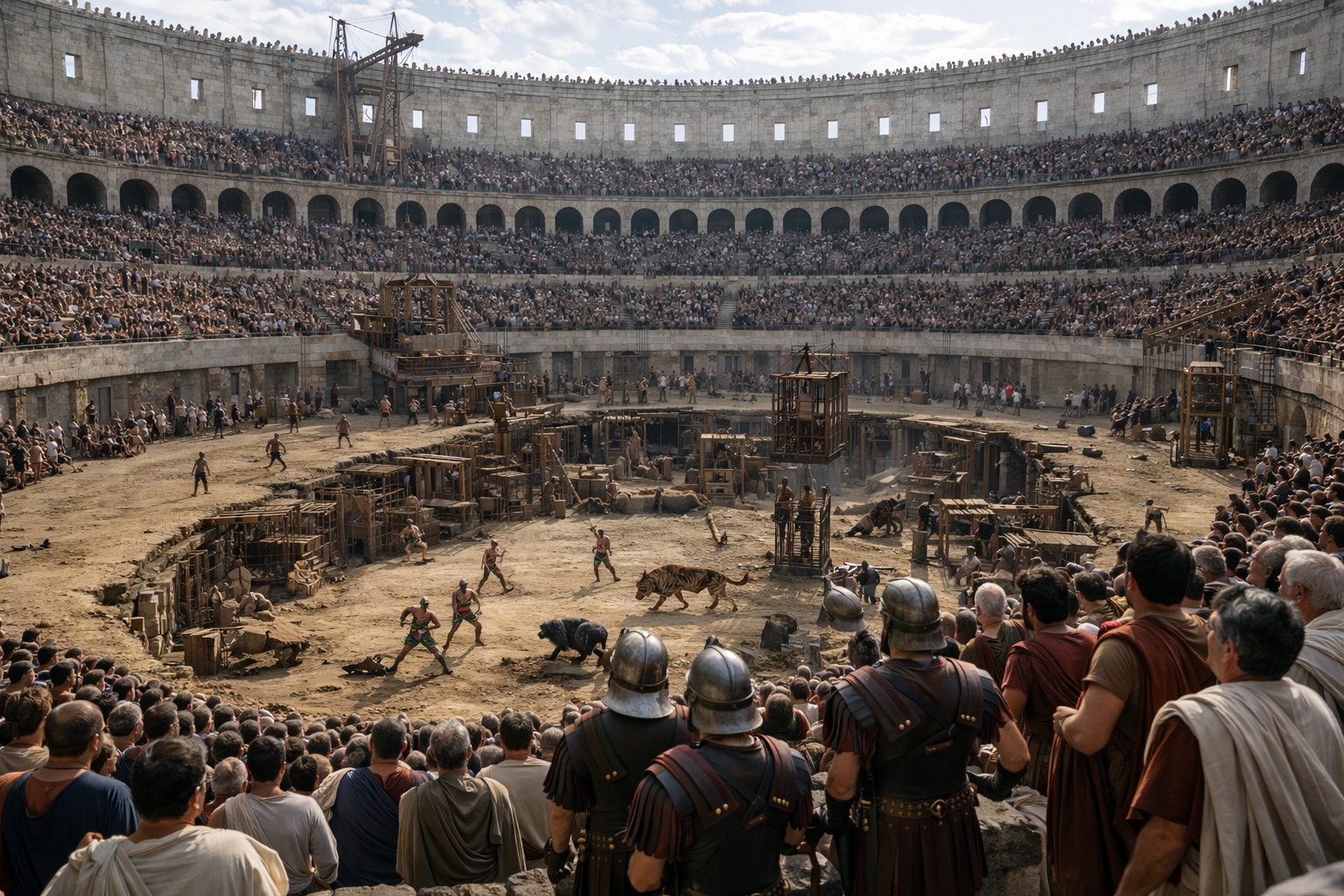


In Rome, the Coliseum held a mass control of 50,000 people to reinforce loyalty and identity, provoking a turning point in how the monument is understood and drawing attention from those who study power, propaganda, and engineering.
The Coliseum is often remembered as a synonym for entertainment, gladiators, and noise. However, in practice, it functioned as something much more strategic, a mega arena that operated as a psychological device.
The size was already a message: two American football fields in length and almost the height of the Statue of Liberty. But the real shock came from what it could do with an entire crowd at once.
The result surprises even today because the arena was not just stone and stands. It hid a mechanism capable of making animals appear out of nowhere, creating forests in the arena, and even flooding the space to reenact naval battles.
-
Family Builds Homemade Wind Turbine to Power Off-Grid Home, Video Reaches 555,000 Views on Ngô Thị Huyền’s Channel

-
Indian Brand Creates Sneakers from Recycled PET Bottles and Discarded Tires, Repurposing Over 1 Million Bottles and Raising $4 Million for Expansion

-
Brazilian Innovator Uses 3D-Printed Device to Cool Two Rooms with One Air Conditioner

-
Brazilian Designer Turns Broken Umbrella Nylon into Jackets, Employs 101 Seamstresses to Create 19,500 Pieces and Earn R$ 240,000


The Largest Arena in Rome Functioned as Mass Emotional Control
The Coliseum could control the emotions of 50,000 people at once, turning blood into spectacle and distracting an unsettled population. This was not a detail; it was a function.
The case recounted by Saint Augustine in his book Confessions illustrates the effect: Alipius swore he would never watch the games. Yet, he was dragged along by his friends. When the crowd exploded, he became intoxicated by the joy of blood and began to shout along.
What seemed like just an afternoon of games turned into a social trigger. The arena had the power to flip the switch for those who entered.
The Problem Rome Needed to Solve Was Bigger Than Fun
Rome didn’t just need a stadium. It needed to deal with a massive political problem: how to control about 1 million angry, unemployed, and hungry citizens.
The narrative itself points to a hard fact: about 25% to 40% of the male population had no stable jobs and lived mainly on food stamps. The arena entered as part of the symbolic, practical solution to keep the streets quiet.
The Coliseum helped shape identity and legacy for nearly 2,000 years. And this explains why so many people still think of the Roman Empire today, exactly the way Rome wanted to be remembered.
Before the Coliseum, There Was a Private Lake, and the Fire of 64 A.D. Changed the Center of Rome
The Coliseum did not emerge on neutral ground. Before it, there was a lake, a private oasis, in the center of Rome. Before the lake, it was a dense area, a working-class district.
After the great fire of 64 A.D., Emperor Nero took over the region and built the Domus Aurea, the Golden House. This gesture was seen as a symbol of tyranny.
Shortly after, rebellions broke out across the empire, Nero was declared a public enemy by the Senate, fled, and ultimately took his own life. The lake remained there as a mark of excess.
It was then that Vespasian saw a political opportunity: he drained the lake and replaced it with something that, in the official message, would never again belong to just one man. A public arena for 50,000 people, built in less than a decade.
Funding, Prisoners, and Propaganda, the Message Was Engraved in the Structure
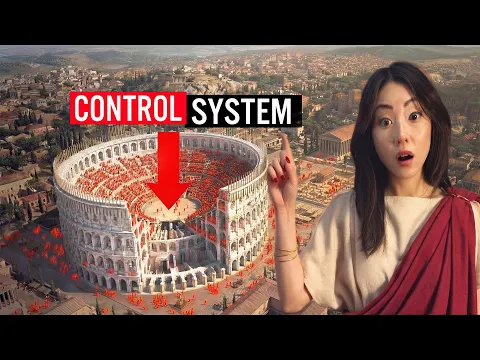

The construction was financed by the spoils of the Judean War and carried out by prisoners. The spectacle began even before the games, as the very construction transformed enemies into labor.
The warning was clear: those who resisted Rome might end up building Rome.
When Titus, son of Vespasian, opened the arena in 80 A.D., the celebration lasted 100 days. There were wild beasts, gladiators fighting to the death, flooded battles, and free entries for Roman citizens.
And it worked. The Coliseum “rebooted” the image of the empire and became one of the most effective propaganda machines Rome ever built.
The Plebeian’s Experience and the Urban Trick That Prepped the Mind Before the Games
Imagine the common Roman of the 1st century, with no position, no glory, just a plebeian. Life is poor, often unemployed, in a cramped building that could catch fire any day. The day starts before the sun because the heat is unbearable and the walls are thin. He sleeps in a tiny room with four children and a wife.
Most days, he looks for work, carries stones, sweeps streets, cleans toilets for a few coins, waiting for grain rations that only arrive the following week. But on game days, everything changes.
The path passes through markets, temples, pigsties, and then the Coliseum appears, the largest structure he has ever seen. The entrance through the vomitoria leads through ramps and stairs to the level of the stands. There, crammed, the view is perfect, and the hierarchy becomes visible: elites with their own entrances, distinct places, and the people separated even from women and slaves.
The entrance of the emperor seemed almost divine, as if he materialized. The emperor gives, the emperor receives. Hours later, exiting through the same corridors, the world seems fine. The citizen feels lucky to be Roman.
The point is simple: this is indoctrination.
And it begins before the games. The Coliseum was positioned at the intersection between palaces and crowded working-class neighborhoods, near sacred areas and the forum. The flow of the city was redirected to force thousands of people from all classes to pass by the arena daily. It was also set in a natural “bowl” between three hills, so the person would always approach from above, seeing the building unfold until it filled their entire view.
The Coliseum replaced Nero’s private lake and repositioned power as generosity, not fear. When the person arrives at the building, they are already prepared to feel admiration, gratitude, and loyalty.
Architecture as Hierarchy, 80 Gates, Greek Orders, and an Ellipse That Creates Narrative
The building had 80 gates, welcoming people from all sides. At first glance, it seemed democratic. But the hierarchy was built-in: two of the four entrances were for the emperor and elites, and the classes sat in distinct pairs.
Even the façade spoke. The three Greek orders appeared as visual vocabulary: Doric, associated with strength and discipline; Ionic, linked to grace and balance; and Corinthian, ornate, beauty in elaborate form.
The Romans stacked these orders in increasing levels of refinement, transforming aesthetics into social language: robust base, elegant center, rich and ornate top.
The metaphor was clear: strength below, administration in the middle, imperial authority on top. Rome was performative with hierarchy; it permeated laws, marriages, places, and even who could wear the color purple. Order was treated as proof of greatness.
And there’s also the shape. The Coliseum was not a perfect circle, but an ellipse. It creates two focal points and pulls the gaze between two centers, generating tension. The ellipse also helps build a natural narrative path: a gladiator enters, the crowd reacts, the emperor decides, and the body is taken away.
The Coliseum was the first to envelop the entire amphitheater in a multi-story monumental structure, closing the spectacle in a controlled environment.
Even awnings existed to shade the sun and cool the space, further isolating the world outside.
The Hidden Mechanism of the Hypogeum, More Than 80 Elevators and the Effect of “Magic” in the Arena
What turned entertainment into something that seemed supernatural was the hidden system. Beneath the sand was a two-level substructure called the hypogeum.
It was added about 10 years after the original construction and became a scene operated by hundreds of men. Underground passages connected the hypogeum to surrounding buildings, allowing gladiators and animals to enter unseen.
There were more than 80 mechanical elevators, powered by pulleys connected to rotating capstans, lifting and lowering props, animals, and even fighters. When they reached the ground, they opened automatically, releasing everything into the arena.
Every detail was designed to make scenes appear from the darkness, as if it were magic. In the end, the Coliseum was just the visible part of a massive and invisible system made of labor, water, grain, logistics, and hierarchy.
Water, Grains, Roads, and the Limit of the Model, When the Spectacle Becomes Addiction to Power
The very idea of flooding the arena for naval battles was only possible because Rome had an advanced water system, with routes spanning dozens of kilometers, crossing mountains and valleys to reach the city. The narrative highlights a striking number: Romans received almost 150% more water per person than most modern cities, and millions of gallons were transported solely by gravity.
The dependence on grains was also central. Rome had over 1 million people in the 1st century, the largest city in the world at the time, and many lived in dense and unsafe blocks. Food came from external shipments, vulnerable to storms, poor harvests, and even piracy. When it was delayed, disturbances erupted quickly. Emperor Claudius was nearly lynched when a grain shipment was delayed.
The empire created a subsidized program that became free monthly grain permits, the annona, feeding about 200 male citizens paid by the empire. And the Coliseum was in the same logic: keeping the population fed and entertained to keep the streets quiet.
However, the Roman model had a condition: constant expansion. Roads channeled resources to the capital, and what sustained games, grains, legions, and public works did not come from taxes, but from spoils of war and newly conquered provinces. When Rome stopped growing, the system began to break.
Without new conquests, there were no large injections of money, but the army still wanted payment, and the grain still needed to arrive. Ironically, the worse things got, the larger the games became. Commodus increased hunts during a fiscal crisis and entered the arena. Caracalla spent so much on festivals that he devalued the currency and executed wealthy Romans to keep the show going.
The spectacle also seemed to control the emperor himself. The narrative suggests a psychological effect of power: 50,000 people waiting for a gesture, a hand movement changing the mood of the arena. And when the empire was crumbling, it was hard to let go of that.
Marcus Aurelius hated the games, sat with a book, found them barbaric and pointless, tried to cut expenses and invest in civic problems. He was hated for it, seen as cold, stingy, un-Roman. After him came Commodus, who lived for the games, demonstrating how difficult the system was to break.
And the final provocation is direct: perhaps there is a modern and invisible version of the Coliseum, capable of transforming fear into entertainment, anger into engagement, and politics into performance. The question is not just whether the spectacle is dangerous, but if it is possible to perceive the moment it starts thinking for the person.
So, which part of this story seems most current: the hunger that turns into gunpowder or the spectacle that becomes routine? Feel free to leave in the comments what bothers you most about this logic and how often the Roman Empire appears in your mind.


O império romano está nas cabeças de todo o povo no século XXI seja de forma passiva ou ativa. O Imperador são os presidentes atuais e o resto é resto.