






 Portuguese
  Spanish
  5 min of reading
  0 comments


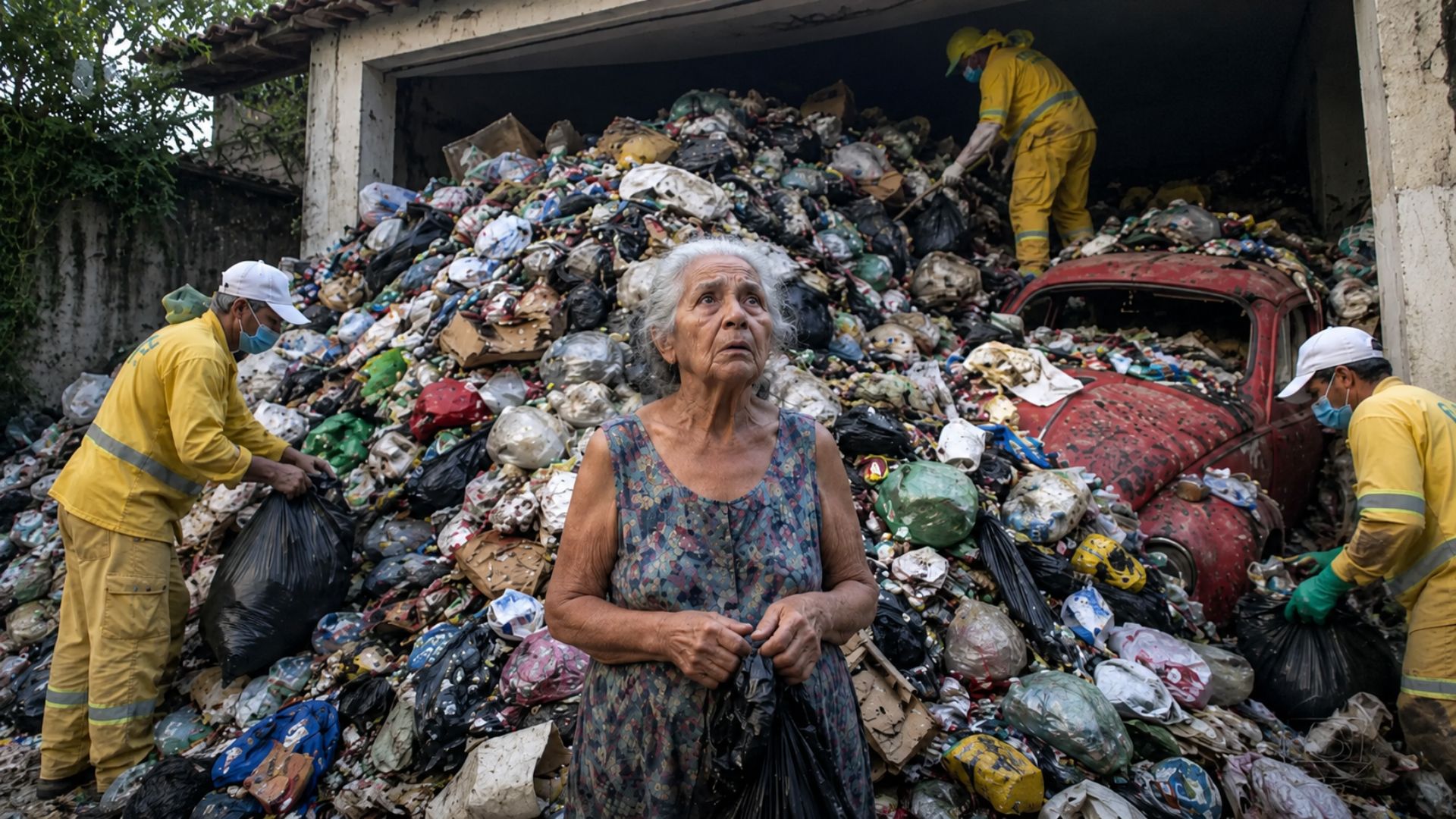
Case in São Paulo revealed a house taken over by recyclables for two decades, mobilized volunteers, and exposed health, housing, and social assistance challenges faced by an elderly woman who turned discarded materials into a source of income.
The recyclable collector Anita Antônia, 73 years old, had her house in São Paulo emptied after two decades of material accumulation, in an operation that mobilized volunteers, Civil Defense, and the team of influencer Guilherme Gomes.
Featured on “Fantástico” on Sunday, May 31, the action removed about 50 tons of waste from the property, a volume distributed in 29 truckloads over the course of the cleaning work.
For years, neighbors saw Anita’s routine as part of the activity of a collector who swept sidewalks, collected discards, and tried to turn recyclable materials into income to support her family.
-
After swapping sewing for cement, a woman from Paraná became a mason, spent 12 years on construction sites, started building her own house, and even gained fame for restoring old Opalas.

-
Tired of relying on a conventional house, a young woman with no construction experience built an off-grid studio apartment with solar energy, rainwater, a biodigester bathroom, and a routine designed to live with more autonomy.
-
The European city hall that transformed an old urban avenue back into a canal, recovered a section that was filled in the 1970s, and delivered a new public space with water, vegetation, and pedestrian paths.
-
Buenos Aires and Montevideo are about 200 kilometers apart in a straight line, but the road trip can exceed 570 kilometers and take up to 8 hours and 30 minutes; see how long the journey takes by plane, ferry, car, and bus.


Over time, however, residents noticed that the objects stopped circulating as merchandise and began to permanently occupy the spaces of the residence.
A neighbor told the program that, at first, the situation seemed common to those who followed Anita’s work on the neighborhood streets and saw the collection as a source of livelihood.
“She picks it up, she sells it, she turns it into money. We thought it was a normal thing. But gradually, we started to realize that it was… She was just adding, accumulating,” she stated.
House taken over by recyclables in São Paulo
Responsible for organizing the cleanup, Guilherme Gomes is known on social media for performing free cleanings in properties of people facing severe hoarding situations.
Upon assessing the extent of the problem inside the house, the team called in Civil Defense to oversee the removal of the waste and help reduce risks during the operation.
For six days, volunteers took turns removing piles of materials that filled the rooms and hindered movement in the property where Anita lived with her family.
At the end of the mobilization, the 29 truckloads of waste highlighted the accumulation maintained for about 20 years and revealed the severity of the living conditions.
In an interview with “Fantástico,” Guilherme stated that there were practically no objects in a state of preservation, as many belongings were deteriorated by time and the way they were compressed.

“We would touch the objects, clothes would fall apart. Because of how long it had been there, more than 20 years pressed,” said the influencer, explaining why memories and personal belongings were also deteriorated.
Anita Antônia’s Journey Before the Cleanup
Born in Maringá, Paraná, Anita moved to São Paulo, where she worked as a domestic worker before relying on collecting recyclables to supplement her income.
After starting a family, she took sole responsibility for caring for her son, who needs special attention, after being abandoned by her husband, as she reported to the news.
Without formal employment and facing the need for sustenance, the collector began gathering materials on the streets and storing part of what she found inside her own home.
Initially linked to survival, the activity took on another significance when Anita began keeping recyclables at home out of fear of losing what she considered the result of her work.
In the collector’s perception, not everything that was accumulated could be classified as trash, as some of the materials could still have utility or some resale value.
“Sometimes people say: ‘Oh, it’s trash.’ But it’s not. Trash is what is useless,” said Anita, explaining her perception of recyclable materials and discarded objects.
Between income, memory, and insecurity, Anita’s relationship with waste began to occupy an increasingly larger space in her domestic routine and inside the house.
Materials such as metals, cardboard, and PET bottles can have value in recycling but require sorting, proper storage, and regular sales, steps that became unfeasible as the volume grew.
Compulsive Hoarding and Health Risks
According to psychiatrist Daniel Costa, a researcher at the Institute of Psychiatry at the Hospital das Clínicas of USP, hoarding becomes a problem when it prevents the use of rooms and causes concrete harm to the person’s life.
Besides compromising the circulation and hygiene of the environment, the condition can involve suffering, isolation, safety risks, and intense difficulty in discarding accumulated objects over time.
“Some objects acquire sentimental value for the person. Therefore, getting rid of them is very painful. It’s equivalent to getting rid of something that has very important material value, for example,” stated the researcher, commenting on the emotional connection that can form with accumulated items.
In Anita’s property, the waste spread through the rooms until it compromised basic living functions, making it difficult to differentiate between living, circulation, and storage areas within the house.
Combined with caring for her son and reported physical problems, years of work as a recycler contributed to transforming the residence into a space without adequate conditions for use.
Among the surrounding residents, concern began to involve the health and safety of Anita’s family, as well as the possible impacts of the situation on the neighborhood.
For this reason, the intervention was not limited to the removal of accumulated materials and also sought to remove Anita and her son from an environment considered unhealthy by those involved in the action.
Family sent to social hotel
After the cleanup, Anita and her family were sent to a social hotel, a measure adopted to ensure temporary shelter while the house situation was reorganized.
During this period, new support stages began to be evaluated, and the mobilization around the case also started to involve requests for help to renovate the property.
Experts warn that compulsive hoarding is not usually resolved just by removing the objects because the behavior may return without adequate mental health support.
Daniel Costa stated that it is a chronic problem, with a tendency to recur, and highlighted the need for continuous monitoring by health professionals to reduce the risk of repetition.
Although the accumulated waste over two decades was removed, the operation did not end the need for care for Anita, her son, and the family’s living conditions.
In similar cases, support needs to consider mental health, social assistance, housing, and family or community networks, without reducing the situation to neglect, lack of hygiene, or simple disorganization.
The story’s repercussion exposed the vulnerability of an elderly woman working with recyclables, the burden of a caregiver mother, and the risks of an accumulation that took over all the spaces in the house.
With the removal of 50 tons, the focus shifted to ensuring monitoring and support so that the family does not return to living in a risky situation.






-

-

-

-

-

-

123 people reacted to this.