






 Portuguese
  Spanish


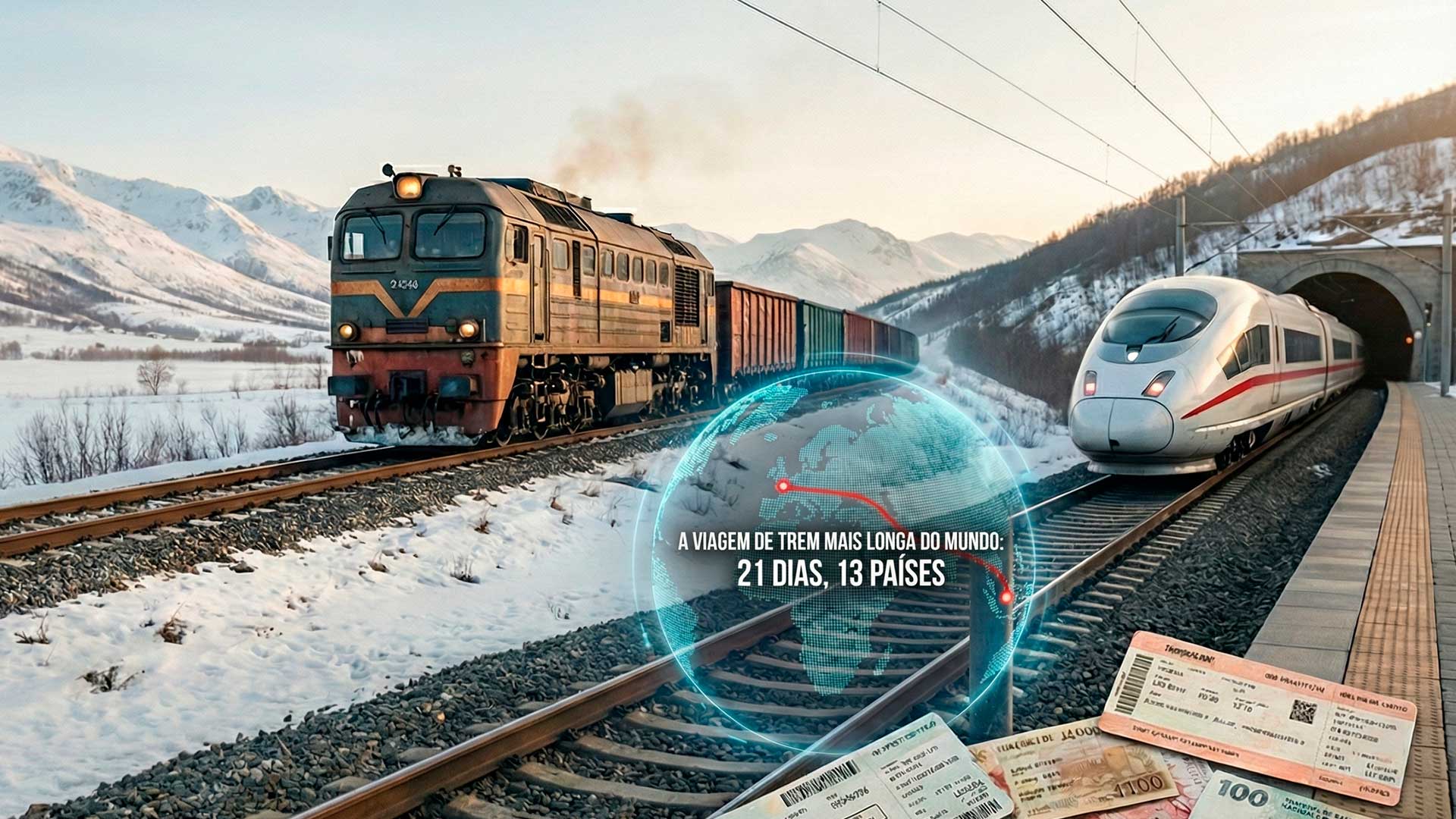


Rail Route Of About 18,755 Km Connects Southern Portugal To Singapore In Approximately 21 Days, Combining Dozens Of Train Segments, Multiple Visas, And A Lot Of Planning.
The so-called Longest Train Journey In The World has gained attention in travel articles and on social media. The route connects Lagos, in the Algarve, to Singapore in about 18,755 kilometers, 21 days of travel, passing through 13 countries and eight time zones.
In practice, there is no single train or continuous ticket for the entire route. The journey combines national and regional rail services, with train changes, station transfers, and occasional bus segments where the network is not yet fully integrated.
The route presents itself as a slow travel experience, in contrast to the flight of less than 24 hours between Europe and Asia. Instead of airports and air connections, the traveler observes the gradual change of landscapes, languages, climates, and architectures through the train window.
-
Billionaire says the most valuable skill will help overcome job elimination caused by AI, following Bill Gates’ fears

-
A Dutchman created a ‘box’ that makes trees grow in the desert almost without water and without irrigation: the invention has already brought seedlings to dozens of countries and achieves up to 90% survival where common planting did not exceed 10%.

-
Abandoned warehouse hid a giant collection of rare computers, with over 2,000 artifacts from the 1930s to the 1980s.
-
Scientists warn that melting ice is triggering an alarming chemical transformation in preserved areas, and the first signs are already concerning researchers worldwide.




This crossing only became possible after the inauguration of the high-speed railway between China and Laos in 2021. According to Euronews and the Brazilian portal Travel.com, the Kunming-Vientiane link closed the railroad “puzzle” that was missing to connect East Asia to Southeast Asia almost entirely by rail.
What Is The Train Route From Portugal To Singapore Like
The most cited starting point is Lagos, in southern Portugal, although some itineraries begin in Lisbon. From the Algarve, the traveler goes to Lisbon and crosses Spain towards cities like Madrid or Hendaye, close to France, before continuing by train to Paris and other European hubs.
From France, the route advances into Germany and Poland before reaching Belarus and the Moscow region, a traditional junction between Europe and Asia.
From there, long-distance trains depart across Siberia towards the east, using branches like the Trans-Siberian and the Trans-Mongolian, considered the epic heart of the journey.
Next, the route enters China, with stops in major metropolises like Beijing, and heads down towards Southeast Asia.
Thanks to the Kunming-Vientiane high-speed line, the passenger travels almost always on rails to Bangkok, Thailand, then Kuala Lumpur, Malaysia, and finally Singapore, via Johor Bahru.
How Much Does The Longest Train Journey In The World Cost
One of the main questions is how much it costs to make the complete journey from Portugal to Singapore by train. Reports from Euronews, the Spanish daily AS, and Brazilian portals estimate that only the main tickets total around 1,200 euros, a value similar to an economy class airline ticket for the same segment.
According to Travel.com, specializing in the Brazilian audience, travelers typically buy between 10 and 15 different tickets, since there is no single pass covering all 13 countries.
The site estimates that, with more stops and higher comfort classes, train expenses can reach 3,000 euros, not including accommodation, meals, visas, and travel insurance.
Practical Challenges And Limitations Of The Portugal-Singapore Route
The same Travel.com points out that the itinerary requires, in some cases, up to seven different visas, depending on the traveler’s nationality and the chosen path. This includes permits for countries such as Russia, Belarus, China, and Southeast Asian nations, which involves dealing with consulate timelines and ever-changing regulations.
Another sensitive point is the geopolitical situation. The classic segment between Paris and Moscow, previously operated as a direct overnight train, has been suspended since the pandemic and remains inactive due to sanctions related to the war in Ukraine, necessitating the use of alternative routes and even segments by plane or bus.
There is also the challenge of the rail network and train availability in some remote regions. An article from Big Think highlights that certain segments, such as the Trans-Mongolian, operate with few departures and high demand, requiring reservations months in advance and flexibility to handle delays or schedule changes.
Furthermore, the standard timeline of 21 days assumes a tight pace, with little time in each city along the way. Travelers who wish to explore museums, restaurants, and local attractions often extend the itinerary to three or four weeks, increasing the budget, while those who rush the connections risk turning the experience into a tiring marathon.
Finally, there is the conceptual question: to what extent can we call a “single train journey” an itinerary that requires changing trains numerous times and resorting to other means in some parts? Railway experts and Big Think itself treat the route less as a closed product and more as a concept of maximum itinerary on rails between Europe and Asia.
Is It Worth It To Take On 21 Days Of Train Between Europe And Asia
For many travelers, the answer is an enthusiastic yes. Reports from NDTV, Brazilian portals, and specialized websites describe this route as a unique experience for those seeking a Long-Distance Train Journey, close contact with distinct cultures, and a more gradual way to cross the map.
Critics, however, note that spending three weeks among cabins, stations, and connections can be tiring, expensive, and logistically stressful. Big Think itself emphasizes that no one has documented completing the entire route exactly as it appears on viral maps, reinforcing the theoretical nature of the “longest train in the world” and fueling the debate on whether it is worth pursuing the record or simply adapting the idea.
In the end, the Longest Train Journey In The World works more as an invitation to rethink the way of traveling than as a ready-made package. Each person decides whether to follow a good part of the route, focus only on iconic segments, or continue using the airplane.
Would you take on 21 days of tracks and borders to go from Portugal to Singapore, or do you think it’s an exaggeration to swap a flight of less than 24 hours for three weeks of train travel? Let us know in the comments if you would take on this adventure.





Eu teria coragem, porque agente ver todas as paisagens .