Portuguese
  Spanish


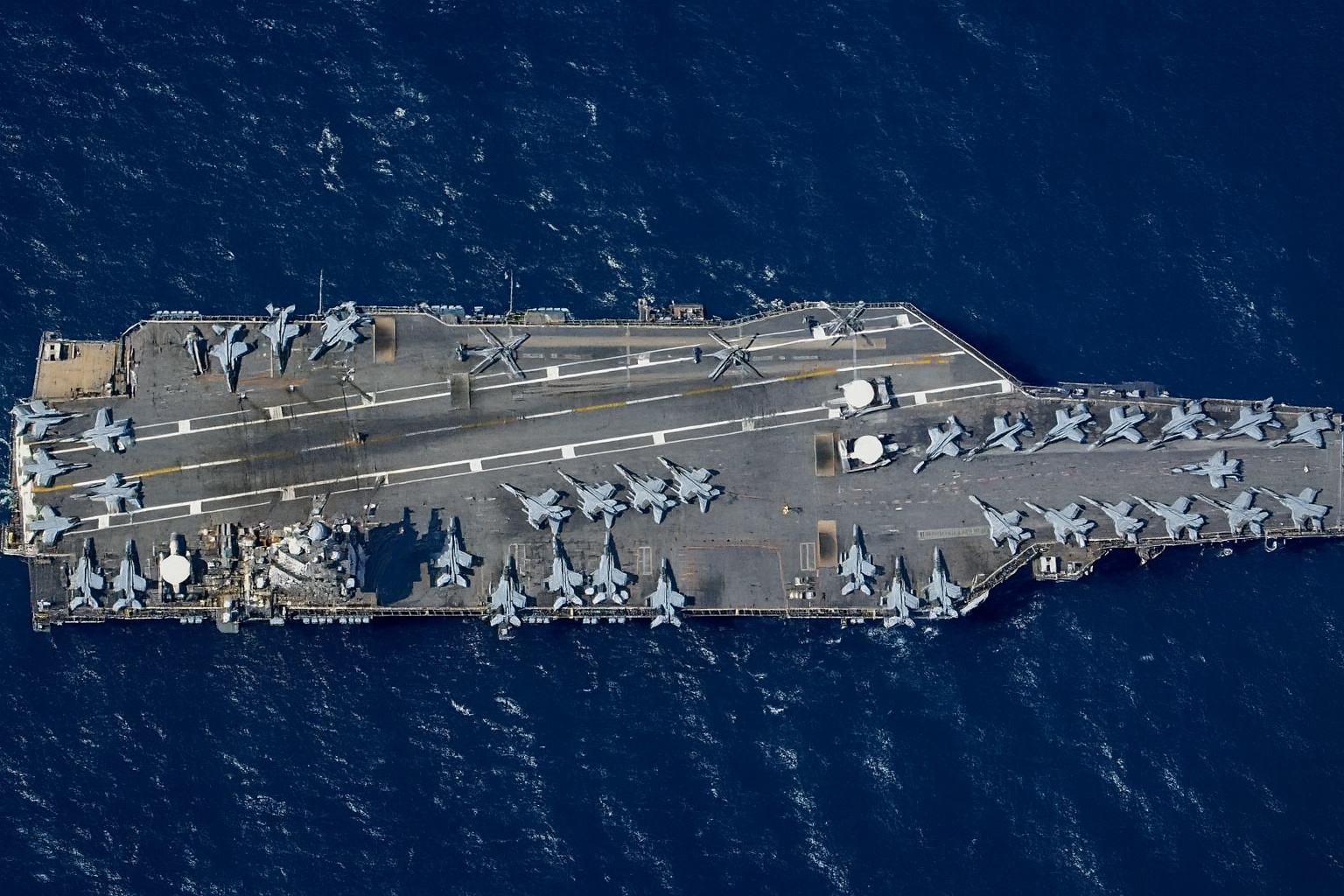


At 333 Meters Long, Nuclear Reactors, and a Cost of Over US$ 13 Billion, the USS Gerald R. Ford Is the Most Expensive and Powerful Ship in History, Capable of Launching 75 Aircraft Simultaneously.
The USS Gerald R. Ford (CVN-78) is not only the largest nuclear aircraft carrier ever built, it represents the definitive transition of the United States Navy into a new era of technological supremacy. At 333 meters long, 78 meters wide, and over 100,000 tons of displacement, the supercarrier is the core of a fleet expected to dominate the seas until around 2075.
Named in honor of the 38th President of the United States, the ship’s construction began in 2009 and officially entered service in 2022 after more than a decade of testing, delays, and budget adjustments.
The result, however, is a masterpiece of engineering and power, capable of operating almost autonomously at any point on the planet.
The Shipyard That Shaped a Colossus
The project was executed by the Newport News Shipbuilding yard in Virginia, the only one in the United States authorized to build nuclear aircraft carriers. More than 5,000 engineers and technicians participated in the process, which involved over 60,000 tons of naval steel and the installation of systems never before seen on warships.
-
The U.S. Navy Conducts Submarine Tests in Idaho Lake to Detect Underwater Noises Hidden by the Ocean

-
Nuclear Submarine USS Alexandria Retired After 35 Years, Having Completed Over 1 Million Miles in Missions

-
MODEC Introduces New Hull Design for FPSO Gato do Mato to Produce Up to 120,000 Barrels of Oil Per Day in Brazil’s Pre-Salt Region
-
This Massive 12-Meter, 21-Ton Underwater Drone Can Operate Autonomously for Up to Five Days


Each section of the ship was built in modules, later joined in an operation that required cranes capable of lifting blocks of up to 1,000 tons.
The complexity was such that the shipyard had to redesign entire logistical processes to meet the Navy’s precision requirements.
The Highest Cost in Naval History
The USS Gerald R. Ford officially cost US$ 13.3 billion just for construction. But the total program value, including research, development, testing, and new launching systems, exceeds US$ 30 billion, according to the Congressional Research Service.


This amount makes it the most expensive ship in human history. Only the electromagnetic aircraft launch system (EMALS) and the AN/SPY-3 multifunction radar consumed billions of dollars in development.
Yet, the Navy defends the investment, claiming that the new design will reduce operational costs by up to 25% in the coming decades, thanks to automation and energy efficiency.
Nuclear Reactors: Energy for 25 Years
The Gerald R. Ford is powered by two nuclear reactors Bechtel A1B, developed specifically for this class. Together, they generate enough energy to power a city of 100,000 inhabitants and can operate for up to 25 years without refueling.
This energy independence ensures nearly unlimited autonomy on long-duration missions, allowing the ship to traverse oceans without needing to refuel.

The excess electric power also helps to supply the new propulsion systems, radar, sensors, and directed-energy weapons—technologies that the Navy plans to gradually introduce by 2035.
Electromagnetic Catapults and Revolutionary Flight Deck
The EMALS (Electromagnetic Aircraft Launch System) is one of the major innovations of the Gerald R. Ford. Unlike the steam catapults used for decades, it utilizes electromagnetic energy to launch aircraft, reducing structural wear, fuel consumption, and the time between launches.
This system allows for the launch of up to 75 aircraft in continuous rhythm, with greater precision and safety. On the flight deck, the complete redesign of the layout has increased operational efficiency by 30%, with shorter taxi paths and new takeoff and landing positions.
Four fully automated weapons elevators transport missiles and bombs directly to the lower hangars, eliminating manual processes and reducing the need for personnel in critical areas.
Aboard a Floating City
The Gerald R. Ford accommodates about 4,500 people, including sailors, pilots, engineers, and support staff. The interior was designed to offer comfort and functionality, something unusual in military vessels.
There are climate-controlled berths, automated industrial kitchens, gyms, recreational areas, and medical centers capable of performing complex surgeries at sea.
The kitchens can prepare more than 15,000 meals per day, and the silent ventilation system ensures better resting conditions. This concern for the crew’s well-being is part of the new long-term operational concept: the ship can stay on mission for months without returning to base.
Technological Supremacy and Deterrent Power
The aircraft carrier was designed to operate the F/A-18 Super Hornet, F-35C Lightning II, and E-2D Hawkeye early warning aircraft. Its AN/SPY-3 multifunction radar allows tracking multiple targets simultaneously and coordinating attacks with surgical precision.

In addition, the Gerald R. Ford is equipped with SeaRAM and Phalanx CIWS missile defense systems, capable of intercepting supersonic projectiles and drones. The extensive use of automation has reduced the crew requirement by nearly 1,000 people compared to the Nimitz class, lowering costs and human risks.
For the U.S. Navy, it is not just a vessel; it is a mobile and autonomous air base, a strategic asset designed to ensure maritime supremacy in any conflict of the 21st century.
From Nimitz Class to Ford Class: The Generational Transition
For over 50 years, Nimitz-class aircraft carriers symbolized American power. But their limitations, such as steam catapult systems and restricted energy capacity, demanded a new generation of vessels.
The Ford class emerged to address these deficiencies, incorporating solutions that increase flight capacity, reduce operational costs, and enhance compatibility with stealth aircraft.
The USS Gerald R. Ford, as the first example, serves as the learning base for the next ships in the series, such as the USS John F. Kennedy (CVN-79), USS Enterprise (CVN-80), and USS Doris Miller (CVN-81). Each will cost less than the previous one, as the construction process becomes more efficient.
The Gerald R. Ford aircraft carrier represents much more than an engineering achievement: it is a global deterrent instrument. Capable of remaining operational for weeks without logistical support, it can move quickly between the Atlantic and the Pacific, projecting power in tension regions.
In recent exercises, the ship led strike groups in joint missions with NATO allies, demonstrating its ability to launch dozens of aircraft in minutes. This power projection serves as a political and military message, reinforcing the role of the United States as an undeniable maritime power.
The Future of Naval Warfare
The USS Gerald R. Ford is more than a weapon—it is a testing platform for the future of naval warfare. Its electrical infrastructure and control systems were designed to accommodate directed-energy weapons like lasers and electromagnetic guns, still under development.
Moreover, new technologies in artificial intelligence and predictive maintenance are being integrated to automate inspections and reduce operational failures. The Navy’s goal is for the next ships of the Ford class to be even more autonomous, economical, and sustainable.
The creation of the Gerald R. Ford shows how naval engineering has become an instrument of geopolitical power. Every detail, from the reactors to the automated elevators, represents a commitment to efficiency and technological domination.
The United States is heavily investing in this model because it knows that control of the seas is vital to maintaining its global influence. The Ford is therefore more than a ship: it is a message of steel, technology, and strategy.
At 333 meters long, powered by two nuclear reactors, and with a cost exceeding US$ 30 billion, the USS Gerald R. Ford is the pinnacle of contemporary naval power. It inaugurates a new era of aircraft carriers powered by atomic energy, automation, and digital intelligence.
Its presence in the oceans redefines the balance of global forces, reaffirming the capacity of the United States to project power at any point on the globe. It is the ultimate symbol of a civilization that transforms science, steel, and strategy into instruments of dominance.