Portuguese
  Spanish


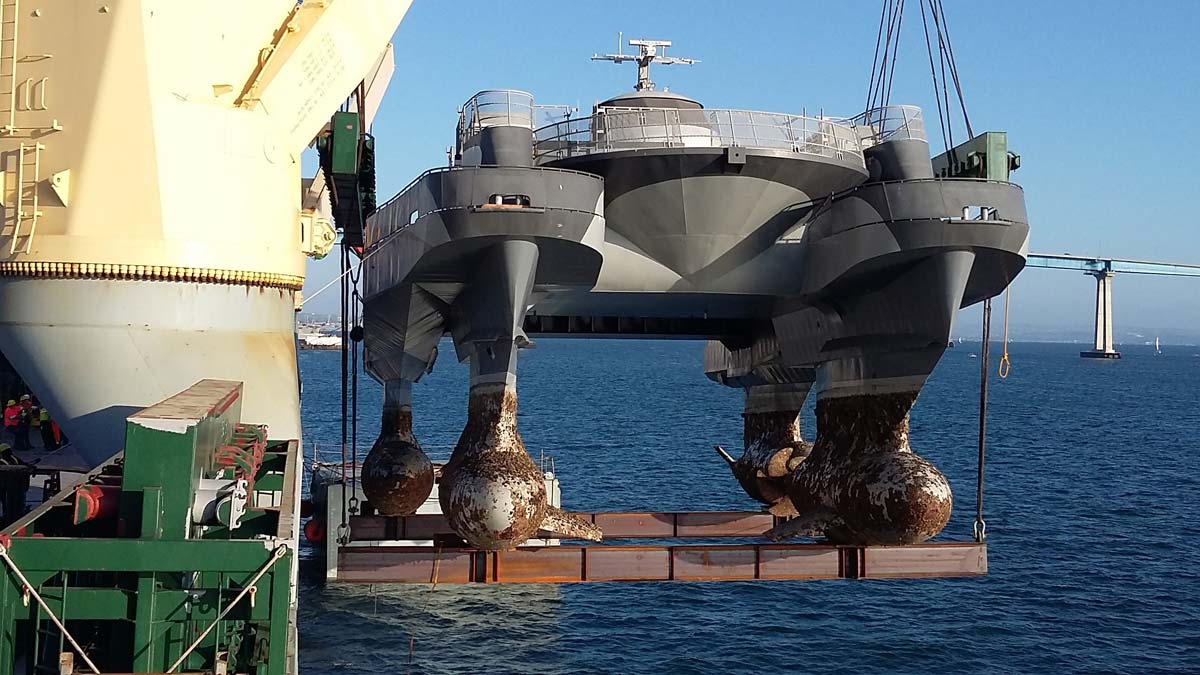

Sea Slice was an experimental ship by Lockheed Martin with four submerged hulls, 105 feet long and stability comparable to much larger vessels.
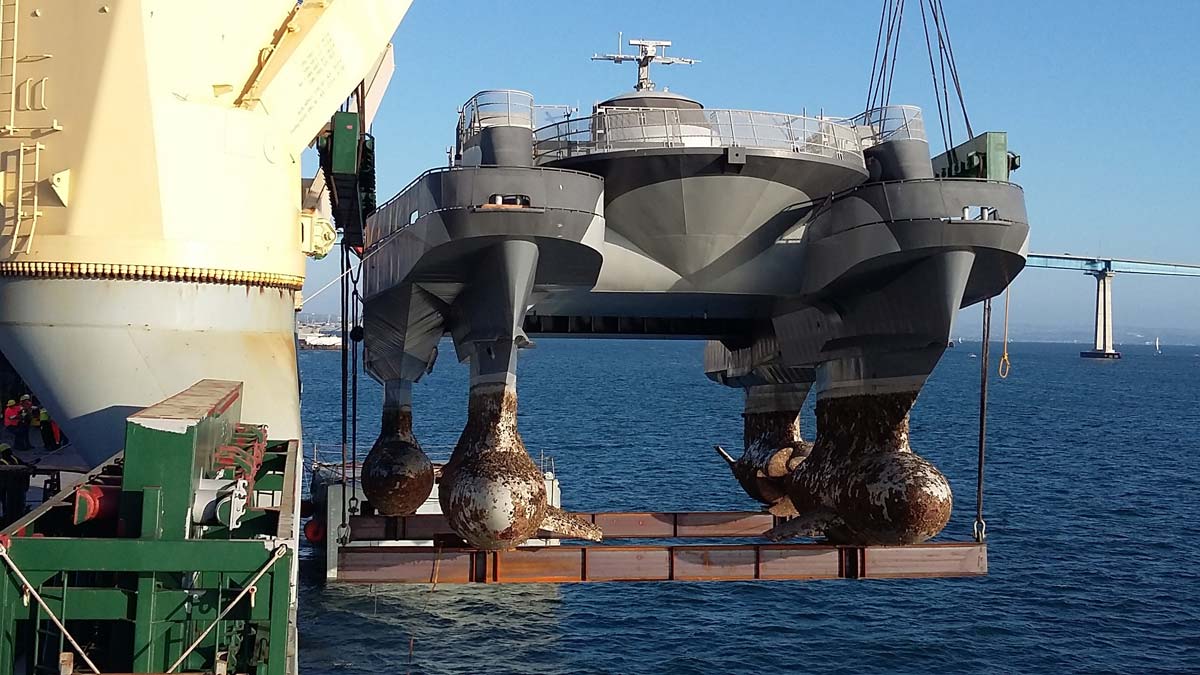
Called Sea Slice, the project was developed as an experimental platform for the United States Navy and utilized a radical variation of the SWATH concept, an acronym for Small Waterplane Area Twin Hull. Instead of the two hulls normally found in this type of vessel, the Sea Slice used four submerged teardrop-shaped hulls, connected to the main structure by narrow supports that gave the impression the ship floated on invisible legs.
The secret of the Sea Slice was hidden below the waterline
The most revolutionary aspect of the Sea Slice could not be easily seen from the surface. While conventional ships concentrate much of the structural volume exactly where waves exert the most influence, the Sea Slice did the opposite.
The four main hulls remained submerged, drastically reducing the contact area with the sea surface.
-
China Unveils Laser Weapon Capable of Instantly Neutralizing Military Drones, Marking a Significant Advancement in Air Defense Technology

-
U.S. Navy’s Ticonderoga-class Cruiser Becomes a 9,800-Ton Missile Fortress with Advanced Aegis System Capable of Tracking Hundreds of Targets

-
France’s Charles de Gaulle: The Sole Nuclear-Powered Aircraft Carrier Outside the US, Weighing 42,500 Tons and Equipped with Two Atomic Reactors

-
The military spaceplane that almost took the Cold War into orbit: Boeing X-20 Dyna-Soar was designed to re-enter above Mach 20, fly for up to 40 hours, land like a plane, and transform Titan rockets into a gateway to a new era of orbital warfare.





This architecture allowed for reducing the effects of waves on the vessel. According to the project documentation, the four teardrop-shaped hulls generated less hydrodynamic resistance and less wave formation than conventional vessels of similar displacement. The result was an extremely stable platform, even in difficult sea conditions.
105 feet long and stability comparable to a much larger ship
At first glance, the Sea Slice did not appear particularly large. The vessel was about 105 feet long (approximately 32 meters), 55 feet wide (about 17 meters), and had a displacement of around 180 tons.
Despite these relatively modest dimensions, its behavior at sea impressed the engineers involved in the program.
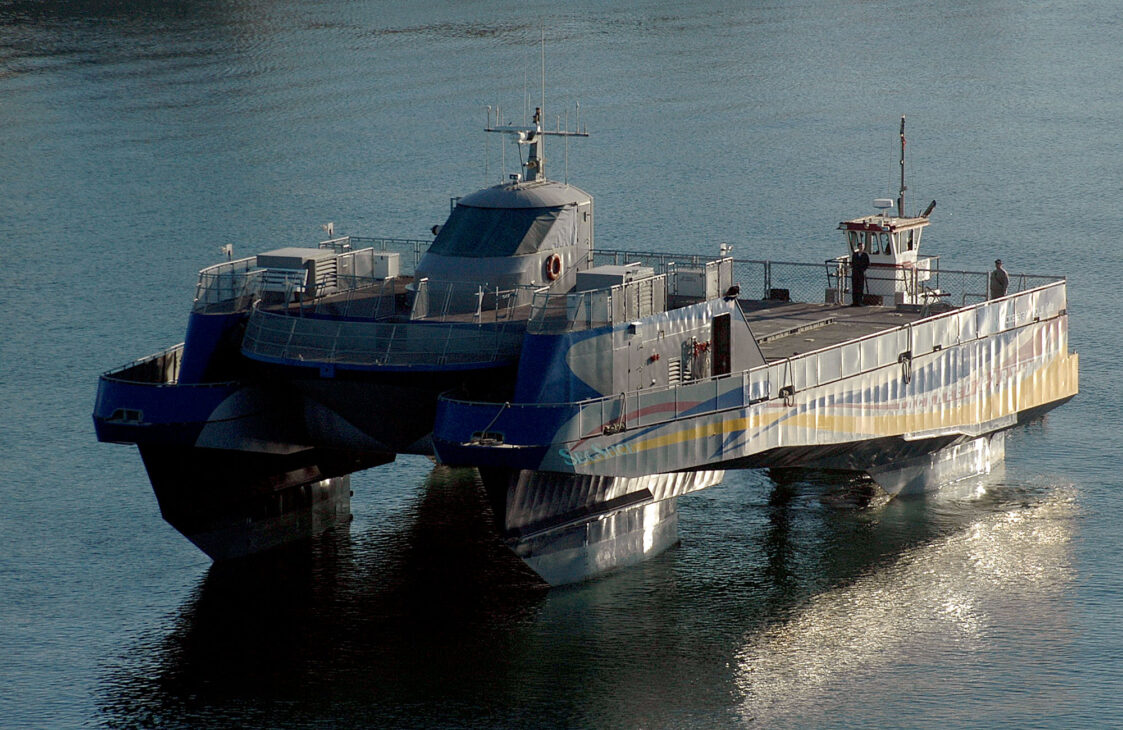
Technical documents produced during the development claimed that the prototype had stability comparable to much larger conventional vessels. A study cited by RTI even described the Sea Slice as being as stable in rough seas as a monohull ship approximately 350 feet long, more than three times larger.
This feature was particularly important for operations that depend on sensors, radars, and electronic systems sensitive to the ship’s motion.
The four hulls allowed cutting through the waves instead of facing them
The concept behind the design was different from most fast vessels. According to Lockheed Martin and the program’s technical studies, the arrangement of four short hulls allowed crossing the so-called “resistance barrier” faced by traditional vessels at high speeds.
The designers claimed that the design could reduce wave-induced resistance by up to 35% compared to conventional SWATH vessels of similar displacement.
offshoreWIND.biz
In practice, this meant that the ship could achieve higher speeds using the same available power while maintaining a smoother behavior on the water.
It was precisely this combination of speed and stability that made the Sea Slice such an interesting experiment for naval engineering.
The prototype cost about US$ 15 million to prove a radical idea
The Sea Slice emerged as a technological demonstration. The vessel was developed by Lockheed Martin in partnership with the Office of Naval Research, using a patented technology simply known as SLICE. The goal was to verify if this architecture could pave the way for new generations of military and civilian vessels.
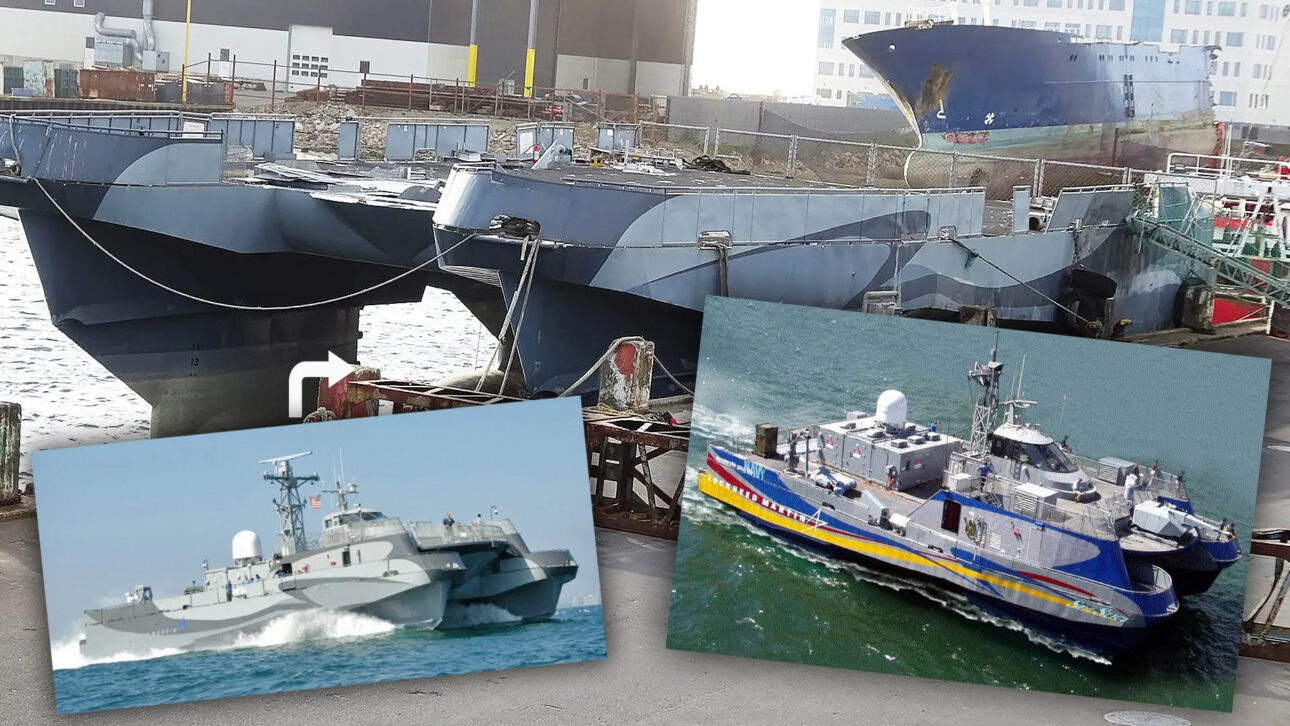
Reports from the time indicate that the project consumed approximately US$ 15 million between development and construction. The amount was relatively modest for an experimental program of this size, especially considering the potential technological impact it could generate.
The vessel was built by Nichols Brothers Shipyards and Pacific Marine & Supply Company, entering tests in the 1990s.
The Sea Slice was created to influence future ships
The goal was never to produce hundreds of units. The prototype functioned as a floating laboratory intended to test concepts that could be applied to future vessels. During its experimental career, the ship participated in technological evaluations and programs related to advanced coastal operations.
In various naval exercises, the Sea Slice was used to evaluate sensors, modular systems, and concepts associated with what would later influence experimental littoral ship programs of the American Navy.
Although the concept did not evolve into a wide operational class, much of the knowledge gained helped expand the understanding of stability, hydrodynamic efficiency, and low-motion platforms.
The “naval UFO” could navigate quickly even in rough seas
Another important result of the tests was the performance in difficult conditions. According to program documents, the Sea Slice reached approximately 30 knots and demonstrated the ability to maintain stable behavior in waves up to 12 feet high during maritime evaluations.
In conventional vessels of this size, similar conditions would normally cause significantly more intense movements.

This capability drew attention because one of the great challenges of naval engineering is precisely to combine high speed with comfort and operational stability. The Sea Slice showed that there were alternative ways to achieve this goal.
After years of testing, the prototype had an unexpected fate
Despite positive results, the Sea Slice never became a class of ships produced on a large scale.
After ending its experimental career, the vessel was put up for sale and later acquired for conversion into a support vessel for offshore wind farms. However, technical and economic difficulties prevented this transformation from achieving the expected success.
In 2019, more than two decades after its launch, the ship ended up being dismantled in Denmark. Its physical disappearance, however, did not erase its historical importance.
One of the strangest experiences in modern naval engineering
The Sea Slice remains one of the most unusual experiments ever conducted by the naval industry. With four submerged hulls, futuristic appearance, 105 feet in length, 55 feet in width, and stability far above what was expected for a vessel of that size, the project showed that ships do not necessarily need to follow the traditional shapes used for centuries.
Although it never became an operational fleet, the “naval UFO” of Lockheed Martin remains a fascinating demonstration of how seemingly strange ideas can challenge established concepts and open new paths for maritime engineering.
In an industry accustomed to gradual evolutions, the Sea Slice was a bold attempt to reinvent the very way of navigating.