






 Portuguese
  Spanish


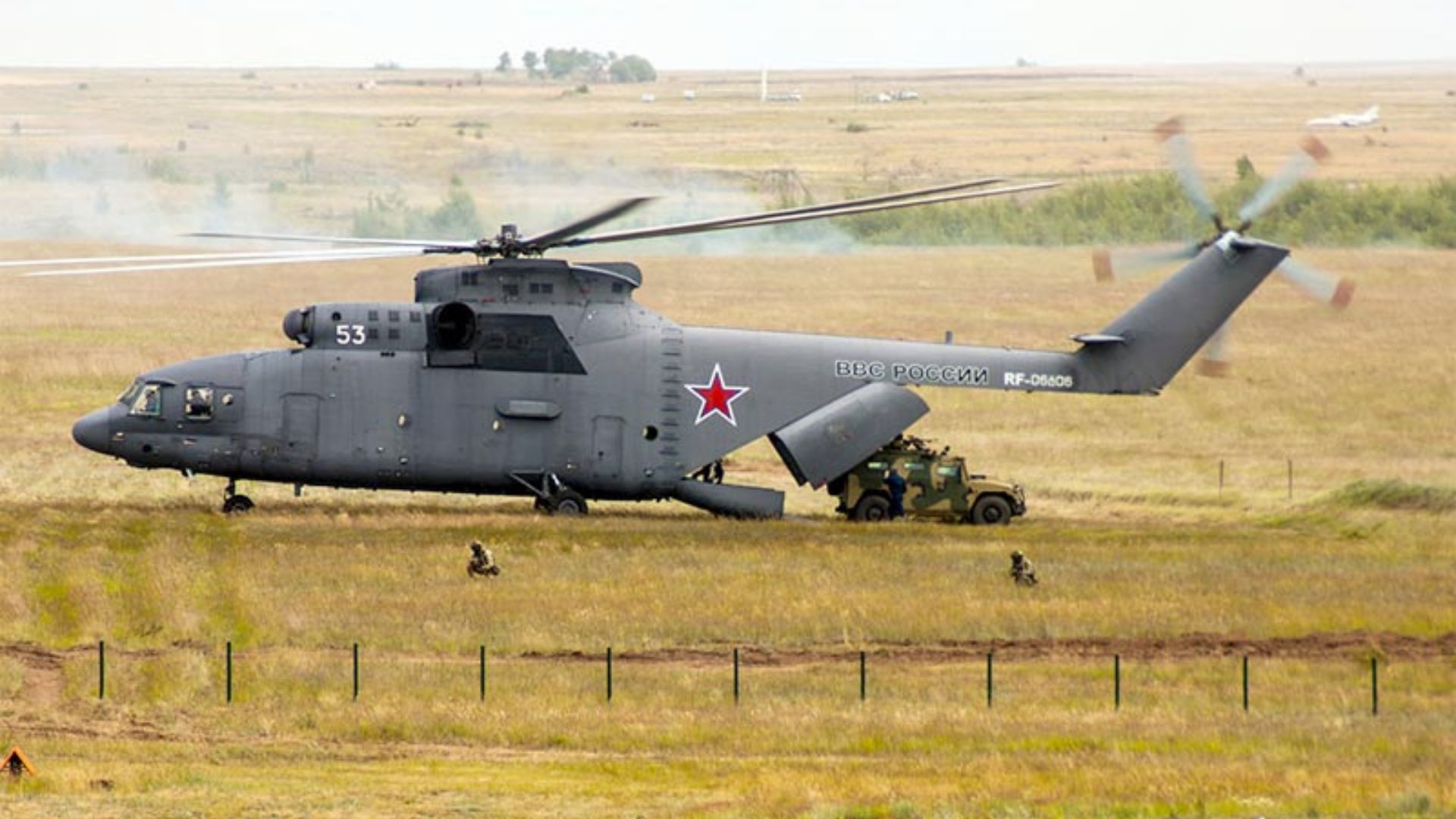


Russian Aviation Giant Combines Capacity Of 20 Tons, Powerful Engines And Impressive Dimensions To Operate Where Almost No Other Helicopter Can Act, Maintaining Prominence In Military And Civil Missions Even After More Than Four Decades Of Service.
With a capacity of up to 20 tons, the Mil Mi-26 remains the largest helicopter produced in series and operationally used, combining heavy transport, a spacious cabin, and high performance for the category, with a maximum reported speed of about 295 km/h.
Although the title mentions 56 meters in length, widely published technical specifications indicate a length of about 40 meters; the number 56 appears accurately in another data point of the model, the maximum takeoff weight of 56 tons.
Developed in the former Soviet Union to meet military logistical demands, the Mi-26 entered service in the 1980s and remains relevant for performing tasks that few helicopters can do, such as transporting vehicles, engines, modules, and bulky loads to areas without runways.
-
15-Year-Old Entrepreneur Malu Lira Publishes 20 Children’s Books on Financial Education, Earns $500,000, and Expands Her Project to the Amazon Rainforest

-
Entrepreneur Turns Rio Cemetery Canteen into a Successful Snack Chain Generating $4.9 Million Annually and Expanding to Metro Stations

-
Rare fox feared “extinct” found alive on Caribbean island after over two decades without official sightings

-
21-Year-Old Brazilian Student Turns Homemade Popsicle Hobby into $100,000-a-Month Business





Military and civilian operators turn to the Mi-26 when the mission requires lifting real weight, whether with cargo in the hold or on an external hook, a feature used to move large equipment in locations where cranes and roads are insufficient.
Dimensions, Weight, And Cargo Capacity Of The Mi-26

The aircraft has a main rotor diameter of 32 meters, with eight blades, and dimensions that explain the frequent comparison to a low-rise building, since its height exceeds eight meters and the fuselage occupies a large area on the ground.
Even empty, the helicopter weighs about 28.2 tons, and this robust structural base allows it to operate with a margin for high payload, as long as performance limits, fuel, altitude, temperature, and flight planning are respected.
When it comes to transporting armored vehicles, the central point is weight: with 20 tons available, the Mi-26 can carry several military vehicles and engineering equipment, although modern main battle tanks typically exceed this limit and require other solutions.
The cargo cabin was designed for quick logistics, with rear access and space to accommodate large volumes, which aids in both military missions and civil tasks, such as moving industrial parts, generators, and infrastructure components.
Engines, Speed, And Operational Performance

Two turbo-shaft engines Lotarev D-136 provide the power needed to sustain the aircraft and the payload, while the main gearbox distributes the torque to the rotor, requiring engineering focused on strength, efficiency, and tolerance to extreme forces.
Still, performance does not depend solely on brute force: controls, stability systems, and operational procedures help ensure safety during takeoffs, approaches, and long flights, especially when the load alters the center of gravity and drag.
The maximum reported speed is close to 295 km/h, with a lower cruising speed, and these figures are relevant because, in transport operations, time is a critical variable, especially when there is a short weather window, operational risk, or the need for quick replenishment.
In mountainous regions or under intense heat, factors such as air density reduce helicopter performance, and therefore operators meticulously plan weight and fuel, adjusting the mission to preserve power margin and maneuverability.
Military Use, Heavy Transport, And Civil Missions


The Mi-26 was designed to transport heavy military material to remote locations, something valuable in a country with large distances and also ended up contracted for civil services precisely for delivering large loads directly to the destination, without relying on roads or bridges.
In humanitarian missions and disaster response, the helicopter can transport essential equipment and emergency infrastructure components, in addition to acting in the removal and relocation of bulky loads when ground access is compromised or interrupted.
Over time, different countries and companies have operated the Mi-26, and the model’s longevity can be explained by the lack of direct substitutes at the same payload level, as similar projects involve high costs and specific demands.
Origin In The Cold War And Permanence As The Largest Production Helicopter

The first flight occurred in 1977, and the entry into service is generally indicated in 1983, milestones that place the helicopter within the Soviet industrial logic of creating robust platforms, focusing on capacity, feasible maintenance, and use in difficult environments.
Since then, variants and specific modernizations have updated avionics and systems, but the essence of the project remains tied to the original objective: to lift a lot of weight reliably, maintaining a rare combination of internal volume, external hook, and consistent performance.
Even decades after its launch, the Mi-26 continues to be cited as the largest helicopter produced in series, while even larger models, such as the Mil V-12, were limited to prototypes and did not enter production, preserving the status of the Mi-26.
If a helicopter with these dimensions and limits is still indispensable in civil and military operations, what type of real-world mission today depends most on an aircraft capable of lifting 20 tons without available ground infrastructure?







Se o helicóptero não têm 56m de comprimento porque então colocou no título da matéria?