Portuguese
  Spanish




Project Plans Two New Stations and Six Trains to Connect the Capital to the Neighboring Municipality, But Construction May Take Up to 64 Months to Complete.
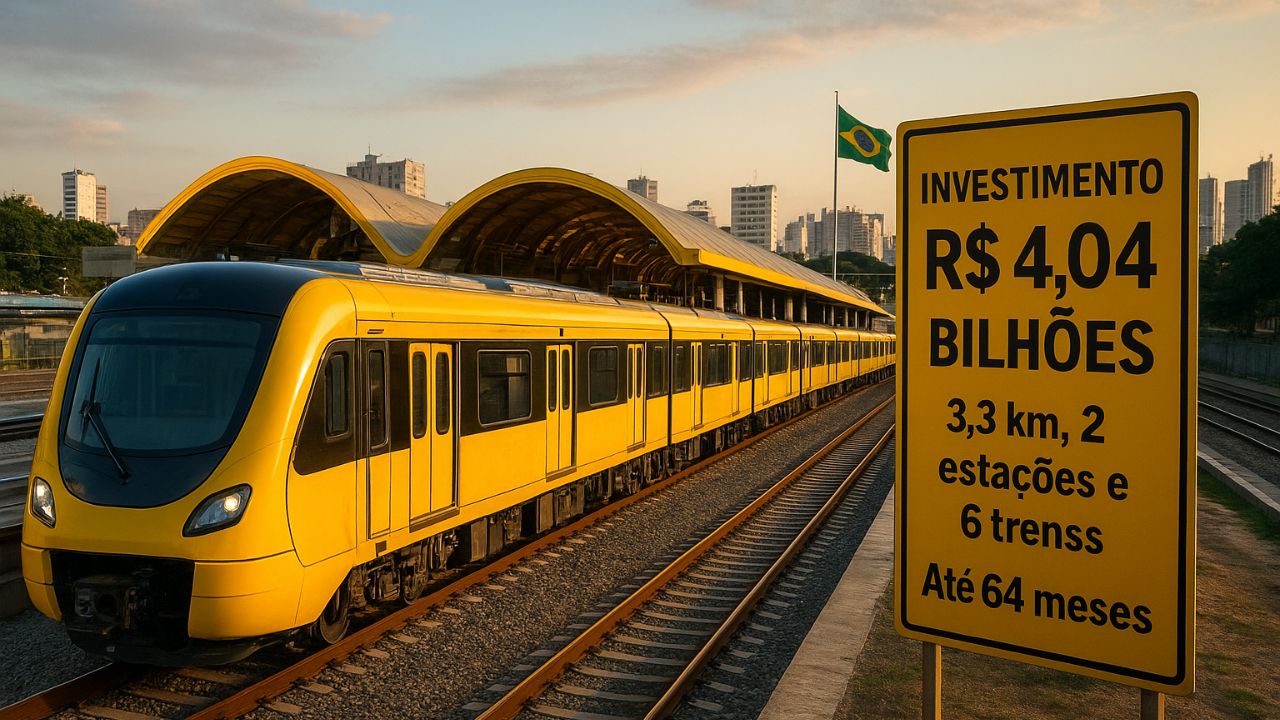
Announced as a milestone for mobility in the São Paulo Metropolitan Region, the expansion of the Yellow Line 4 to Taboão da Serra will receive an investment of R$ 4.04 billion. The information, confirmed by the state government and the concessionaire Motiva on Monday (29), represents one of the largest investments in transportation infrastructure in recent years. The project aims to extend the route by 3.3 km from the current Vila Sônia station, directly benefiting thousands of passengers who make the daily journey between the capital and the neighboring municipality.
According to what was reported by the portal InfoMoney, the plan not only extends the tracks but also modernizes the fleet and support infrastructure. The expectation is that, once completed, the project will add over 50,000 new passengers per day to the subway system, easing traffic on major roads like Francisco Morato and Professor Eliseu de Almeida avenues. However, the population will have to wait: the estimated delivery time varies between 48 and 64 months, that is, from four to more than five years.
Details of The Billion-Dollar Investment
The amount of R$ 4.04 billion results from a carefully structured public-private partnership. Of the total, R$ 3 billion will be composed of state resources from São Paulo and financing obtained from the World Bank, ensuring most of the capital needed for large-scale works. The remaining R$ 1 billion will come directly from the private sector, as a counterbalance from the concessionaire responsible for operating the line.
-
28-meter, 156-ton titans traveled 20,000 km from China to the port of Santa Catarina: Portonave received 7 fully electric megacranes, part of a R$ 210 million package, to double container handling.

-
They exchanged the idea of a large house for a 35 m² warehouse, spent US$ 12,000 on the structure, and created a tiny house in Colorado with space to live and work.

-
A newly opened terminal in the middle of the Amazon has begun transporting soy and corn through Amapá, eyeing the queue of ships that is congesting the ports in the South.

-
Goodbye to old tiles: renovation technique without construction transforms bathrooms in a few hours, eliminates debris, and reduces costs with coverings using special paints, high-resistance adhesives, and modern finishes that completely renew the space.


In exchange for this investment, the contractual addendum formalized with ViaQuatro, the consortium that operates the Yellow Line 4, provides for a 20-year extension of the concession. This financial model, according to experts consulted by InfoMoney, is common in high-complexity infrastructure projects, as it allows the public authority to carry out large-scale works without solely relying on budgetary resources while also offering legal security and returns for the private partner.
What Changes in Practice for the Passenger?
The main change will be the creation of a new 3.3 km stretch, which will take the Yellow Line 4 beyond the boundaries of the São Paulo capital for the first time. The project includes the construction of two new stations: Chácara do Jockey, which will serve a high-density residential and commercial area, and Taboão da Serra, which will be the new terminal station. The Taboão da Serra station is especially anticipated, as it will be a strategic connection point for residents throughout the southwestern region of Greater São Paulo.
In addition to the stations, the improvement package includes the acquisition of six new trains to ensure that the frequency of the trains is not affected by the increased route. The support structure will also be strengthened with the construction of a new energy substation and the implementation of modern operational systems. Another fundamental point of the project, highlighted by InfoMoney, is the integration of the new stations with the bus terminals of Vila Sônia, São Paulo-Morumbi, Butantã, and the future Taboão da Serra terminal, facilitating intermodal movement.
Deadlines and Challenges: Waiting for Taboão da Serra
Despite the positive announcement, the schedule presented by the government of São Paulo requires patience. The estimated delivery time, ranging from 48 to 64 months, reflects the complexity of a subway construction in a densely populated urban area. This period considers all project stages, from detailed engineering studies to environmental licenses, expropriations, and the physical construction of tunnels and stations.
Logistical challenges are the main factor for such an extended timeline. Underground excavations, the need for partial road closures, and heavy civil construction amid the intense traffic in the region are operations that require time and careful planning. Coordination between the public authority, the concessionaire, and engineering companies will be fundamental to meet the schedule without significant delays, a history that concerns São Paulo residents when it comes to subway expansion.
Will the expansion of the Yellow Line 4 to Taboão da Serra impact your daily life? Do you believe that the timeline of up to 64 months is justifiable by the benefit? Share your opinion in the comments below. We want to hear the perspective of those who use public transportation and live in the area.