Portuguese
  Spanish


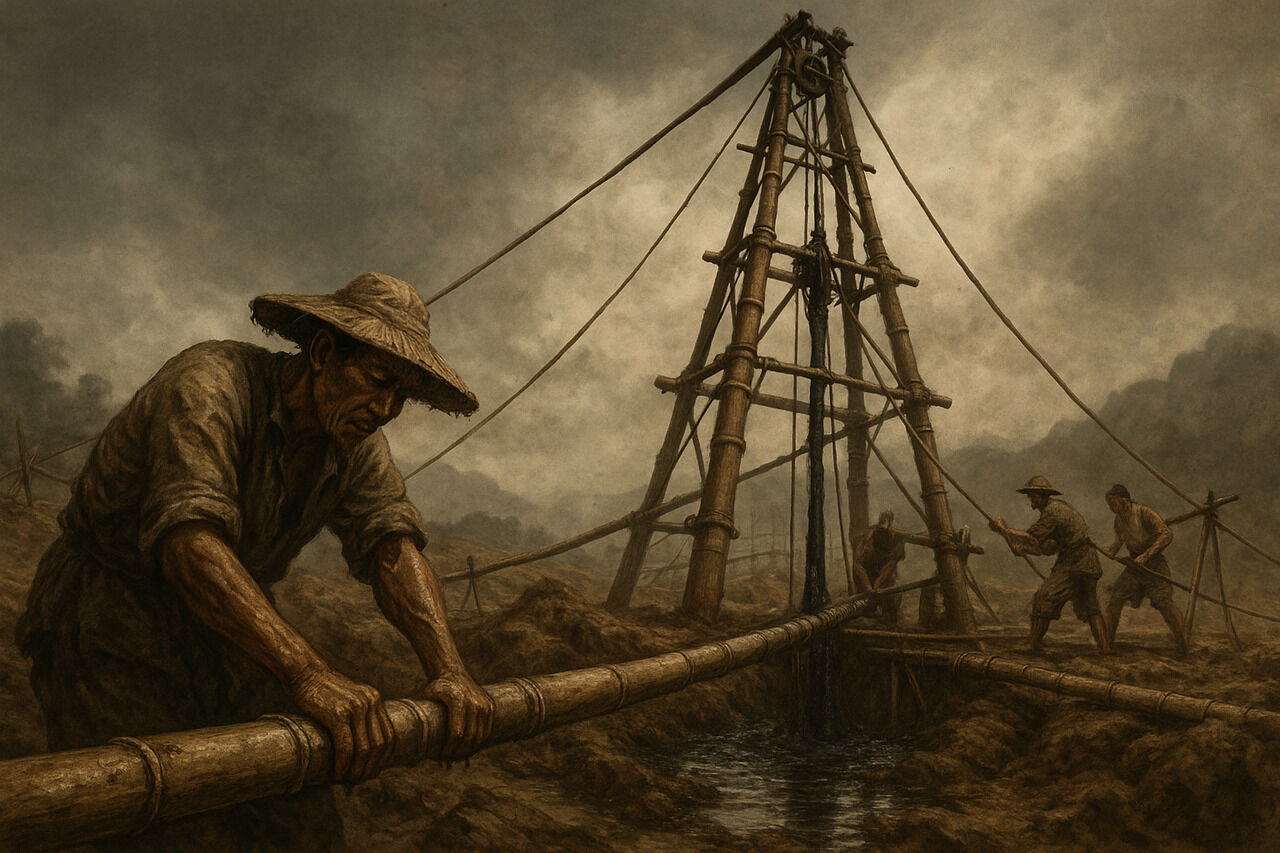


Long Before The Industrial Revolution, The Chinese Were Already Drilling Wells, Extracting Gas, And Transporting Energy With Ingenious Bamboo Systems
The history of the oil and gas industry often starts in the 19th century, with the Industrial Revolution and the first commercial wells in the United States. But long before that, a civilization had already mastered drilling, extraction, and even the transportation of energy resources with ingenious solutions. That civilization was China.
More than a thousand years before Edwin Drake drilled the first commercial oil well in 1859, communities in the Sichuan province were already exploring the underground in search of brine.
This activity led to the development of techniques that also allowed for the discovery and utilization of natural gas.
-
Explosion at QatarEnergy Plant in Ras Laffan Kills 13 and Injures 66; Investigation Rules Out Sabotage

-
Brazil’s Búzios Oil Field Sets Record with 1.2 Million Barrels Per Day, Strengthening Global Leadership in Deepwater Production

-
Petrobras and Equinor Reach Agreement for 50% Stake in Itaimbezinho Block in Brazil’s Pre-Salt Campos Basin
-
Venezuelan Refinery Halts Operations After Power Outage, Highlighting Country’s Energy Infrastructure Challenges


Drilling In The Warring States Period
The work began during the Warring States Period, between 480 and 221 BC. At that time, the Chinese were seeking salt, essential for food.
The search for brine led to the development of percussion drilling systems, with bamboo towers, pulleys, jumping platforms, and metal tools.
These tools had different shapes depending on the type of rock. Some resembled fish tails, others silver ingots or horseshoes.
During the Tang dynasty, wells reached up to 250 meters. And in the 19th century, even before the expansion of oil in the West, China had already surpassed the mark of 1,000 meters.
Ingenious Solutions For Technical Challenges
Chinese engineers also faced technical challenges with creativity. To solve the problem of broken drill bits or collapsed wells, they used bamboo pipes with valves, tung oil-based cements, and even expanded straw for sealing.
Around the year 1050, the use of flexible bamboo cables further facilitated operations.
An important milestone occurred in 1835. The Shenghai well officially reached a depth of 1,000 meters. It was the deepest well in the world at that time.
From Salt To Natural Gas
During drilling work in search of salt, pockets of natural gas emerged. Initially, these pockets were seen as dangerous or useless.
But over time, gas began to be used as a source of energy. It was used for heating, lighting, and powering boilers that evaporated brine.
When deforestation made it difficult to use firewood, gas became even more important. The Kang Pen drum was created, allowing for the extraction of both brine and gas at the same time.
Primitive forms of carburetors also emerged to mix gas with air for more efficient combustion.
Furthermore, drillers began to better understand the underground. They positioned gas wells in elevated areas and brine wells in lower areas, respecting the geological formations.
Bamboo Pipelines And Legal Contracts
With the advancement of the technique, the Sichuan region had hundreds of kilometers of bamboo pipelines.
These pipelines were sealed with braided ropes and special cements, making them very durable.
In the 1950s, there were still over 95 kilometers of these pipelines in operation. Cities like Zigong became industrial, commercial, and cultural centers thanks to the gas infrastructure.
The system was so well organized that it operated in shifts and required written legal contracts. These contracts, recorded in the history of China, defined roles and responsibilities among workers.
Millennial Legacy And Historical Impact
The Sichuan gas field surpassed similar operations in regions like Naples or Baku. The production was higher, but the highlight was the efficiency and continuity of the system.
To this day, the region remains productive. About 30 billion cubic meters of gas are extracted annually, in part from wells that are centuries old. This shows the lasting impact of the technology developed there.
On the other hand, the work still involves risks. In 2003, a gas explosion near Chongqing killed 233 people and left 9,000 injured from poisoning.
Even so, experts believe that the tragedy could have been worse had it not been for the technical knowledge accumulated over the centuries.
The historical importance of this system is preserved in the Shanxi Salt Museum. There, original tools and models documenting this technological feat are on display.
A New Way Of Looking At History
What happened in Sichuan changes the way we view the history of oil and gas. Instead of starting in the 19th century, this history was already being written a thousand years earlier, with Chinese engineers drilling into the ground, extracting resources, and creating efficient transportation networks.
The legacy left by these communities proves that ancient civilizations were capable of impressive feats, even with the resources available in their time.
With information from Xataka.