Portuguese
  Spanish


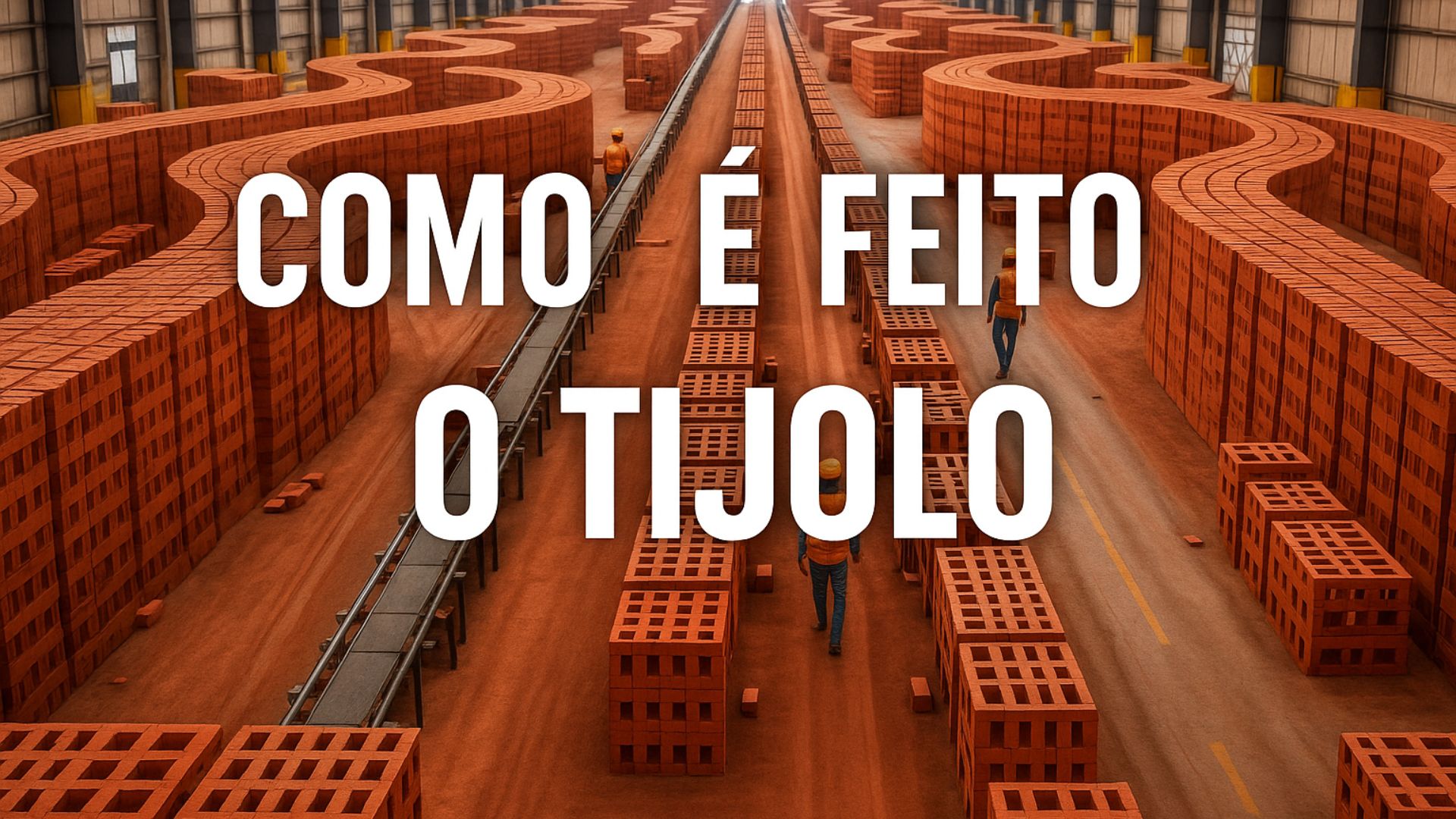


Refractory Bricks And Industrial Cables Reveal Invisible Processes That Sustain High Temperature And High Load Operations.
In high furnaces, steel pots, cement kilns, and even in home fireplaces, a specific type of brick works silently to withstand temperatures exceeding 1,600 ºC, comparable to the inside of a volcano.
According to a report published by the website Giants of Industry, these refractory bricks form a kind of thermal armor, essential for metals, glass, and cement to be produced safely and predictably.
Production Of Refractory Brick And Kaolinitic Clay
Unlike regular construction bricks, the base of refractory bricks is not just any clay.
-
Brazilian Fishing Couple Spends 4 Years Building Solar-Powered Floating Home on the Paraguay River, Now a Navy-Approved Vessel with Leisure Area and Tour Demand

-
While the World Opens New Airports and High-Speed Trains, Brazil Rushes to Complete Projects Stalled for 40 Years
-
Brazil Invests in Massive Waterway to Transport Soybeans by Barge, Reducing Costly Truck Reliance
-
Bridge Rebuilt in Just One Year Reconnects Two Brazilian States


The raw material is a kaolinitic clay, known as refractory clay, rich in alumina and silica.
The proportion and content of these components determine the melting point and the strength of the final product.
Thanks to this composition, the material reaches high melting points, ensuring dimensional stability and predictable performance under extreme heat.
To achieve this result, the industry adopts a technical process that starts even before molding.
Chamotte And Thermal Resistance
A portion of the extracted clay undergoes firing in kilns that can reach around 1,500 ºC.

At this stage, the clay loses plasticity, sinters, and transforms into chamotte, a hard material similar to rock.
According to investigations by the Giants of Industry website, after being fired, the chamotte is crushed and reintroduced as a main component.
A fraction of fresh plastic clay is added, which acts as a binder.
This combination reduces shrinkage and deformation during final drying and firing.
Crushing, Mixing And Pressed Mass
The industrial cycle begins with the preparation of the components. Clays, other rocks, and burned chamotte go to crushing.
Crushers break down the larger blocks. Next, mills reduce the material to a fine powder of controlled granulation.
This control defines the density of the brick, its mechanical strength, and thermal conductivity.
After milling, automated systems precisely dose each component according to the refractory formulation.
The mixture then goes to industrial mixers until it forms a homogeneous mass with low moisture.
Semi-Dry Pressing And Drying
The most common method is semi-dry pressing. The mass is loaded into high-strength metal molds.
Presses apply forces of hundreds of tons. The particles come together and expel the air.
The result is the green brick, dense and geometric, but still fragile. The piece is placed in tunnel dryers, where it remains for hours or days.
The uniform removal of moisture avoids internal stresses that can cause cracks.
Tunnel Kiln Firing And Mullite Formation
After drying, firing takes place in tunnel kilns. The pieces are gradually heated to about 1,700 ºC, depending on the refractory class.
The heating triggers chemical reactions in the alumina-silica system. The particles fuse, forming a continuous ceramic structure.
In this process, crystals of mullite emerge, reinforcing the piece internally. After reaching the thermal peak, controlled cooling prevents thermal shock. The brick then exits rigid and resistant.

Market And Industrial Applications
After firing, each batch undergoes quality control. Dimensions, physical integrity, and specific properties are checked.
The bricks are marked, packed, and distributed. The Giants of Industry website also pointed out that iron and steel is the main global consumer.
A blast furnace can demand thousands of tons of refractories. A chamotte brick SAA5 weighs about 3.5 kg and withstands temperatures close to 1,690 ºC.
The cement industry uses refractories in rotary kilns that reach 1,450 ºC. The glass industry uses special materials in melting furnaces that operate near 1,600 ºC.
Refractories are also present in boilers, refineries, chemical industries, and home fireplaces.
High-Strength Industrial Cables

In addition to refractories, steel cables are essential in high-load operations.
According to manufacturers in the sector, specialized cables can reach high values for being part of critical systems.
The structure of these cables starts from high-alloy carbon steel enriched with chromium, nickel, and molybdenum.
Engineers state that these elements increase mechanical strength, durability, and tolerance to the environment.
Wires, Rolling, And Thermal Treatments
In detailed information from the Giants of Industry website, before forming the cable, the steel undergoes rolling that reduces the diameter to the size of the wires.
Then comes the thermal treatment, involving heating and rapid cooling. Afterwards, the wire receives anti-corrosive or polymeric coatings.
Each wire goes through computerized calibration, which evaluates measurements, micro-curvatures, and symmetry. Experts inform that minimal variations can compromise the final performance.
Weaving, Testing, And International Certification
The assembly occurs in carousel machines that organize layers of wires around a central core.
The tension of each wire is controlled automatically. Some cables combine metallic layers with special external coatings.
Then testing begins, where rupture tests apply high loads. Fatigue tests simulate repeated cycles.
Torsion tests and environmental assessments expose the cables to saltwater, low temperatures, heat, and chemicals.
Only the approved cables receive international certifications. After that, they are coiled, transported, and installed with precision.