Portuguese
  Spanish


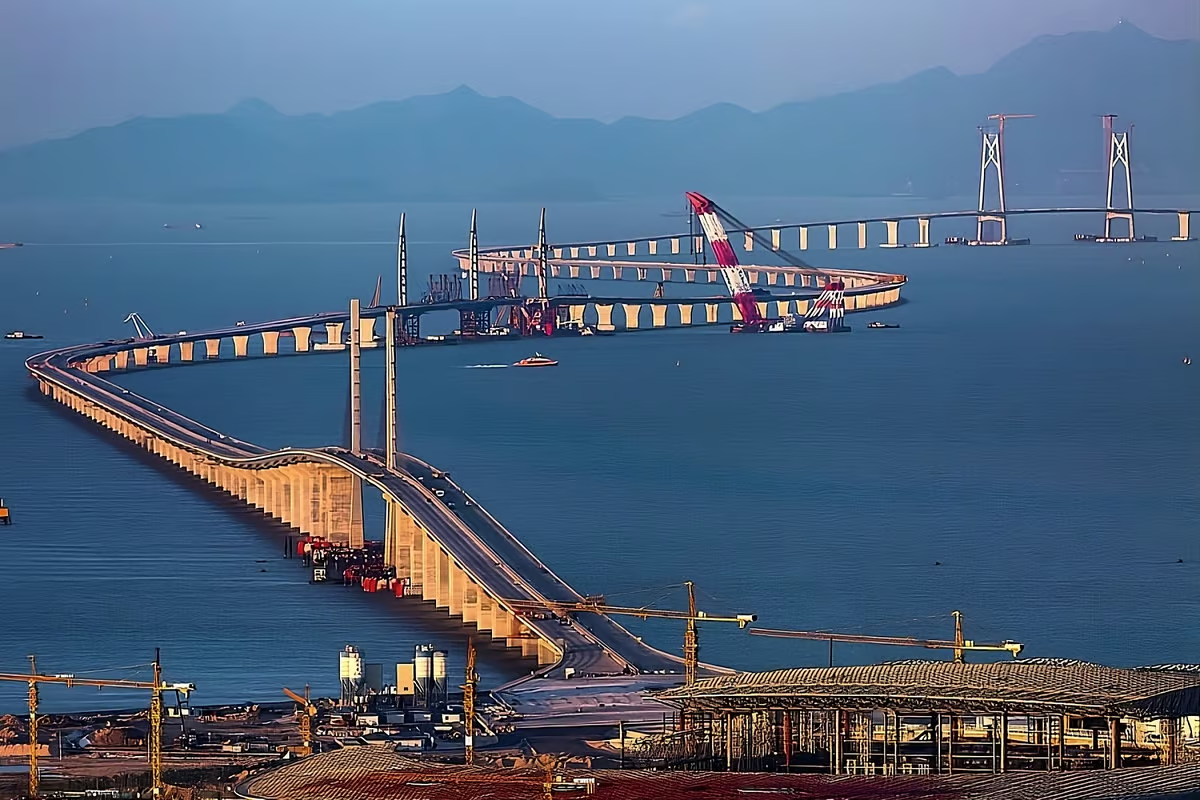

The Hong Kong-Zhuhai-Macau Bridge Uses Innovative Bamboo Panels to Face Extreme Climate Challenges, Highlighting the Sustainability and Resilience of the Material
With a length of 55 kilometers, the Hong Kong-Zhuhai-Macau Bridge (HZMB) is the largest sea-crossing bridge and tunnel system in the world. This impressive piece of engineering, which cost US$ 18.8 billion, consists of three cable-stayed bridges, a submarine tunnel, and four artificial islands.
The construction was designed to last over a century, withstanding the extreme climate of China, featuring intense sunlight, corrosive seas, and fierce typhoons.
The need for robust structures is clear. The Chinese coastline is affected by seven tropical cyclones annually, requiring infrastructure capable of supporting extreme weather conditions.
-
Brazilian Researcher Develops Protein Supplement from Tilapia Waste, Combining Innovation and Sustainability with Economic Potential

-
Women in São Paulo Unknowingly Tracked by Coin-Sized Tags Hidden in Cars and Belongings, Raising Stalking Concerns
-
Near a $750 million AI data center in Brazil, a resident’s well runs dry, leaving her unable to afford the $25,000 needed for repairs.

-
16-Year-Old from Brazil’s Sertão Wins Young Scientist Award for AI Predicting Rainfall with 94.5% Accuracy to Aid Farmers


With this requirement in mind, the HZMB was designed to be strong and rigorous, utilizing modern resources to face the challenges of the marine environment.
Innovation in the Use of Bamboo
One of the most notable aspects of this construction is the 20,000 square meters of bamboo panels used in the artificial islands of the bridge.
Since the HZMB’s inauguration in 2018, these panels have proven resilient to adverse conditions, attracting international attention.
The innovation in the use of bamboo, an abundant and sustainable material, stands out as an ingenious solution to face environmental difficulties.
Bamboo in China
China, the world’s largest bamboo producer, has excelled not only in quantity but also in innovation in the use of this material.
With over 6.67 million hectares of bamboo forests and an industrial production of US$ 74.2 billion in 2023, the country has been exploring bamboo in various areas, such as construction, piping, furniture, and even decorative products.
This material is highly recognized for its strength and renewability, making it an environmentally friendly alternative for large-scale projects.
However, bamboo is a delicate material and can deteriorate quickly if not properly treated.
Therefore, one of the most important innovations has been the thermal treatment developed by Chinese engineering.
This process eliminates the nutrients that cause bamboo deterioration, preserving its structural integrity for a longer period.
This treatment, which also reduces time and energy consumption, allows bamboo panels to last for at least five years without the need for additional treatment.
Sustainability and Technology
Additionally, a low-emission adhesive has been developed, with reduced levels of formaldehyde and phenol, to minimize environmental impacts.
These product innovations position China prominently in the bamboo industry, highlighting its role in developing new technologies for utilizing this natural resource.
The Performance of Bamboo in the Hong Kong-Zhuhai-Macau Bridge
Six years after the bridge’s inauguration, the bamboo panels remain in excellent condition, proving the effectiveness of the solutions adopted.
According to Lou Zhicao, an associate professor at Nanjing Forestry University, the strength and longevity of bamboo, after thermal treatment, are impressive.
This not only ensures the durability of the HZMB’s artificial islands but also reinforces bamboo’s potential as a material for future infrastructure construction in extreme conditions.
The Hong Kong-Zhuhai-Macau Bridge is an example of how China has harnessed its natural resources in an innovative way, contributing to the evolution of global infrastructure, and showing the world that nature-inspired solutions can be highly effective even in the face of the greatest environmental challenges.
With information from Interesting Engineering.