






 Portuguese
  Spanish
  2 min of reading
  0 comments


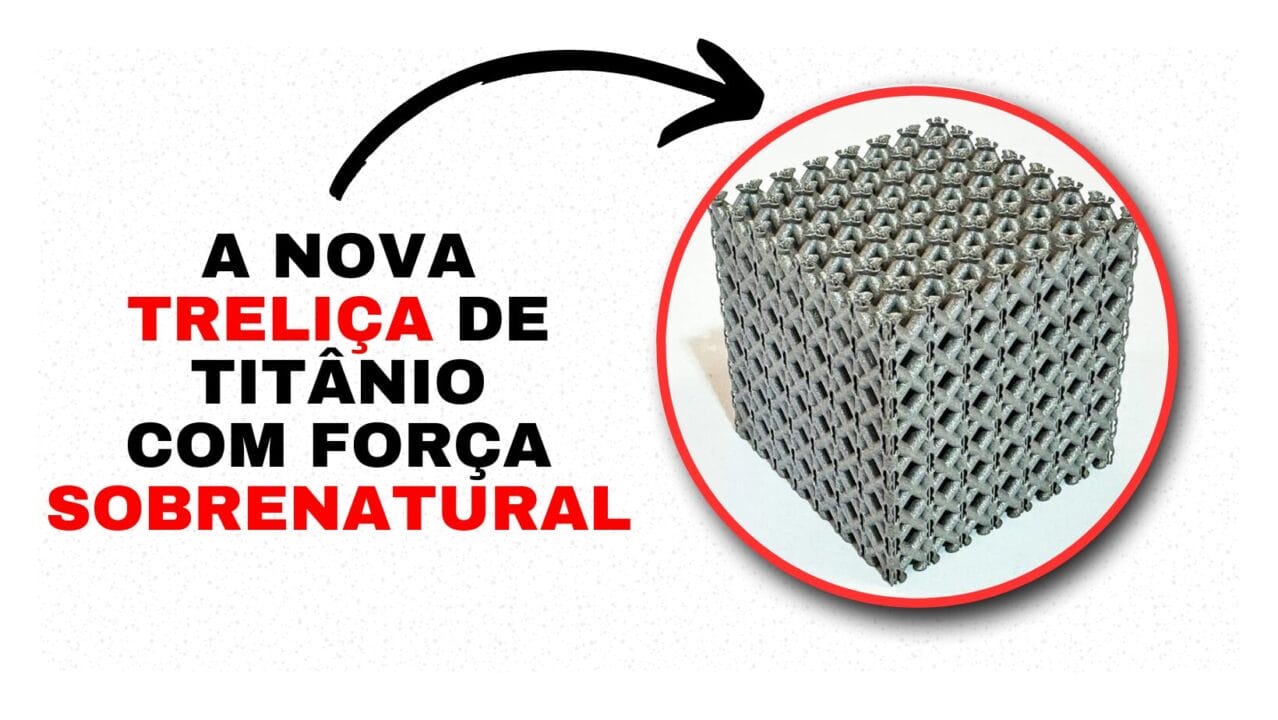
RMIT Developed a 3D Printed Titanium Lattice 50% Stronger Than Conventional Alloys, Designed to Distribute Stress Uniformly.
The Royal Melbourne Institute of Technology (RMIT) is revolutionizing the aerospace industry with the development of a 3D printed titanium lattice, renowned for its remarkable strength, being 50% stronger than conventional alloys like WE54. This achievement represents a significant advancement in the pursuit of lighter and more robust materials for space applications.
The Titanium Lattice from RMIT and Its Incomparable Superiority
The technology behind this titanium lattice leverages the unique properties of the material, providing an exceptional combination of lightness and strength.
This complex structure was designed after a thorough analysis of its weak points, resulting in a significant improvement in its structural strength.
-
Europe unveils armored tank with remote turret, 1,500 horsepower, and 120-millimeter cannon

-
Old hard drives may hide neodymium, dysprosium, praseodymium, and terbium, and a United States company is expanding its network with a new 93,000-square-foot facility to recover rare earths used in electric cars, artificial intelligence, defense, and renewable energy.

-
Giant crane lifts up to 3,000 tons, requires special logistics to reach the site, and can transform 18-hour operations into just 3 hours, speeding up the hoisting of oil platforms, refineries, and plants in giant industrial projects.

-
A discarded microwave may contain 22-carat gold in internal components; study recovered a 450 mg nugget from electronic boards.


One of the key innovations is the reduction of stress concentration at the joints where supports meet.
This enhancement allows stress to be distributed more uniformly throughout the lattice, granting it exceptional strength.
RMIT scientists also reinforced conventional tubular lattices by adding a second lattice on top of the first, in an “X” cross-sectional configuration, which interweaves between the tubes and joints.
Exploring the Multiple Facets of the Titanium Lattice
The versatility of this technology is highlighted by the ease with which it can be printed on a laser selective melting 3D printer.
This feature opens doors for efficient and scalable production, optimizing large-scale manufacturing processes.
The potential applications of this titanium lattice are vast, with expectations of significant impact in the aviation and aerospace rocket sectors.
Moreover, the technology also shows promise for use in medical bone implants, where the combination of lightness and strength is essential.
Challenging Extreme Heat
The thermal resistance of this lattice is remarkable, withstanding temperatures of up to 350°C when manufactured from magnesium.
However, this capability can be expanded to 600°C if a heat-resistant titanium alloy is used.
This attribute makes the lattice adaptable to various conditions of use, especially in challenging space environments.
Inspired by lattice designs with hollow support and organ pipe corals, this creation from RMIT represents a milestone in the quest for more advanced and weight-efficient solutions for the demanding needs of space exploration.
The promising future of this titanium lattice highlights the ongoing commitment to innovation and the search for materials that push the boundaries of aerospace engineering.
Source: CanalTech





Be the first to react!