Portuguese
  Spanish


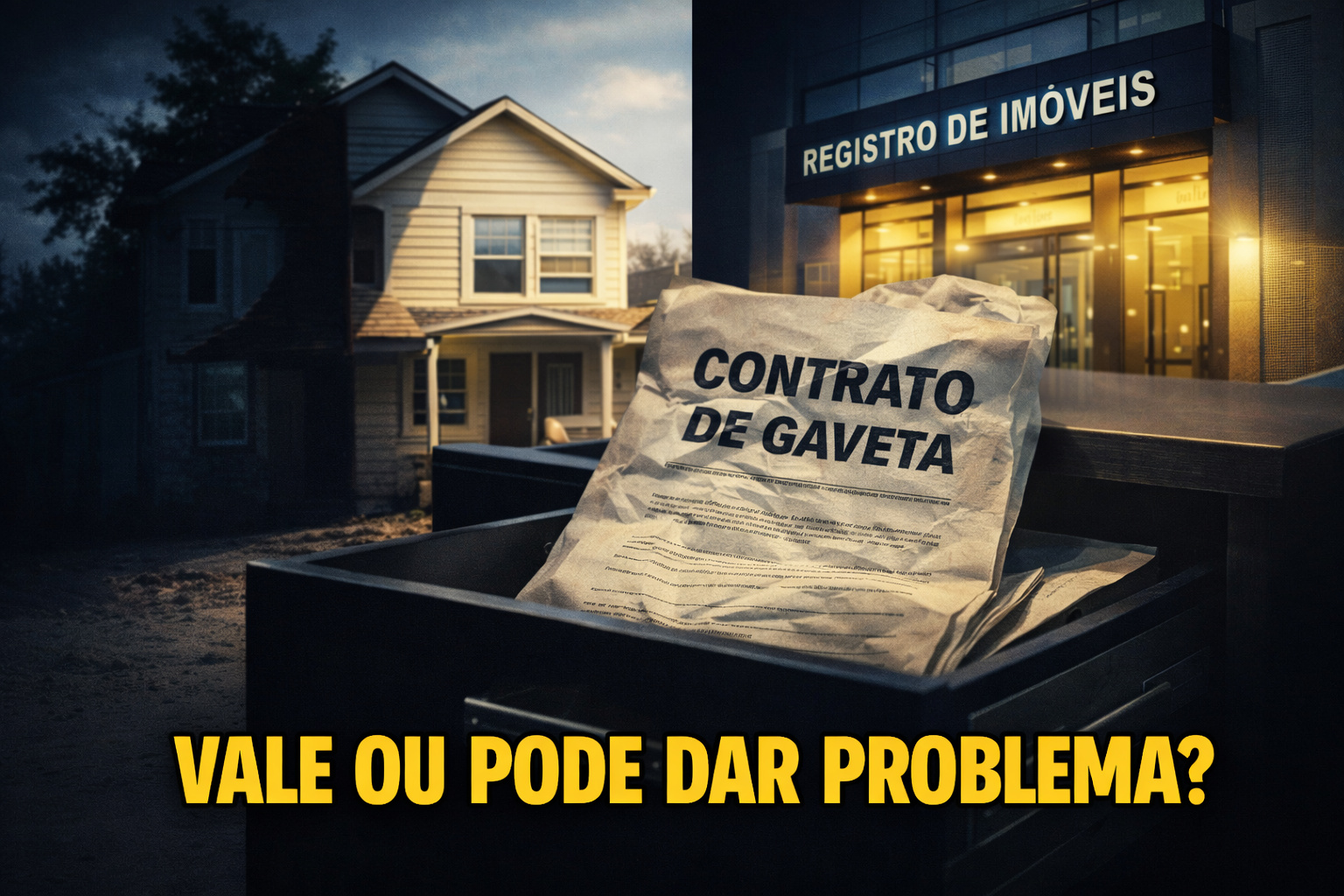


Under-the-Table Contracts Can Become a Headache: Without Deed and Registration, the Resident is Not a Legal Owner and Faces Risks, Losses, Frozen Inheritances, Denied Financing, and Permanent Legal Uncertainty
In many neighborhoods in Brazil, especially in areas developed from the 1970s to the 2000s, property purchases were made using private contracts, receipts, or purchase and sale promises — methods known as “under-the-table contracts.” The problem arises when the buyer fails to convert this paper into real property, that is, public deed + registration at the Land Registry Office, which defines legal ownership.
Nevertheless, what many do not know is that, in certain situations, the under-the-table contract can indeed be converted into a deed and registration, without the buyer needing to “start all over again.” But when is this possible? And when does it become a problem?
What the Law Considers an “Under-the-Table Contract”
In Law, the term “under-the-table contract” does not exist formally. What exists are private contracts that have not been duly executed or registered. It can involve:
-
Cat banned from roaming in shopping mall wins court case and regains the right to roam freely in the place where it has lived for years.

-
Brazil Approves Proposal to Cap Vehicle Tax at 1% of Car Value
-
Brazilian Senate Approves Bill to Automate Child Support Payments Directly from Debtors’ Accounts

-
Brazilian Congress Advances Bill to Ensure Full Pension Benefits for Families Receiving Reduced INSS Death Benefits



- purchase and sale promise
- assignment of rights
- private instrument with notarized signatures
- partial payment receipts
- old contracts for financed properties


These documents do not transfer ownership. According to Brazilian Civil Code, property ownership is only transferred with registration, as per Article 1,245 of the Civil Code:
“Property is transferred among living persons by registering the title that conveys it at the Land Registry.”
In other words: even if everything is paid, the buyer is not an owner before the State without registration.
When the Under-the-Table Contract Can Turn into a Deed
There are real scenarios where the buyer can complete the ownership chain, converting the paper into regular property. The most common situations are:
(1) When the Seller is Still Alive and Reachable
In this case, the buyer can ask the seller to execute the deed and then register it. When the seller refuses, the following paths can be pursued:
- judicial mandatory adjudication, or
- extrajudicial mandatory adjudication (Law No. 14,382/2022)
This path is precisely for the buyer who has paid, has a contract, but cannot obtain voluntary signature.
(2) When the Property has a Deed but Has Never Been Registered
Common cases of old properties where the deed exists in the notary’s office but has never been taken for registration. In this case, it is enough to register the deed — it does not depend on the seller again.
(3) When the Property is Under an Old Financing
In the 80s and 90s, many properties linked to the Housing Finance System (SFH) were transferred through “under-the-table contracts,” and Caixa and the bank recognize some of them after payment and documentation regularization.
When It Becomes a Headache (and Can Lead to Loss of Property)
The under-the-table contract does not guarantee ownership, leading to a series of problems:
- Problem 1 — Heirs: If the seller passes away, the buyer must deal with the inventory and heirs, who may contest, demand supplements, or even refuse to acknowledge the sale;
- Problem 2 — Lien: If the seller has debts, the property can be seized, as the registration is still in their name;
- Problem 3 — Double Sale: Without registration, the seller can sell the same property to another person, and whoever registers first wins, according to the established understanding of the courts.
The Superior Court of Justice (STJ) has already consolidated the understanding:
“Registration defines property before third parties.”
In other words: whoever registers is the owner.
And When is the Contracted Property Irregular?
Another layer of problems arises when the subdivision itself is informal or old, which requires REURB (Urban Land Regularization) — a federal program that allows for the regularization of entire areas and issuing of individual registrations. REURB can resolve situations of:
- lots without registration
- old subdivisions without infrastructure
- consolidated areas in outskirts and medium-sized cities
It is an alternative used by many municipalities since 2017.

How the Buyer Proves They Paid and Took Possession
To advance in regularization, the buyer generally needs to gather:
- private contract
- payment receipts
- proofs of possession
- property tax (IPTU) in the buyer’s name (does not transfer ownership but helps prove possession)
- utility bills
- photos and testimonies, in some cases
These proofs are useful for both adjudication and adverse possession, which is another relevant avenue.
And When Does the Path Turn to Adverse Possession?
There are cases where the buyer has lived in the property for decades, without litigation and with animus domini.
There are modalities, such as:
- ordinary adverse possession — 10 years
- extraordinary adverse possession — 15 years (or 10 with residence/work)
- family adverse possession — 2 years
- extrajudicial adverse possession at the registry office** (Provision CNJ 65/2017)
The advantage is that it does not depend on the seller, but requires legal requirements, such as peaceful and continuous possession.
Under-the-Table Contracts Are Not Verdicts, But Require Caution
What cannot happen is for the buyer to believe that paying and having an informal paper makes them an owner before the registry office. In Brazil, the real estate relationship is governed by title + registration — ignoring this creates family disputes, liens, and loss of property. In summary:
- Is regularization possible? Yes, in many cases.
- Is it simple? Not necessarily.
- Does it depend on the seller? Sometimes yes, sometimes no.
- Does it require registration? Always.
In the end, the under-the-table contract is not the problem itself — the problem is failing to complete the legal cycle of ownership.