Portuguese
  Spanish


The Brazilian Traffic Code has dozens of little-known traffic signs that leave any driver confused. Among the strangest are the one that prohibits wheelbarrows, the one that warns of crosswind with a windsock drawing, and the customs sign that requires stopping. Understand what each one means.
Everyone knows the “stop” and speed limit signs, but Brazil has traffic signs that would make any driver scratch their head. The Brazilian Traffic Code includes dozens of rare models, from curious prohibitions to unusual warnings, as shown by NSC Total.
Many of these signs follow strict official rules. The codes, drawings, and meanings of each are found in the Brazilian Traffic Sign Manual, from CONTRAN, the agency that defines the signage used on the country’s streets and roads and guides drivers.
The curious thing is that almost no one knows they exist. These are traffic signs made for specific situations, which rarely appear in daily life, but are part of the CTB and can result in fines if disobeyed by those unaware of the rule.
-
Are Companies Required to Release Employees During Brazil’s World Cup Matches? Understanding Workers’ Rights

-
Brazilian Family’s Homeschooling Success Sparks International Debate: Daughters Read 30 Books Annually and Speak Multiple Languages

-
Piauí Governor Enacts Law Requiring State Contractors to Reserve Jobs for Former Inmates with Minimum Wage and Verification Before Payment
-
Providing Your Tax ID at Supermarkets: A Routine Step That Can Unlock Discounts and Rewards but Also Reveals Your Shopping Habits




Next, discover the strangest traffic signs of the CTB, understand what each symbol means, and why these rare signs exist to ensure everyone’s safety.
The traffic signs that almost no one knows
Brazil has much more signage than most people imagine. The CTB provides for more than 230 models of vertical signs, and a good part of them is so specific that most drivers have never encountered one on the street.
There is a logic to colors and shapes. The traffic signs for regulation, which require or prohibit something, are always round, with a red border and white background. Warning signs, which alert of danger, are yellow diamonds with a black border.
This standardization helps safety. Even without reading the legend, the driver can understand by the shape if the traffic sign is instructing to do something or just warning of a risk ahead, which speeds up the reaction at the wheel.
The problem is ignorance. Since some traffic signs appear only in very specific locations, many drivers do not know what to do when they encounter them, which can cause confusion and even infractions, even without bad intentions.
It’s worth understanding the division of groups. The vertical signage of the CTB is divided into three major families: regulation, which mandates or prohibits; warning, which alerts to a danger; and indication, which guides the driver. Knowing which group each traffic sign belongs to already helps to understand the message.
The colors and shapes follow a logic of safety. Red and the circle indicate an order to comply with; yellow and the diamond, an alert; and blue and the rectangle, information. This visual code was designed so that drivers understand the traffic sign quickly, even from a distance.
“Handcart Prohibited”: the R-40 sign
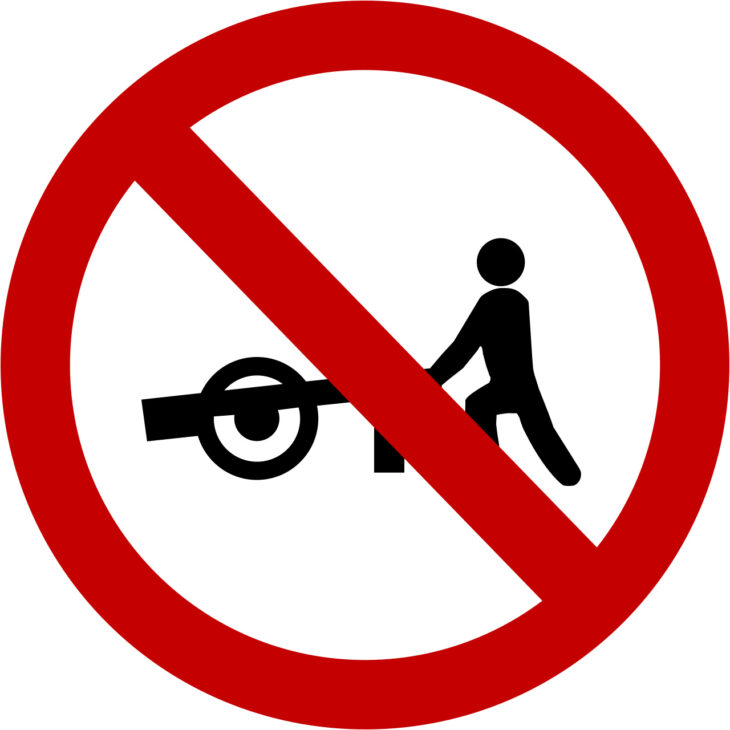
Perhaps the most curious of all is the R-40. Officially named “traffic prohibited to handcarts,” it prohibits the circulation of handcarts, those human-powered carts used to carry loads, from the point where the traffic sign is installed.
The design is unmistakable. Inside the red-bordered circle, appears the silhouette of a handcart in black, something that sounds almost comical to those used to seeing only cars and trucks in road signage.
The rule has a reason. This traffic sign usually appears in high-traffic areas or in heritage and tourist areas, where the presence of handcarts could hinder circulation or compromise the safety of pedestrians and vehicles.
Even though it is rare, it holds as much weight as any other. A handcart driver who ignores the R-40 is violating the CTB, proof that even the most unusual signage has legal weight on Brazilian streets.
Where it appears usually makes sense. Historic centers, markets, areas with high pedestrian traffic, and heritage sites are points where a handcart could obstruct or cause an accident, and it is there that this traffic sign is most likely to appear to protect everyone’s safety.
“Customs” and “Chains Required”: the signs that order stopping or equipping
Another sign that confuses is the R-21, for customs. It indicates the existence of a customs office, at borders, dry ports, or checkpoints, where stopping is mandatory, and failing to do so may constitute an infraction as outlined in article 208 of the CTB.
Few drivers have seen this signage. As it only exists in specific inspection areas, the customs sign is far from the daily routine of most, but it is essential for the control of goods and for safety in these regions.
Even rarer is the R-22, for mandatory chain use. This traffic sign requires the use of chains on the vehicle’s drive wheels, something necessary in difficult sections, such as roads with snow, ice, or mud.
In Brazil, it appears very rarely. The R-22 usually only appears in mountainous regions during the harshest winter, making it one of the most exotic signs in the country for drivers accustomed to the warm climate.
Ignoring the customs sign can be costly. According to article 208 of the CTB, crossing a roadblock with mandatory stop signage without stopping constitutes an infraction, showing that these rare traffic signs are not mere decoration and involve punishment for the driver who disrespects them.
“Crosswind”: the windsock sign that warns of danger (A-44)
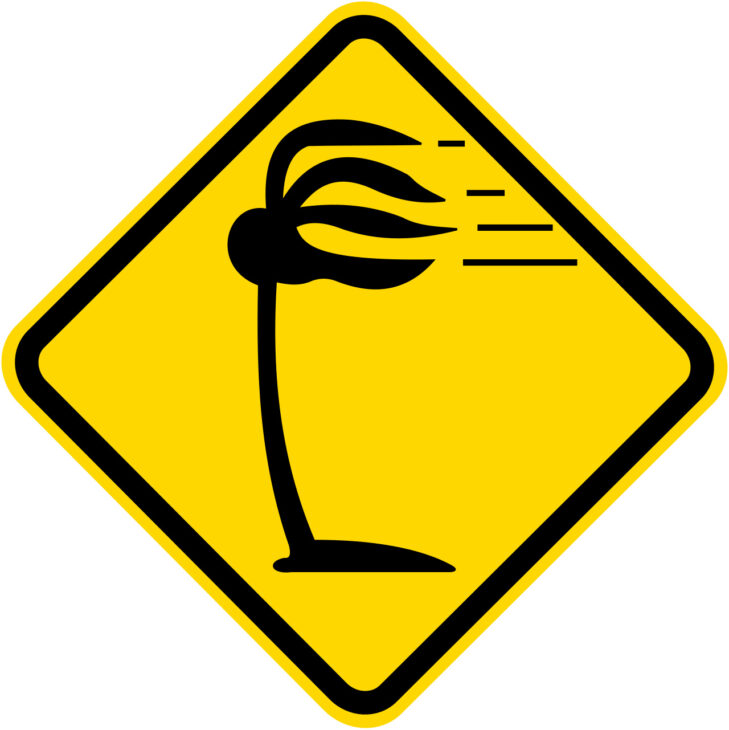
Among the warning signs, the A-44 is one of the most remembered. Called “crosswind,” it warns drivers about strong and sudden lateral gusts that can affect the vehicle’s stability in certain sections.
The symbol is a windsock. The traffic sign shows the drawing of a wind sleeve, that fabric cone used at airports, which indicates the direction and intensity of the gusts, helping the driver understand the risk ahead.
It appears in exposed locations. Bridges, viaducts, embankments, and open highways, often near the coast, are points where crosswinds can push the car sideways, and the signage serves precisely to reinforce safety in these sections.
Ignoring this warning is risky. Upon seeing the A-44, the ideal is to reduce speed and grip the steering wheel firmly, because an unexpected gust can be dangerous, especially for tall vehicles, like trucks and vans, which are more sensitive to crosswind.
The windsock was an intelligent design choice. Instead of text that no one would read in time, the traffic sign uses the image of a windsock, a universal symbol that any driver associates with gusts, reinforcing safety with an immediate visual message for those passing by at high speed.
Drawbridge, airport, and LRT: more unusual signs
The list of rarities continues. The A-23 sign, for drawbridges, warns about structures that can open for the passage of vessels, something common in regions with boat traffic, but rare for most Brazilian drivers.
There is also the A-43, for airports. This traffic sign warns of the proximity of an airport area, where aircraft fly lower, an important warning for safety and to avoid startling those driving near runways.
Rail transport has gained space in signage. The R-41 sign reserves a section for the exclusive circulation of LRT or trams, something increasingly present in cities investing in this type of transport and needing to separate the tracks from the rest of the traffic.
All follow the same principle. Even though they are uncommon, these traffic signs exist to organize specific situations and protect drivers, pedestrians, and passengers, showing how much the CTB tries to anticipate every detail of the roads.
The drawbridge is a good example of this logic. In cities crossed by navigable rivers, the structure needs to open to let boats pass, and the traffic sign warns the driver in advance, preventing them from proceeding unaware that the road can be interrupted at any moment.
Cyclists and pedestrians: the signs that organize those who walk together
With the increase in bikes, signs have emerged to organize the space. The R-36a determines that cyclists stay on the left and pedestrians on the right on the same lane, while the R-36b reverses this order, separating those who pedal from those who walk.
This signage avoids conflicts. On shared bike paths and sidewalks, making it clear where each should walk reduces the risk of accidents and improves coexistence, a safety precaution that many drivers and pedestrians don’t even realize exists.
The detail is the similarity between them. Since the R-36a and the R-36b are almost identical, changing only the position of each figure, it’s easy to confuse them, which requires attention to follow the correct traffic sign in each section.
These signs show a trend. As cities encourage cycling and walking, the signage needs to account for new characters in traffic, and the CTB is updating to include these situations in daily life.
The same applies to rail transport. With more cities investing in LRT and trams, specific traffic signs have emerged to reserve lanes and organize the crossing of these vehicles with cars, bicycles, and pedestrians, a safety measure that tends to become more common on Brazilian streets.
Why do such rare signs exist in the CTB?
The answer lies in the country’s diversity. Brazil has mountains, coastlines, borders, ports, and large cities, and each reality requires its own traffic sign, which makes the CTB accumulate dozens of models for very specific situations.
Better to have too many than too few. Having a ready signage for each scenario ensures that when danger or a rule appears, there is a standardized symbol to warn the driver, even if this sign is almost never used in most of the territory.
There is also the issue of international standardization. Many of these traffic signs follow models used in other countries, which helps foreign drivers understand Brazilian signage and Brazilians to manage abroad.
There is also the concern to update the rules. The specifications of Brazilian traffic signs undergo revisions and resolutions by the traffic authority, which adjust designs and uses as new needs arise, always aiming to keep the signage clear for drivers.
In the end, everything revolves around safety. Each rare traffic sign exists to reduce risks in a specific situation, and knowing these signs, even the strangest ones, is part of driving responsibly in Brazil.
What this has to do with Brazil
Knowing the signage is a duty of every driver. In Brazil, ignoring a traffic sign, even without knowing what it means, can result in a fine and points on the license, besides putting the safety of those on the road at risk.
Ignorance is common but avoidable. Many Brazilian drivers never studied the CTB in depth after driving school, and encountering these rare signs again is a good opportunity to reinforce what each symbol means.
There is a message for traffic education. Promoting the less known traffic signs helps to form more attentive drivers, which translates into fewer accidents and more respect for the rules on the country’s streets and roads.
It’s even worth revisiting the subject from time to time. After driving school, few drivers go back to studying traffic signs, and encountering these rare signs again is a good excuse to reinforce what each symbol means, which translates into more safety behind the wheel.
Finally, here’s a useful curiosity. Knowing that there is a sign that prohibits wheelbarrows or warns of side wind is not just fun: it’s about knowing the CTB better and being prepared for any signage that may appear along the way.
And you, were you familiar with these traffic signs?
The CTB is full of traffic signs that are out of the ordinary, from the prohibition of wheelbarrows to the side wind warning with the windsock, including customs and mandatory chains. They all exist for a reason and are as valid as any other signage.
More than just curiosity, knowing them is a matter of safety. A driver who understands each traffic sign reacts better, avoids fines, and helps make traffic more organized, even in the face of the country’s rarest signs.
And you, have you ever seen any of these traffic signs around, or did you just discover now that they exist? Tell us in the comments which one surprised you the most and share with that driver friend who claims to know everything about the CTB.