In news published on February 24, 2025, the Improve Aquatic LIFE project reported that the first action took place in the Pjältån Nature Reserve, in Östergötland, with the removal of a 60-meter concrete gallery, return of the original flow, and a restoration plan in nine counties in southern Sweden.
Sweden has initiated one of the most symbolic actions of Europe’s largest aquatic restoration project by removing a 200-ton, 60-meter-long concrete gallery from the Pjältån River, within the Pjältån Nature Reserve, in Östergötland.
The intervention, completed in September 2024 and announced on February 24, 2025, by the Improve Aquatic LIFE project, returned the water to the river’s original bed and marked the beginning of a seven-year program, with more than 500 environmental actions in rivers, wetlands, and coastal areas of southern Sweden.
Removal returned the river to its original course
The first action of Improve Aquatic LIFE was direct and visually striking: removing a 200-ton concrete gallery that diverted the natural flow of the Pjältån River. With the removal of the structure, the water returned to flow through the original bed, recovering a dynamic that had been altered by a rigid construction.
-
Key Infrastructure Projects for Brazil’s Next President: Expanding Railways to Cut Transport Costs, Reduce Truck Traffic, Create Jobs, and Boost Industries Nationwide

-
While China Builds Undersea Rail and Mexico Connects Two Oceans, Brazil Struggles with Grain Transport Due to Lack of Railways

-
Students Build Kansas’ First Hemp-Insulated Social House for a Needy Family: 85% Less Concrete, Solar Roof Returns Energy to Grid, Carbon Negative in Under 20 Years

-
China to Drill 90 Kilometers Under the Sea to Connect Two Cities Currently Linked Only by Ferry


According to the project, the removed structure was 60 meters long. The removal was not presented merely as demolition but as a water restoration intervention. The central goal was to reopen the natural path of the water and allow the river to function again as a living system, not as an artificial channel.
The case draws attention because it shows a change in logic in environmental works. For decades, many interventions sought to control rivers with concrete, galleries, barriers, and channeling. Now, part of environmental engineering is moving in the opposite direction: removing old structures to give space back to natural flow.
In Pjältån, this decision marks the practical start of a much larger program. The removal of the concrete gallery serves as a symbol of the project: less rigid containment where it no longer makes sense and more recovery of natural processes to strengthen aquatic environments.
European project will have more than 500 environmental actions
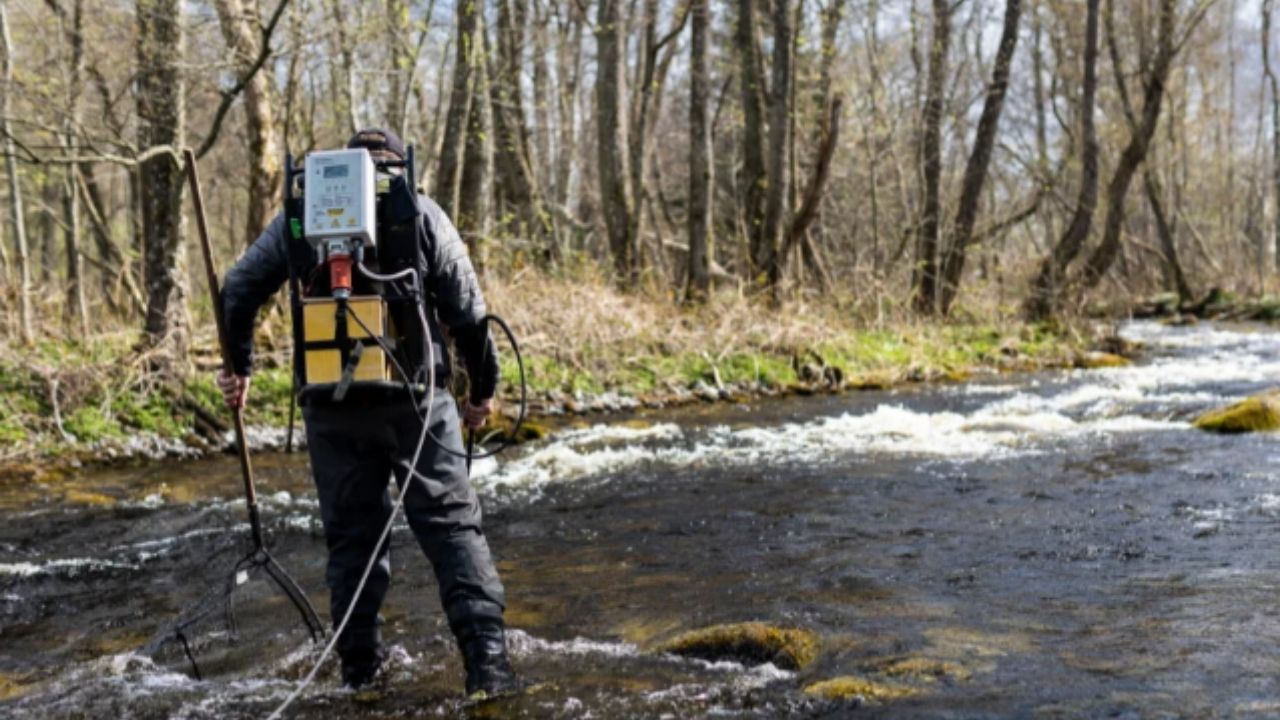
Improve Aquatic LIFE is presented as the largest aquatic restoration project in Europe. The initiative will last seven years and includes more than 500 actions in rivers, wetlands, and coastal areas, operating in nine counties in southern Sweden.
The total investment reported is nearly 400 million Swedish crowns. The project is funded by the European Union, the Swedish Agency for Marine and Water Management, the Swedish Environmental Protection Agency, and other partners. The financial and territorial scale shows that this is not an isolated action, but a structured environmental policy.
The planned activities include the removal of migration barriers, planting of eelgrass meadows, river restoration, and wetland recovery. Although each measure has its own characteristics, they all follow the same logic: to restore natural functions that have been degraded by past interventions, intensive land use, or accumulated environmental changes.
The project will also have support from advanced university research. The source cites studies on movement patterns and habitats as a basis for understanding the best way to restore a river. This indicates that the actions do not rely solely on machinery and construction, but also on monitoring, applied science, and evaluation of results.
Nine counties participate in the restoration
The list of partners shows the breadth of the program. Administrative boards of the counties of Värmland, Västra Götaland, Halland, Skåne, Blekinge, Kronoberg, Jönköping, Kalmar, and Östergötland are involved, along with national environmental agencies, universities, municipalities, and associations.
Among the institutions mentioned are Karlstad University, the University of Gothenburg, and Lund University, as well as the municipalities of Helsingborg and Tingsryd. This composition reinforces the integrated nature of the project, which combines public management, academic research, local execution, and European funding.
The restoration of the Pjältån river, therefore, is just one of the fronts. The removal of the concrete gallery in Östergötland appears as the first concrete delivery of a network of actions that will spread across different water landscapes over the coming years.
This type of coordination is important because rivers and wetlands do not respect simple administrative boundaries. An intervention in one section can influence water quality, flow, sediments, and connectivity in nearby areas. Therefore, broad projects tend to require coordination between various regions.
Environmental engineering swaps containment for recovery
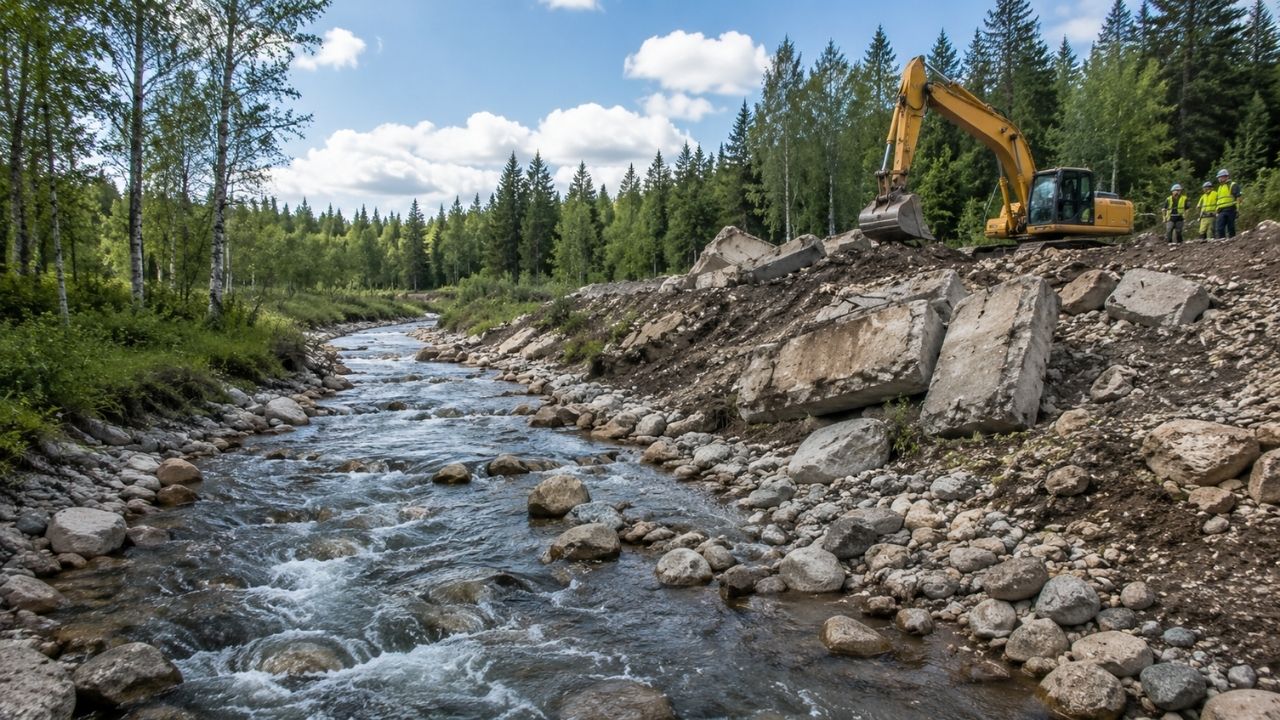
The removal of a 200-ton structure shows that environmental restoration can also involve heavy construction work. It’s not just about planting vegetation or monitoring water; in some cases, it’s necessary to remove entire pieces of infrastructure that have started to block natural processes.
In the Swedish case, the concrete gallery was replaced by the restoration of the original riverbed. This change returns the river to a form closer to its previous dynamics, allowing the water to follow a less artificial course. The intervention combines demolition, hydraulic planning, and ecological recovery.
The logic is similar to that of other modern restoration projects: identifying structures that harm natural functioning and assessing whether their removal brings more benefits than their maintenance. When this happens, concrete ceases to be seen as a permanent solution and becomes a removable obstacle.
This approach also aligns with climate adaptation. Restored aquatic environments can help make landscapes more resilient, improve water retention, recover wetlands, and reduce pressures on degraded systems. The Swedish project specifically declares the goal of improving aquatic environments and mitigating the effects of climate change.
Science monitors river recovery
One of the relevant points of Improve Aquatic LIFE is the use of scientific knowledge to guide actions. The source states that university research should provide data on how to restore rivers more efficiently, including movement patterns and habitat characteristics.
This monitoring is essential because the simple removal of a concrete gallery does not conclude the process. After removal, it is necessary to observe how the river responds, if the flow stabilizes, how the bed reorganizes, and what adjustments may be needed over time.
Aquatic restoration requires patience. Unlike conventional construction, where delivery is usually seen at the moment of physical completion, such projects depend on gradual responses from the environment. The real result appears when water, soil, banks, and vegetation begin to interact in a more balanced way.
Therefore, the new platform improveaquaticlife.se was created to monitor the program’s activities. According to the publication, the site will gather project areas, news, videos, podcasts, and updates on the progress of restoration fronts.
First action became the showcase of the program
The choice of the Pjältån river as the first completed action has narrative strength. The removal of the concrete gallery is easy to understand even for those not familiar with environmental engineering: a heavy structure was removed, and the water returned to its original path.
The project states that the measure benefits the river’s environment and mentions that trout and lampreys share this habitat. Nevertheless, the main focus of the intervention is on restoring the flow, reconstructing the natural bed, and creating more suitable conditions for the functioning of the aquatic system.
The project manager of Improve Aquatic LIFE, Karin Olsson, stated in the publication that large-scale initiatives can make a real difference for threatened environments and their habitats. The statement reinforces the idea that the program seeks broad, sustainable, and long-term results.
The removal of the concrete structure also serves as a public message. It shows that recovering rivers does not only depend on building new structures, but often on undoing old interventions that no longer meet current environmental needs.
When removing concrete becomes a work for the future
The removal of the concrete gallery in the Pjältån river summarizes an important shift in how we view rivers and aquatic landscapes. Instead of treating the watercourse as a problem to be fitted into rigid structures, the project attempts to return space for the natural system to function again.
With more than 500 actions planned over seven years, Improve Aquatic LIFE transforms a single work into part of a continental restoration strategy. Rivers, wetlands, and coastal areas become the focus of an agenda that combines infrastructure, science, public funding, and environmental adaptation.
The Swedish case also prompts a useful reflection for other countries. If a 200-ton structure can be removed to recover a river’s natural bed, how many old works could still be re-evaluated in the name of water security, environmental quality, and climate resilience?
Do you think that removing old concrete structures can be a smart solution to recover rivers, or does this type of intervention still seem too risky? Leave your opinion in the comments.