Portuguese
  Spanish


In Saudades, in the west of Santa Catarina, Fernando Hentz brought from Scotland the idea of a circular stone house, and his father, José, built stone by stone a construction with 97 cm thick walls that became the Steinhaus, now an agritourism hub run by father and son.
There are dreams that fit in the palm of your hand and dreams that weigh tons. The Hentz family’s dream is of the latter type. In the countryside of Saudades, in the west of Santa Catarina, a father and son are building, stone by stone, a round house with walls up to 97 centimeters thick. The idea was born on the other side of the world, in the stone constructions the son admired during trips to Scotland, and ended up on a small rural property in Santa Catarina, becoming a circular stone house that already attracts visitors.
The story was told by ND Mais in December 2025 and is one of those that mixes affection and bricks, or rather, affection and stone. The construction, named Steinhaus, which means stone house in German, began in April 2024 and uses only the stone found on the property itself. More than a rustic dwelling, it became the heart of an agritourism project that father and son built together, turning a passion into income in the countryside.
An idea brought from Scotland
Fernando Hentz, an animal scientist and project creator, traveled to Scotland and other European countries, where he fell in love with the ancient stone constructions.
-
Sweden Removes 200-Ton Concrete Gallery to Restore Pjältån River’s Natural Flow in Europe’s Largest Aquatic Restoration Project

-
Key Infrastructure Projects for Brazil’s Next President: Expanding Railways to Cut Transport Costs, Reduce Truck Traffic, Create Jobs, and Boost Industries Nationwide

-
While China Builds Undersea Rail and Mexico Connects Two Oceans, Brazil Struggles with Grain Transport Due to Lack of Railways
-
Students Build Kansas’ First Hemp-Insulated Social House for a Needy Family: 85% Less Concrete, Solar Roof Returns Energy to Grid, Carbon Negative in Under 20 Years


“I thought they were beautiful,” he summarized, recalling the houses he saw there.
But the admiration didn’t stop there.
By taking courses on ecological houses, Fernando realized that the material of those European buildings was right under his feet, on his own farm.
“When I took courses on ecological houses, I realized we had an abundant resource here: stone,” he said.
It was the perfect combination of desire and availability.
Foreign inspiration met local raw materials, and the idea of building a circular stone house in the interior of Santa Catarina went from fantasy to project.
Scotland planted the seed, and Santa Catarina provided the ground.
Father and son, stone by stone
If the idea was the son’s, the hands-on work is the father’s.
José Hentz, a farmer who had never worked in construction before taking on this endeavor, is building the Steinhaus.
“I was never a mason,” he admitted, with the sincerity of someone who learned by doing.
The method is artisanal and patient, with no rush.
“We think a lot, move stones around, check the plumb,” José described, summarizing the care each stone requires until it fits in the right place.
It’s an ant’s work, where father and son progress slowly, stone by stone, since April 2024.
This joint effort is what gives soul to the work.
It’s not a construction company erecting a development, but a family raising, with their own hands, something that will last generations.
The circular stone house is, above all, a father and son project.
A 97 cm wall and the circular shape
The construction numbers impress with their robustness.
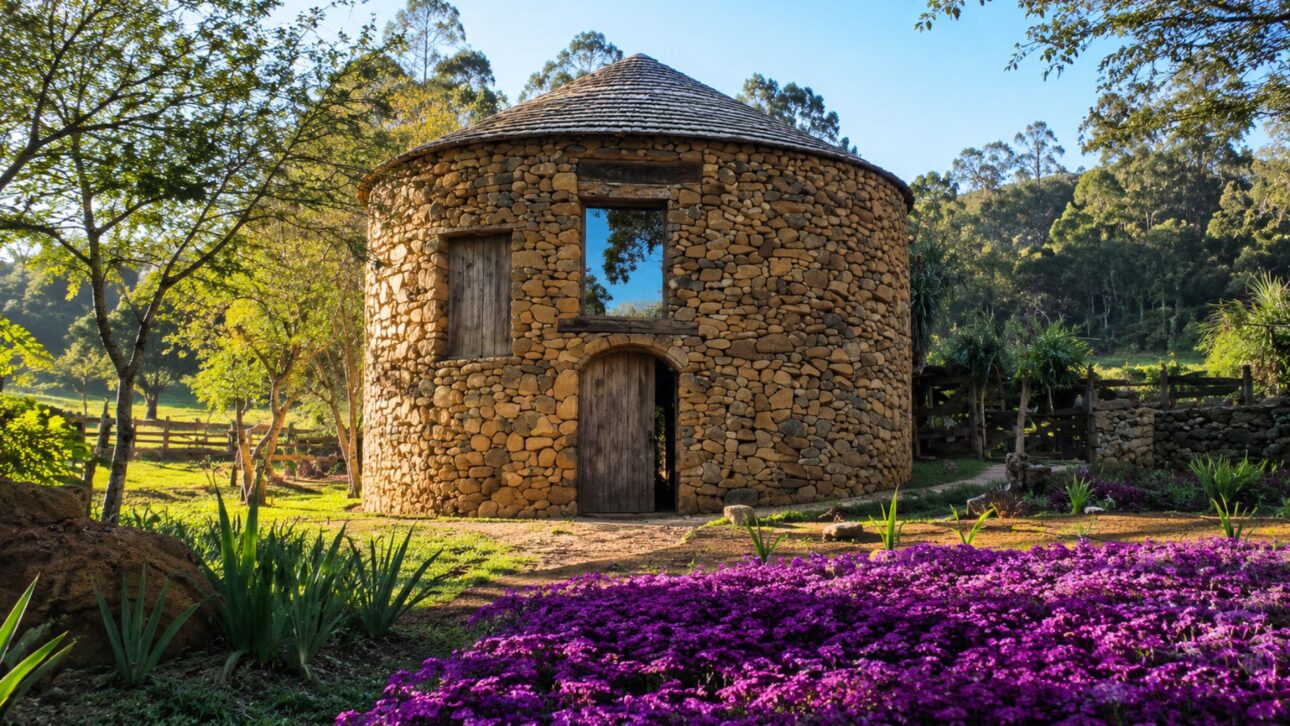
The walls of the Steinhaus reach 97 centimeters in thickness, almost a meter of solid stone separating the inside from the outside.
The chosen shape was circular, less common and more challenging to erect than a traditional rectangular house.
This combination is not just aesthetic.
Such thick walls ensure natural thermal insulation, keeping the interior cool in the heat and warm in the cold, without relying on air conditioning or heaters.
The raw stone also dispenses with plaster and paint, reducing maintenance over the years.
The result is a construction that seems born from the landscape itself.
The circular stone house, with its nearly one-meter wall and shingle roof, has the appearance of something ancient and solid, exactly the rustic charm the Hentz family sought.
It’s rustic engineering made by hand, without a manual.
From rustic dream to agritourism
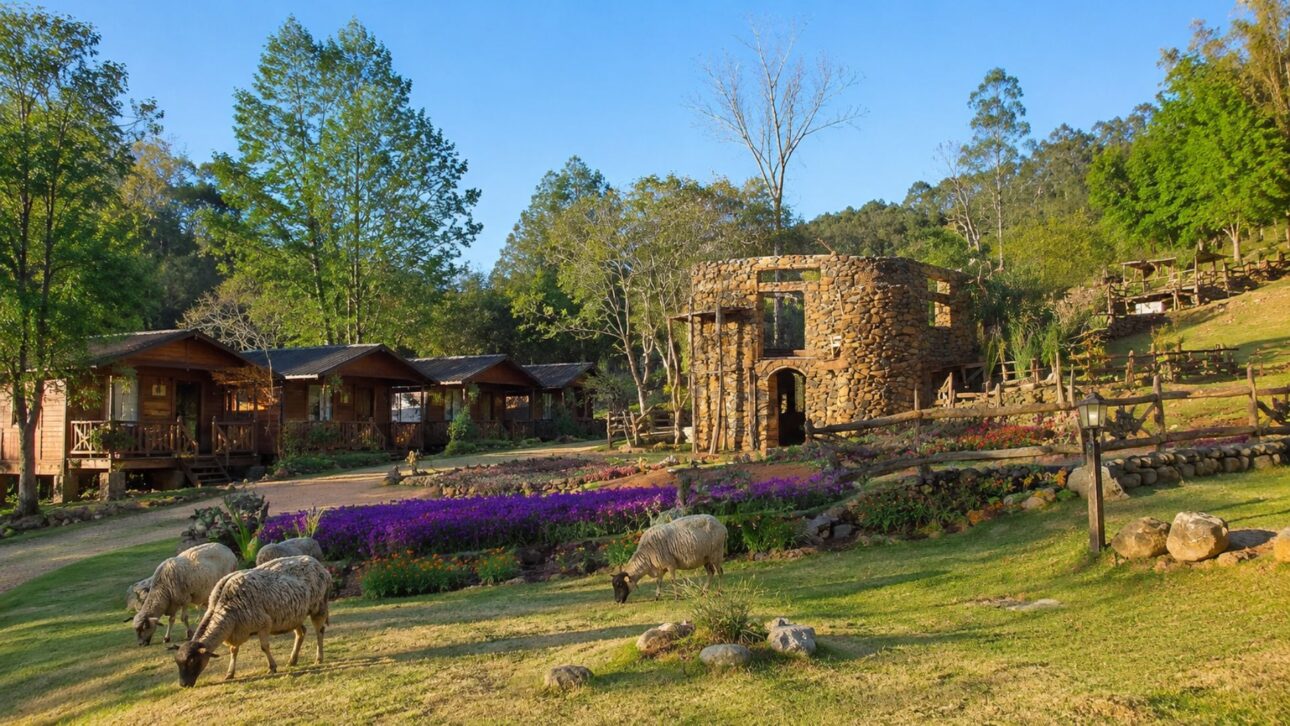
What was a personal project turned into the center of an agritourism hub, attracting people who want to escape the city and enjoy the countryside.
The property already has two completed chalets and two more under construction, designed to accommodate visitors.
The tourist profile is well defined.
“I’ve always liked chalets. We want each chalet to offer comfort for stays of days or weeks,” explained Fernando, targeting couples and families seeking tranquility.
The Steinhaus itself is intended for couples seeking privacy and contact with nature.
The family’s agritourism goes beyond accommodation.
Sheep farming is part of the itinerary, and the property hosts technical visits, school excursions, and study groups, combining education and tourism in the same space.
Fernando summarizes the proposal: “Here the vibe is different: those who come want silence, greenery, flowers, landscaping.”
Stone from the property itself: cheap and ecological
One of the project’s advantages is the origin of the material.
All the stone used in the Steinhaus comes from the family’s own land, which eliminates the cost of purchasing and transporting construction material from elsewhere.
This choice aligns with Fernando’s passion for ecological houses, which utilize available resources on-site instead of importing them.
The logic is simple and powerful.
When the raw material is already on the ground of your property, building becomes a matter of work and time, not large expenses.
The circular stone house proves that it’s possible to erect something impressive without relying on an expensive materials industry.
There is also the environmental gain.
Using local stone reduces the impact of transportation and dispenses with concrete and industrialized finishes, bringing the construction closer to the surrounding nature.
It’s cheap, durable, and ecological at the same time.
Why stone houses enchant so many people
Stone constructions exert a fascination that spans centuries.
They evoke castles, ancient villages, and a solidity that common brick does not convey, giving a sense of permanence and history.
That’s why stories of people who build a stone house by hand tend to go viral and move people.
The Steinhaus stands out in two ways.
First, it’s the work of father and son, a partnership between generations that adds an extra emotional weight to the cold stone.
Second, it didn’t just remain as a home or personal trophy, it became an agritourism hub that generates income and boosts the interior of Santa Catarina.
This combination is what makes the case special.
It’s not just a beautiful circular stone house, it’s a project that brings together tradition, sustainability, family ties, and rural entrepreneurship into one.
The stone here is both medium and message.
What the Steinhaus Case Teaches
The most beautiful lesson is about turning passion into purpose.
The Hentz family took travel inspiration, a resource they had in abundance, and the desire to work together, and turned it all into a unique agritourism project.
It’s proof that you can create something unique and profitable from what seems simple, like stones on a plot of land.
Of course, it’s important to keep your feet on the ground.
Building a circular stone house stone by stone is slow, laborious, and doesn’t happen overnight, and living off agritourism depends on location, promotion, and a constant flow of visitors.
It’s not a magic income formula, it’s the result of years of dedication from a family that loves what they do.
Even so, the example inspires.
The Steinhaus shows that tradition and innovation can fit in the same 97-centimeter wall, and that the interior of Brazil is full of people capable of turning a good idea into a tourist destination.
From the charm of Scotland to the tranquility of Santa Catarina, father and son prove that big dreams are also built slowly.
And you, would you leave the hustle and bustle of the city to spend a few days in a circular stone house in the middle of greenery, surrounded by sheep and silence? Tell us in the comments if you would be up for visiting the Steinhaus or even building a project like this on your own land.