






 Portuguese
  Spanish




A Silent System That Works While Closed Farms Enter Crisis
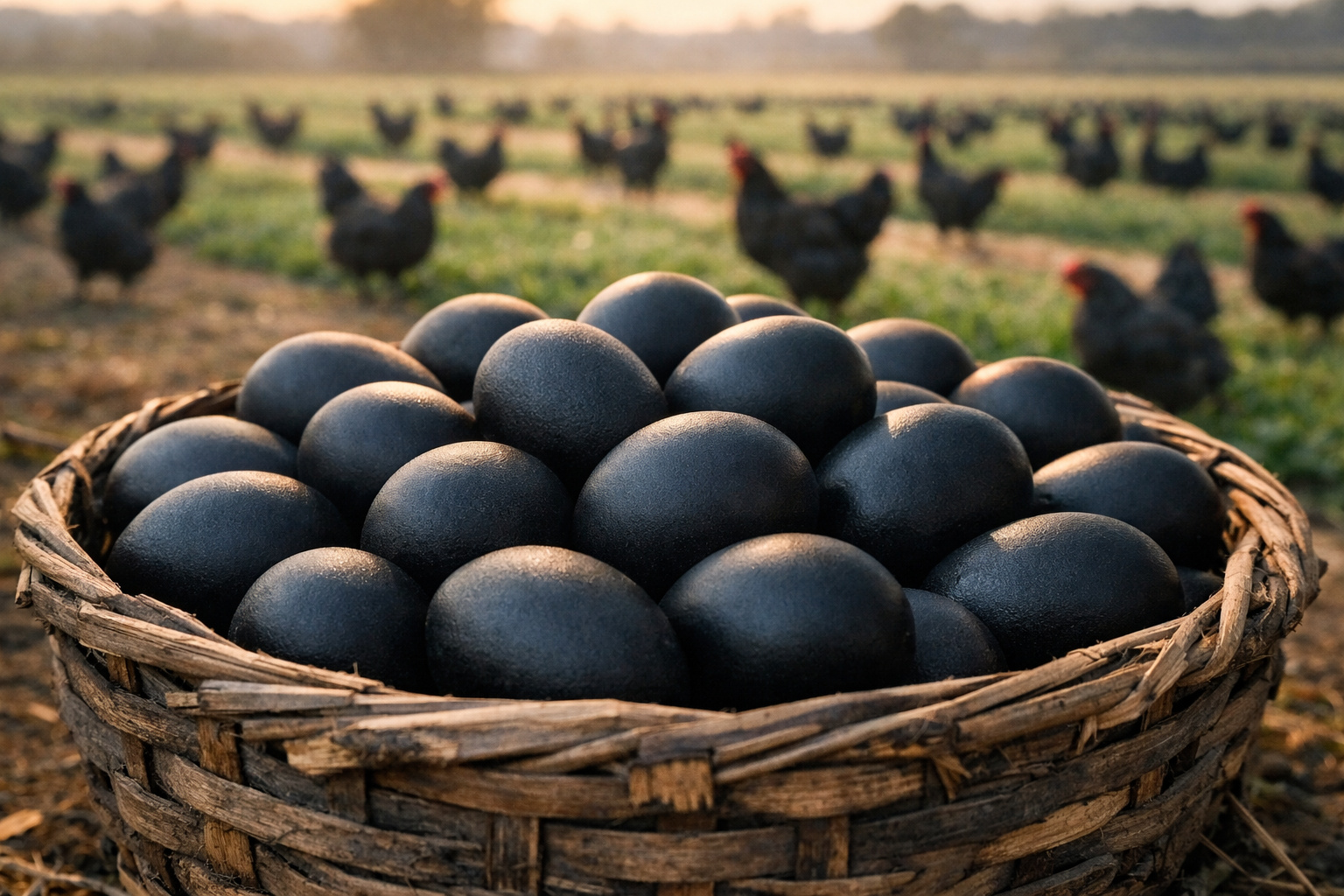
Did you know that some of the most resilient chickens in the world are completely black? Not just the feathers, but also the skin, bones, and even internal organs are dark in color. Still, these birds lay eggs daily, outdoors, in productive systems where human interference is minimal and nature does most of the work.
In just a few minutes, it’s possible to understand how farmers manage to raise millions of free-range black chickens, facing heavy rain, extreme heat, climatic variations, and natural predators, while still maintaining an absurd egg production throughout the year. More than that, this model is rapidly growing as closed farms are being abandoned in several countries.
Still in the early morning, when the ground is cold and the mist covers the fields, the black chickens are already awake. Unlike traditional confinement, they do not live trapped, do not hear engines, and do not smell the strong odor of industrial feed piled up in closed barns. The environment is open, silent, and predictable.
-
At 35, Lawyer Leaves Corporate Career to Turn 1-Hectare Farm into Organic Supplier for Schools in Southern Brazil

-
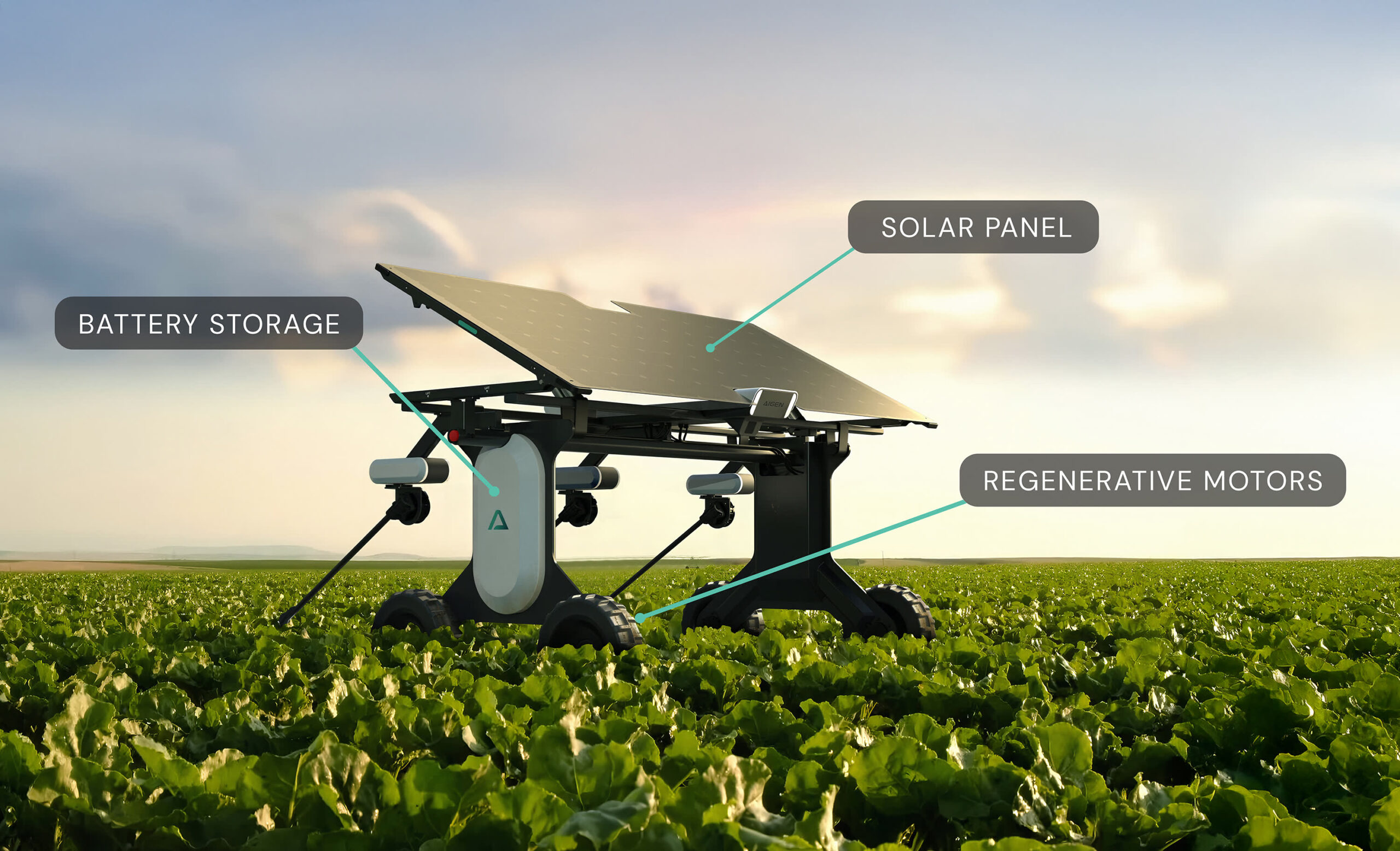
Solar-powered agricultural robots operate 24/7, remove weeds with 8mm precision, and aim to cut herbicide use without fuel consumption in the fields.

-
Brazilian Farmer Invents Low-Cost Tractor Using Motorcycle Parts, Efficiently Working 2 Acres on 1 Liter of Diesel

-
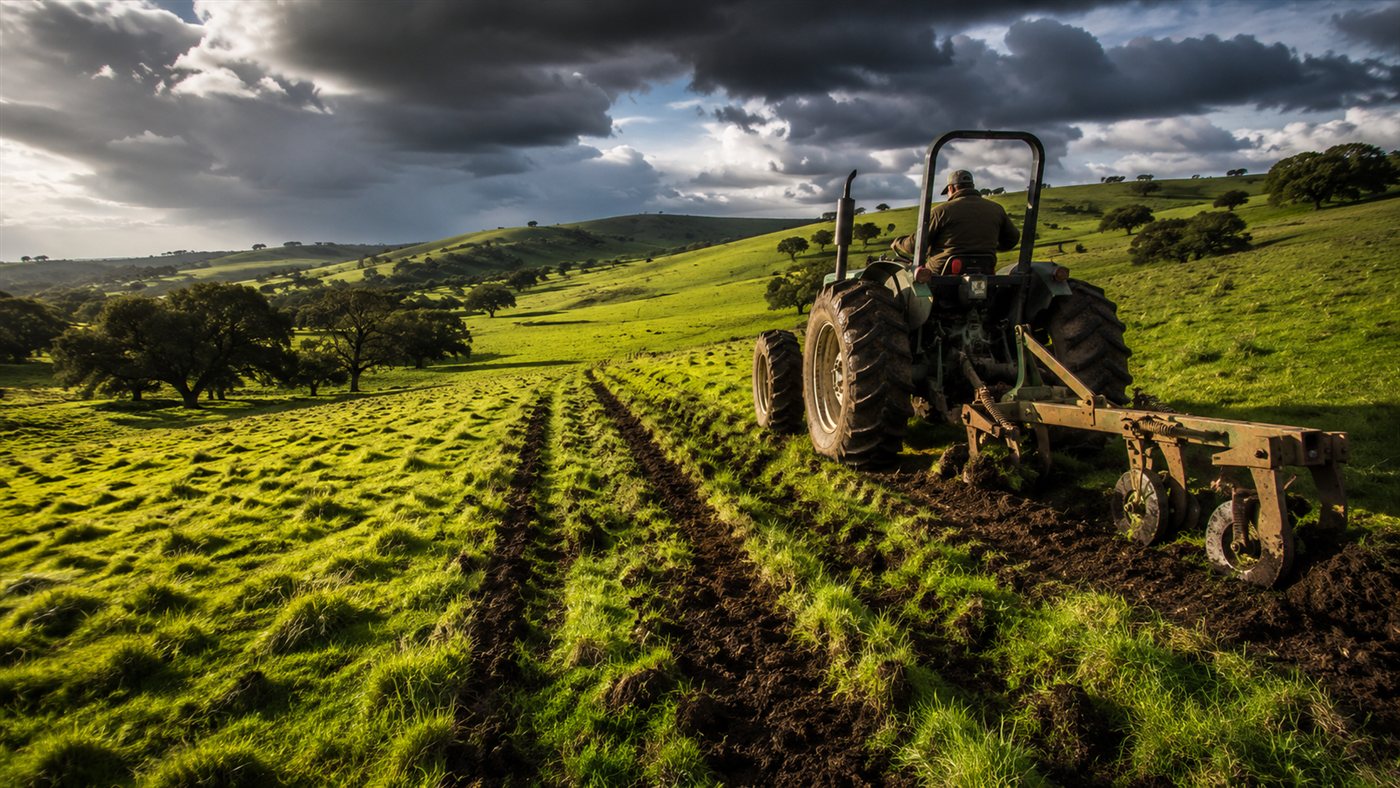
Regenerative Farmers Use Keyline Plow to Improve Pasture Hydration, Storing 1 Gallon of Water Every 30 Centimeters



The information was released by specialized reports on sustainable livestock production and extensive farming systems, as well as field analyses conducted by channels and portals focused on modern poultry farming, which monitor the gradual migration of this model in different regions of the world.
The Secret Starts with the Natural Behavior of Black Chickens

At dawn, the black chickens go out alone in flocks. They walk through the pasture, scratch the earth with their feet, and search for insects, seeds, and small grains forgotten on the ground. This seemingly simple behavior is the first big secret of the system.
Raised outdoors, these chickens expend energy daily, develop muscle, strengthen their immune system, and get sick much less often. As a direct consequence, egg production becomes more stable, predictable, and enduring throughout the production cycles.
Contrary to what many might think, farmers do not start with millions of birds. Everything begins on a small scale, with lines specifically selected for physical resistance and consistency in laying. The chosen black chickens can withstand strong sun, cold nights, and walk kilometers a day without showing signs of stress.
Meanwhile, the scenery is repeated in different regions: open hectares, simple fences, strategically placed trees for shade, and thousands of water points distributed intelligently. Nothing there is improvised. Every detail is designed to reduce human intervention and maximize biological efficiency.
The second big secret lies in space. Unlike closed farms, where a chicken can barely move, in this system each bird has meters of space to roam freely. This reduces fights, decreases mortality, and keeps production stable. Although it may seem contradictory, giving more space results in more eggs in the long run.
Less Human Control, More Productive and Financial Efficiency
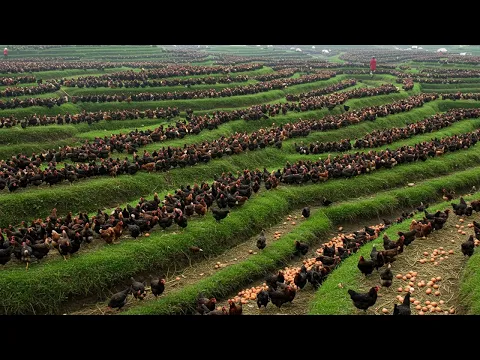

This is one of the loops that binds the farmer to the extensive system. The more natural the environment, the less human intervention is needed. During the day, the black chickens follow an almost wild routine, feeding themselves for much of the time. Still, they receive balanced supplements at specific times, which avoids waste and helps control laying.
As the sun begins to set, something curious happens. Without commands, without artificial stimuli, the chickens slowly start to return to their shelters. It is at this moment that the farmer observes everything from a distance, noting behavior patterns, without touching, forcing, or interfering.
The eggs do not appear on noisy conveyor belts nor fall onto iron grates. They are found in nests scattered throughout the field, made of straw, wood, and dry earth. Each chicken chooses where to lay. This detail drastically reduces stress and, as a result, generates more resilient shells, firmer yolks, and more consistent production.
Another little-known curiosity reinforces the model. Free-range black chickens tend to lay eggs with tougher shells than common breeds raised in confinement. This reduces losses during transport, washing, and sorting, increasing the economic efficiency of the system.
The collection of millions of eggs also follows a silent logic. There are no giant machines crossing the field. Workers follow fixed routes, almost like trails, always at the same times. The chickens recognize the pattern and do not panic, which maintains the balance of the environment.
In addition, soil management is rigorous. There is rotation of areas, resting of the land, and natural regeneration. When an area begins to deplete, the birds are directed to another space. The previous soil recovers by itself, fertilized by the chickens themselves.
The farmer does not fight against nature. He uses nature to his advantage.
Why This Model Grows While Closed Farms Disappear
Here lies the point that explains the accelerated expansion of the system. Veterinary costs plummet. Chickens that roam, scratch, and are exposed to the environment develop natural immunity. Common diseases in closed barns simply do not spread outdoors.
As a result, there are fewer medications, fewer losses, and more eggs at the end of the month. It is a silent cycle that works without drawing attention. Meanwhile, the eggs go to simple sorting centers, where they are washed, separated by size, and packaged without aggressive processes, preserving quality and increasing shelf life.
The consumer notices the difference. Eggs from free-range black chickens tend to have darker yolks, more intense flavor, and higher market value. This perception strengthens consumer loyalty and supports higher prices.
But how does this scale to millions of eggs? The answer lies in the repetition of the model. It is not about a single gigantic farm, but rather dozens or hundreds of connected areas, all following the same pattern. Each nucleus operates independently but feeds the same distribution chain.
If one nucleus fails, the others continue operating. This is the loop that keeps production stable even in difficult periods. At the end of the day, when the sun disappears and the field darkens, the black chickens settle onto their perches in silence. There are no intense artificial lights, no constant noise.
The farmer closes the gates, checks the water points, and leaves. The next day, everything starts again exactly the same. It is this simple repetition that sustains billions of eggs throughout the year.
And the final detail explains everything. This system does not grow only because it is more ethical or visually appealing. It grows because it works financially. Less spending, fewer losses, valued products, and loyal consumers. While closed systems struggle against diseases, high costs, and public rejection, the free-range black chickens keep laying, walking, and sustaining a model that seems old but is more modern than ever.






Fox heaven
We have these free ranging in Madagascar, verynimble at traversing traffic and very difficult to catch compared to our free rangers in Australia. But they get diseases and are prone to predators and ,of course, theft.
This was painted so nice billions of eggs a year all natural free range chickens just everywhere. I hope people aren’t really naive enough to believe to this crap. If you do then you’ve been raised with no common sense.
I just wish you had an idea about clusters. i.e. A system where a sizeable number of different farmers produce the same product under the same guidelines to feed into a single marketing channel. A good example is “Nortura” in Norway.
It sounds really great–BUT I HAVE GEESE ONLY A SMALL NUMBER, 30 OR SO, BUT INCREASING EVERY YEAR, AND THEY ARE A BEAUTIFUL GOLDEN YELLOW COLOR!!, AND THEY LAY GOLDEN EGGS, MADE OF GOLD, IMPOSSIBLE TO PICK UP BY HAND SO HAD TO ADAPT MY TRACTOR WITH A SPECIAL STICK RAKE SO IT CAN LIFT THE EGGS, BUT AFTER 100 THE WEIGHT CREATES ISSUES FOR THE TRACTOR
LoL!