






 Portuguese
  Spanish


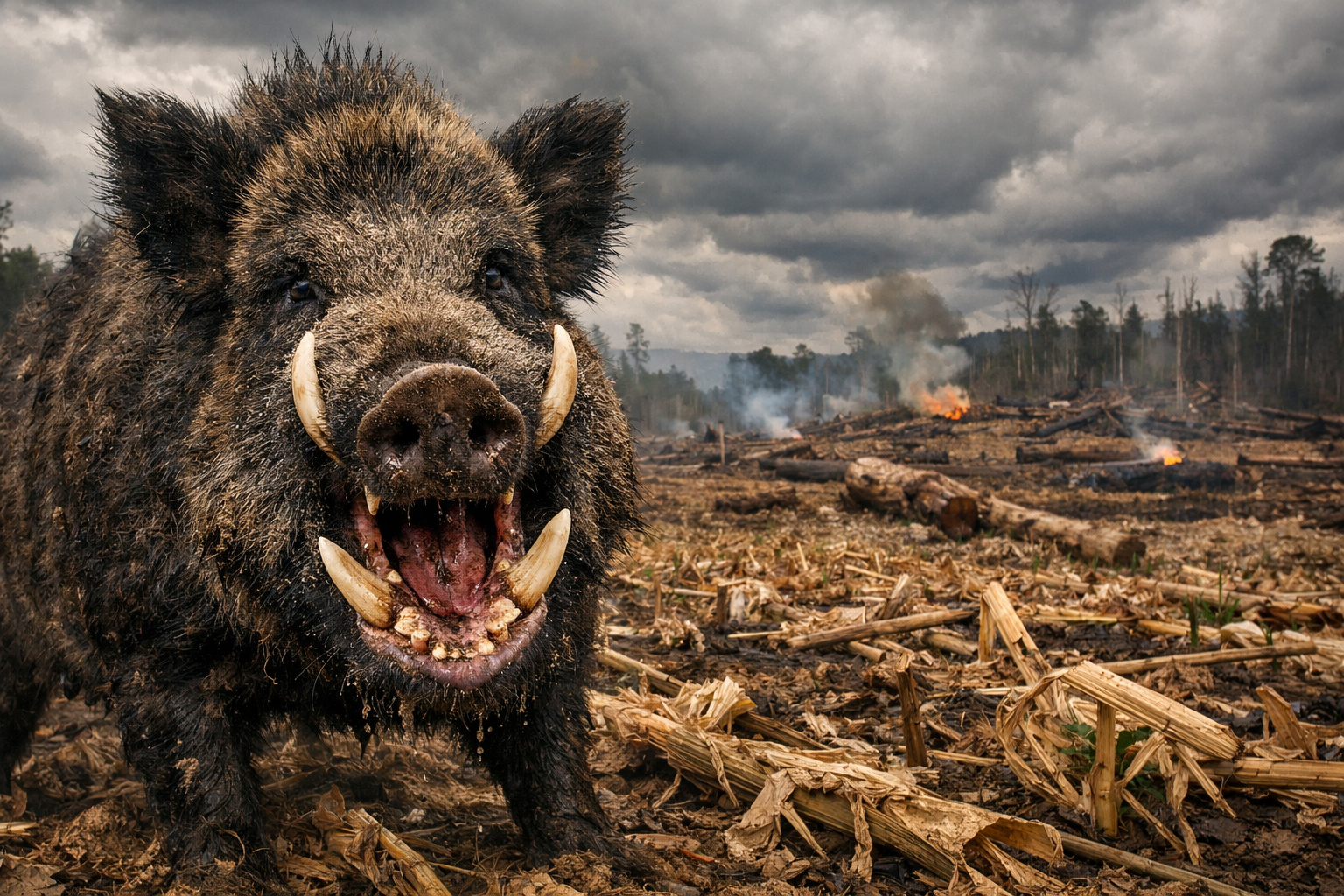


Introduced Artificially into the Country, the Animal Spread Without Natural Predators, Causing Growing Environmental and Economic Damages and Forcing the Government to Adopt Increasingly Controversial Control Measures
The European Wild Boar (Sus scrofa) has ceased to be merely a nuisance for farmers and is now treated as an environmental, sanitary, and public safety risk in Brazil. Introduced artificially into the country, the animal spread without natural predators, found an abundance of food, and now occupies agricultural areas, forests, and even regions near urban centers, creating a challenge that experts consider one of the most complex issues in current Brazilian environmental policy.
The rapid expansion of the species led the government to authorize control measures deemed extreme, including controlled culling, which sparked a sensitive debate among environmental conservation, animal ethics, and public safety.
An Invasive Species Created by Humans

The boar is not native to the Brazilian fauna. It was introduced into the country mainly in the final decades of the 20th century, initially for commercial farming and sport hunting. Some of these animals escaped or were released irregularly, interbred with domestic pigs, and gave rise to the so-called javaporco, even more resistant and adaptable.
-
Small Farm in Brazil’s Minas Gerais Produces 403 Liters of Milk Daily, Sets Benchmark for Rural Producers

-
Man Revives 1930s Abandoned Trout Farm, Learns from Scratch, and Earns $1.1 Million Annually Selling Fish to Michelin-Starred Restaurants

-
Bangladeshi Farmers Use Bamboo Levers to Pump Thousands of Liters of Water Daily Without Engines or Electricity
-
Brazilian Forests Could Expand by an Area Twice the Size of Switzerland by 2035, but Agricultural Sector Holds the Key, Study Finds




Without natural predators capable of controlling its population, the boar found an ideal environment in Brazil to multiply. A female can produce two litters per year, with up to 12 piglets, making the population growth explosive and practically impossible to contain using only conventional methods.
Environmental Impacts That Go Beyond Agriculture
Although agricultural damages are the most visible — destruction of corn, soybean, sugarcane, and pasture plantations — environmental impacts are considered even more severe. The boar uproots the soil in search of food, destroys native vegetation, compacts the ground, and compromises the regeneration of forests and riparian areas.
Moreover, the animal competes directly with native species for food and shelter, consumes bird eggs and small vertebrates, and alters entire ecological chains. In protected areas, its presence is already associated with reduced local biodiversity and the degradation of sensitive ecosystems.
Sanitary Risk and Threat to Public Health
Another factor that elevates the boar to a national problem is the sanitary risk. The species is a potential vector for diseases such as brucellosis, leptospirosis, tuberculosis, and classical swine fever, ailments that can affect both domestic animals and humans.
Health authorities warn that an outbreak of diseases associated with the boar could jeopardize entire productive chains, especially Brazilian pig farming, one of the most relevant sectors of the national agribusiness.
Authorized Control, but Surrounded by Controversies
In light of the severity of the situation, Ibama authorized the population control of the boar through culling, provided that it is carried out by registered individuals, with specific rules and environmental oversight. The measure is presented as a management action, not as sport hunting.
Even so, the topic divides opinions. Environmentalists acknowledge that the boar is a highly destructive invasive species but warn about the risks of indiscriminate use of firearms, failures in oversight, and possible collateral impacts on other species.
Farmers, on the other hand, assert that without lethal control, damages become unsustainable, jeopardizing properties, income, and even the safety of families in rural areas.
A Problem Without a Simple Solution
Experts agree that there is no quick or painless solution to the problem of the boar in Brazil. Methods such as capture, sterilization, or physical barriers are considered unviable on a large scale, while total eradication is seen as practically impossible in the short term.
Technical consensus indicates that the boar has become a structural problem, created by human action itself, and that any control strategy will require national coordination, rigorous oversight, and unpopular decisions.
Does saving native fauna and Brazilian ecosystems justify extreme measures against an invasive species created by human action?





Ta aí a picanha (Suina) prometida pelo presidente…. só deixar os sem terra, e populacde baixa renda caçar eles e fazer churrasco…
Tudo isso só acontece por causa de políticos inúteis .
É bem simples, se é uma espécie invasora e que causa riscos a humanidade ,permita a caça dos animais e ababem logo com o problema.