Portuguese
  Spanish


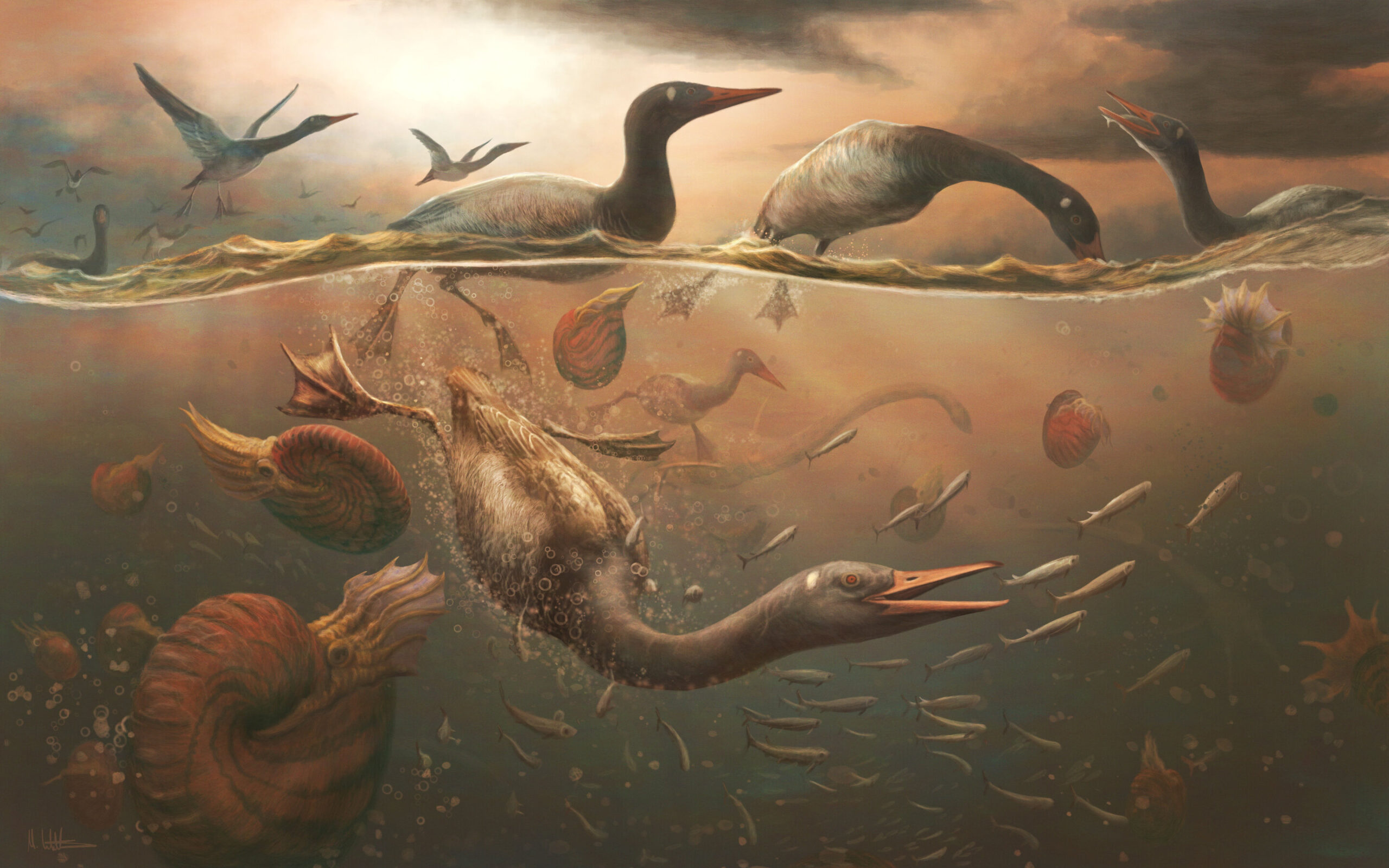

Researchers Found A Fossil That May Be One Of The Ancestors Of Modern Birds. The Discovery Raises New Questions About The Evolution Of Birds. Learn More!
66 million years ago, an asteroid collided with Earth, extinguishing 75% of the species, including the dinosaurs. Despite this, some survivors evolved, such as birds, which may have developed before the impact, according to recent studies.
Researchers have debated for decades whether modern birds emerged before or after the cataclysmic event.
Now, a new study published in the journal Nature presents a discovery that may end this discussion: a 69 million-year-old fossil belonging to the extinct bird Vegavis iaai.
-
18 Iron Age gold coins discovered by a teacher using a metal detector in a Suffolk field sell for £33,200 at auction, exceeding estimates.

-
Chinese Farmer with No Formal Education Builds Over 60 Homemade Robots from Scrap Metal, Each Bearing His Surname
-
Telescope Set to Discover 100,000 New Planets Arrives at Launch Site, Ushering in a New Era of Astronomy

-
Humanoid Robots Transition from Demonstrations to Real Work in Factories


This fossil, considered the oldest known modern bird, provides evidence that modern birds were already evolving during the reign of the dinosaurs.
Identification And Importance Of The Fossil
The analysis of the fossil was conducted by a team of paleontologists led by Christopher Torres from the University of the Pacific, co-authored by Julia Clarke from the University of Texas.
The importance of the discovery goes beyond merely defining a timeline. The new evidence reveals anatomical features that align Vegavis with modern birds, supporting the idea that birds were already evolving alongside dinosaurs and survived the catastrophic impact.
Characteristics Of The Vegavis And Its Similarities To Modern Birds
The first Vegavis fossil was identified 20 years ago by Clarke and her team, but the lack of a skull hindered precise analysis of the species.
In 2011, a new expedition to Antarctica revealed another fossil, this time nearly intact, including the skull.
The new evidence is clear: the Vegavis had a long, toothless beak, along with a brain with similar characteristics to modern birds. The beak and particularly the brain structure suggest that the Vegavis was closer to present-day birds than previously thought.
These findings are corroborated by analysis from experts such as Amy Balanoff, an evolutionary biologist from Johns Hopkins University, who noted that the neuroanatomy of Vegavis is strikingly similar to that of living birds.
“It Looks Very Much Like A Living Bird”, she stated. The size and shape of the animal’s beak, along with its neuroanatomy, are characteristics that point to the evolution of modern birds, especially aquatic ones.
The Hypothesis Of A Pursuit Diver
However, the classification of Vegavis is not without controversy. One of the main questions raised by scientists is its possible relationship to aquatic birds, such as ducks and geese.
According to Torres, the Vegavis may have been a “pursuit diver”, capable of propelling itself in water with its legs.
This ability would be similar to that of grebes, but not to ducks or geese, as suggested in previous studies. “It Closed Its Mouth Underwater While Searching For Fish”, Torres explained, pointing to a lifestyle different from that observed in modern ducks.
Although the discovery has generated excitement in the scientific community, as highlighted by Chase Brownstein, a biologist from Yale University, some remain unconvinced that Vegavis is a direct relative of aquatic birds.
In any case, the research reveals something important: Antarctica, where the fossil was found, may have been a crucial location for the preservation and evolution of birds during the Cretaceous, far from the devastating effects of the Chicxulub impact.
Antarctica: Refuge For Birds In The Age Of Dinosaurs
Antarctica, with its temperate climate and abundant vegetation 69 million years ago, may have been a safe refuge for many species, including birds.
This fact positions the region as significant for understanding the early stages of the evolution of modern birds.
Paleontologist Matthew Lamanna, co-author of the study, emphasizes that Antarctica has much to reveal about life on Earth during the Age of Dinosaurs. And with this discovery, it seems we are closer to understanding the secrets of prehistoric life.