






 Portuguese
  Spanish


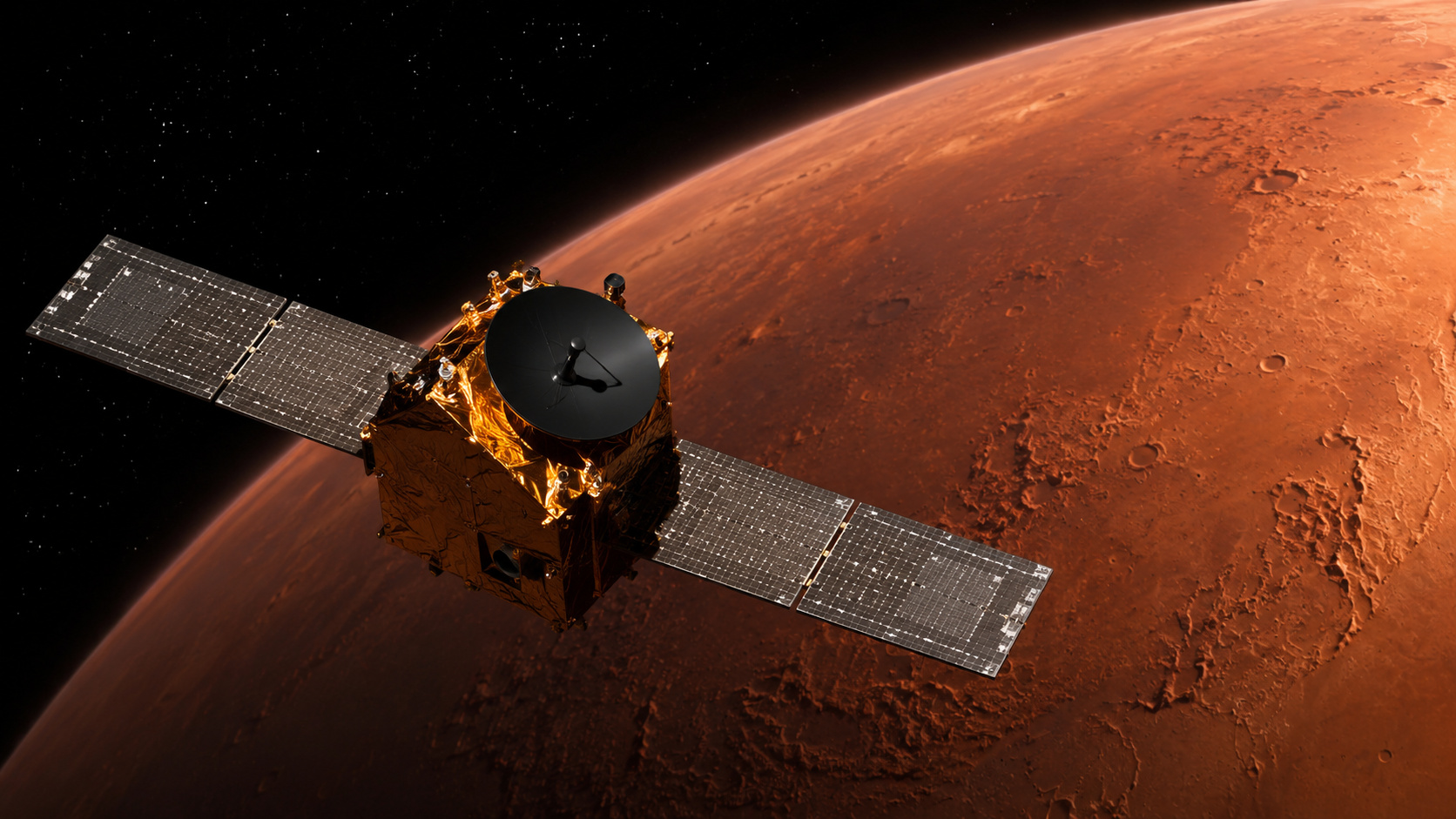

Hope Mission of the United Arab Emirates reached Mars in 2021, became the first Arab interplanetary probe, and produced an unprecedented global map of the Martian atmosphere.
According to NASA, the Hope Probe, called Al Amal in Arabic, was launched on July 20, 2020 aboard a Japanese H-IIA rocket from the Tanegashima Space Center. The probe represented the first interplanetary mission in the history of an Arab and Islamic country, created by the United Arab Emirates in just six years, from a space program that had officially begun in 2006. On February 9, 2021, after seven months of travel, the spacecraft executed a critical maneuver of 27 minutes to reduce its speed from 121,000 km/h to about 18,000 km/h, enough to be captured by Mars’ gravity.
According to Space.com, confirmation reached the mission control in Dubai with about a 15-minute delay, the time needed for the signal to travel the distance between the two planets.
Hope Mission marked the arrival of the United Arab Emirates to Mars in just 50 years of national history
The arrival of the Hope Probe was not planned just as a technical achievement. According to the University of Colorado Boulder, the mission was designed to coincide with the 50th anniversary of the founding of the United Arab Emirates, a country created in 1971 by the union of seven emirates.
-
Self-Driving Harvester Now Operating in Brazil’s Vast Farmlands

-
Astronomers Discover Two Giant Exoplanets as Light as Cotton Candy, Challenging Current Scientific Models 1,110 Light-Years from Earth
-
NASA’s Plan to Dump ISS Debris in Ocean Sparks Environmental Concerns Among Scientists
-
14-Year-Old Invents Eco-Friendly Water Pump Using Recycled Materials to Aid Communities Without Water Access


In half a century, the nation went from a newly formed state structure to placing a probe in orbit around Mars.


According to the same university, the Mohammed Bin Rashid Space Centre, the MBRSC, was founded in 2006. In a few years, the Emirates launched Earth observation satellites, developed the KhalifaSat with local engineers, and in 2014, officially announced the mission to Mars. The leap was so rapid that it compressed into a few years a path that other space powers took decades to traverse.
This speed helped transform the mission into something larger than a scientific project. It also became a demonstration of national capability, technological ambition, and accelerated building of human capital in science, technology, engineering, and mathematics.
Hope was built with American universities and a joint team between Dubai and the United States
According to Physics World, the mission was developed in partnership between the MBRSC and three American universities: the University of Colorado Boulder, the Arizona State University, and the University of California, Berkeley. The spacecraft itself, weighing about 1,500 kilograms, was physically assembled at the Laboratory for Atmospheric and Space Physics, the LASP, at the University of Colorado.
The construction was not a simple outsourcing. The project brought together Emirati and American engineers in an integrated team, which allowed the Emirates to accelerate the learning curve and absorb technical capacity during the process.
This model was central to making the mission viable within the extremely short timeframe the country had set for itself.
According to Fatma Lootah, a member of the scientific team at MBRSC, the years leading up to the arrival on Mars were completely dominated by preparation for that moment. The mission carried, at the same time, scientific expectation, political weight, and enormous symbolic value for the entire Arab region.
27-minute orbital insertion maneuver decided the success of the mission without real-time correction chance
The most dangerous stage of the Hope Probe was the orbital insertion at Mars. According to Space.com and the Lahore Astronomical Society, the distance between Earth and Mars at that moment was so great that any signal took about 11 minutes to arrive. This meant that if something went wrong during the maneuver, the team in Dubai would only find out after the problem had already occurred.
Therefore, the probe had to execute the entire sequence autonomously. For 27 minutes, its six thrusters worked to slow down the spacecraft and allow its gravitational capture by the red planet. There was no room for immediate human intervention. Everything depended on the software, sensors, and the reliability of the onboard engineering.
This type of operation helps explain why so many missions to Mars have failed throughout history. The margin for error is minimal, the distance prevents quick correction, and any failure in the sequence can mean the total loss of the spacecraft. When confirmation reached Dubai, the moment was treated as a historic milestone for Arab space exploration.
Hope’s Orbit Enabled the First Complete Global Map of Mars’ Atmosphere
According to LASP and the University of Colorado, the major difference of the mission was not just reaching Mars, but the way it was designed to observe it. The Hope Probe was placed in an elliptical orbit between 20,000 and 43,000 kilometers in altitude, completing a revolution around the planet every 55 hours.

This configuration gave the probe a capability that previous missions did not have in the same way. Instead of observing limited regions at similar times, Hope managed to see Mars on a global scale, monitoring how the atmosphere changed at different latitudes, times of day, and seasons. This allowed for the creation of the first complete global map of the Martian atmosphere.
This point is important because many previous missions from the United States, Russia, ESA, and India produced valuable data but did not have an orbit designed to capture this global atmospheric portrait with the same pattern of systematic coverage.
The Three Instruments of Hope Showed Dust, Water Vapor, Ozone, and Atmospheric Escape on Mars
According to LASP, Hope carried three scientific instruments. The first was the Emirates eXploration Imager, the EXI, responsible for observing water, ice, dust, aerosols, ozone and also generating high-resolution images of Mars in the visible and ultraviolet ranges.
The second was the Emirates Mars Infrared Spectrometer, the EMIRS, which monitored temperature, water vapor, and dust using thermal infrared. The third, the Emirates Mars Ultraviolet Spectrometer, the EMUS, analyzed ultraviolet emissions in the upper atmosphere, allowing the study of the Martian thermosphere and the halos of hydrogen and oxygen around the planet.
The combination of the three instruments gave the mission a rare capability. It could connect phenomena from the lower atmosphere with those of the upper atmosphere, offering an integrated view of how the Martian climate behaves and how the planet continues to lose gases to space.
Hope recorded the hydrogen and oxygen corona of Mars with unprecedented detail
According to eoPortal, one of the first significant scientific images sent by the mission on February 20, 2021, just 11 days after orbital insertion, showed the hydrogen and oxygen corona around Mars with a quality that scientists had not obtained in that way before.
The EMUS captured images in three ultraviolet wavelengths simultaneously, allowing observation of the behavior of these atoms in the upper atmosphere. This result helped confirm that Mars continues to lose atmosphere to space, a process that over billions of years contributed to transforming a planet that once had more water and a denser atmosphere into the cold and rarefied environment known today.
The mission also identified what scientists called a discrete aurora, in addition to mapping the distribution of dust, ice, and water vapor during a complete Martian year. These data were made available to the international scientific community, extending the mission’s reach far beyond the United Arab Emirates.
Sarah Al Amiri became a symbol of the mission and female leadership in Arab space science
According to Gulf News, one of the faces most associated with the success of Hope was Sarah Al Amiri, a satellite systems engineer who became the mission’s scientific leader and later president of the UAE Space Agency. When the probe reached Mars, she was 33 years old and came to be seen as one of the central figures of the Emirati space program.

Al Amiri’s visibility had special significance because the mission also served as a message about who can lead cutting-edge science and technology in the Arab world. The image of an Emirati engineer at the center of an interplanetary operation helped internationally project a narrative of technological modernization and investment in human capital.
This aspect was deliberate from the start. The mission was not presented just as a quest for data about Mars, but also as a tool to inspire young people, increase interest in STEM, and reposition the United Arab Emirates in the global scientific imagination.
Hope Mission showed that the Emirates wanted more than just to reach Mars
The Hope Probe did not attempt to exactly replicate the American or Russian model of a space program. According to the institutions involved, it was conceived as a focused, fast, scientifically clear mission strongly connected to the internal transformation of the United Arab Emirates.
By delivering the first complete global map of Mars’ atmosphere, the mission ensured real scientific relevance. At the same time, being launched by a country with a space center founded in 2006 and reaching Mars in 2021, it became proof that the Emirates wanted to accelerate their entry into the group of nations capable of operating at extreme technological frontiers.
In the end, the Hope was more than a Martian probe. It became a declaration of national capability, a scientific project with concrete results, and a symbol of how the United Arab Emirates decided to use space to redefine their image in the 21st century.


