Portuguese
  Spanish


Dormant black hole found by James Webb is over 10 billion light-years away and may help explain the evolution of galaxies.
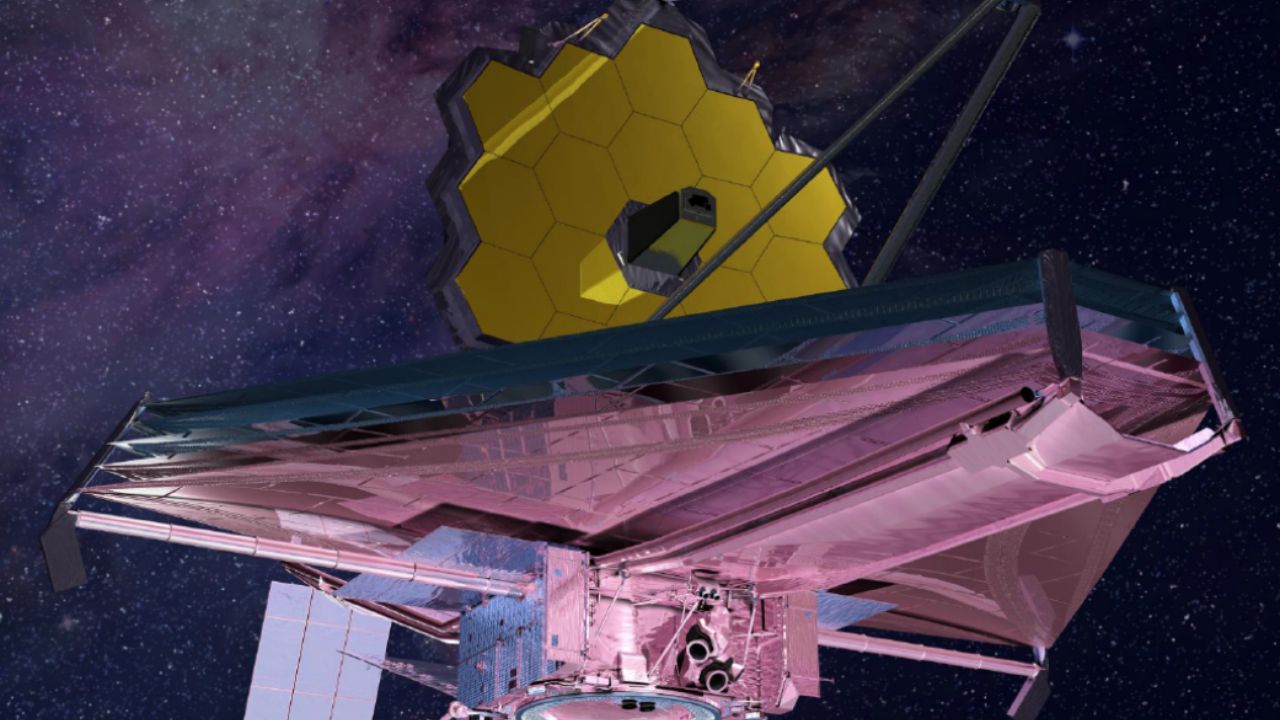
An international team of astronomers announced the identification of the most distant dormant black hole ever recorded. Located in the galaxy MRG-M0138, more than 10 billion light-years from Earth, the object was detected with the help of the James Webb space telescope. The results, published in the journal Science on Thursday (June 4, 2026), offer new clues about the formation and transformation of galaxies in the first billions of years of the Universe’s existence, currently estimated at 13.8 billion years.
The discovery is noteworthy not only because of the record distance. According to the researchers, the studied object is inactive, making its observation extremely difficult. Even so, advanced analysis techniques allowed them to estimate its mass and reconstruct part of the history of the region where it is located.
How was the black hole found?
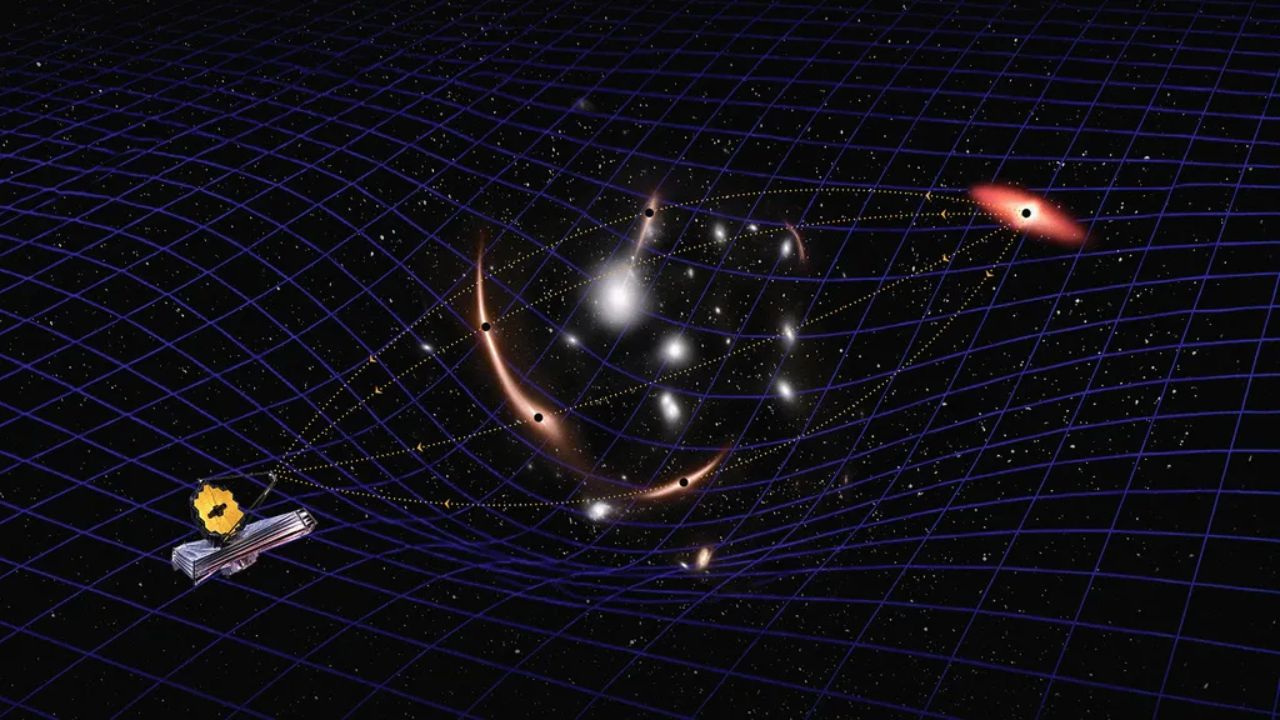
As reported by Olhar Digital, since the object did not emit visible signals, the researchers resorted to an indirect technique. Using the gravitational lensing effect — which magnified the image of the observed galaxy — the team was able to track the speed and trajectory of stars near the galactic center.
-
Project Daedalus: The 190-Meter Spacecraft Aiming to Reach Another Star with Nuclear Fusion and a 50-Year Fuel Supply

-
Giant 2.2 km Device Sweeps Plastic from Pacific Ocean, Cleaning an Area the Size of a Football Field Every 5 Seconds to Contain World’s Largest Ocean Garbage Patch
-
Brazil’s Public Health System Launches Study on Semaglutide’s Impact on Obesity
-
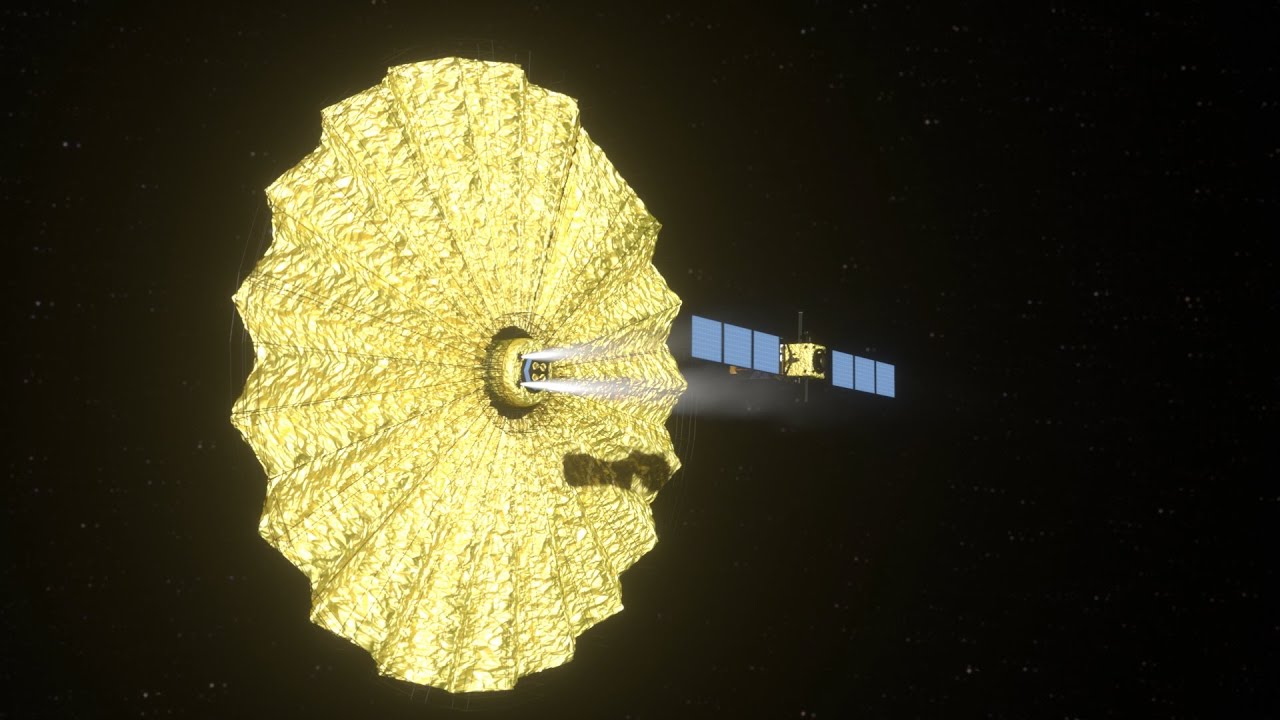
NASA’s Giant “Space Flower” to Unveil Earth-like Planets by Blocking Distant Stars’ Light




The analysis of these movements revealed the strong gravitational influence of a supermassive black hole, allowing its mass to be estimated at approximately 6 billion times the mass of the Sun. One of the decisive factors for the success of the research was a phenomenon known as gravitational lensing.
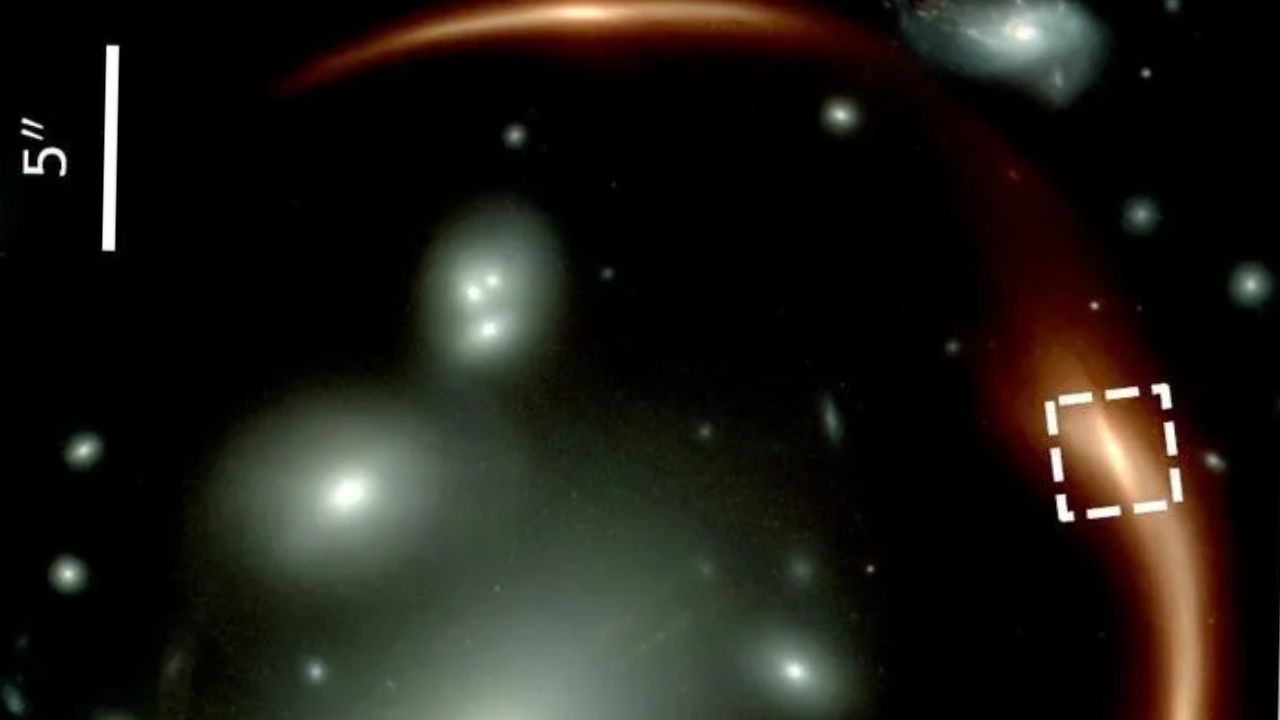
In this case, a galaxy located between Earth and MRG-M0138 acted as a kind of natural amplifier. The gravitational force of this intermediate object distorted and magnified the image of the background galaxy.
According to the study data, this effect increased visualization by approximately 30 times, allowing researchers to more accurately track the speed and stellar trajectories near the black hole.
Main elements that allowed the observation:
- Use of the James Webb Space Telescope;
- Application of technique based on the movement of stars;
- Utilization of gravitational lensing effect;
- Magnification of the galaxy image by about 30 times;
- Detailed analysis of the galaxy MRG-M0138.
Black hole has mass equivalent to billions of suns
Another data point that impressed researchers was the estimated size of the structure.
Calculations indicate that the object has a mass approximately 6 billion times the mass of the Sun. Determining this value represented an additional challenge, as the system is in a state of rest and practically does not interact with the surrounding material.
Without consuming large amounts of gas or emitting intense radiation, the black hole remains hidden in different light ranges, making conventional observations difficult.
For this reason, the team needed to adapt methods normally used in galaxies much closer to Earth.
What happened to this galaxy in the past?
Researchers believe that the observed region went through a very different phase from the current one.
The hypothesis presented in the study suggests that the galaxy MRG-M0138 previously housed a quasar, a structure associated with an extremely active supermassive black hole.
During this period, the object would have grown rapidly and expelled large amounts of gas from the galaxy. As a consequence, the raw material necessary for the birth of new stars would have drastically decreased.
With less fuel available, star formation was halted and the region’s activity lost intensity over time.
The conclusions of the work sparked interest as they help answer important questions about cosmic evolution.
In a statement to Live Science, researcher Andrew Newman from Carnegie Science compared these ancient galaxies to “embers.” According to him, studying these remnants can help scientists understand what caused stellar activity to disappear over time.
Richard Ellis, an astrophysicist at University College London, highlighted that the technique employed paves the way for an unprecedented survey of similar structures.
According to the researcher, this type of analysis allows for a better understanding of the influence of black holes on the development of galaxies observed today.
Why is this black hole important for science?
The studied object offers a rare opportunity to observe a remote period of cosmic history.
Having formed when the Universe was still young, it functions as a kind of natural record of the processes that shaped the first galaxies.
Scientists hope to use similar discoveries to answer questions related to:
- Formation of ancient galaxies;
- Growth of supermassive black holes;
- Interruption of star formation;
- Evolution of the Universe over billions of years;
- Processes related to large-scale gravitational dynamics.
Furthermore, studies on the evolution of galaxies and the processes that shape their formation and transformation over time contribute to expanding scientific knowledge about the origin, structure, and functioning of the universe.
New telescopes should expand the census of rare objects
Although James Webb played a central role in the research, experts emphasize that future observations will depend on other instruments.
The study is part of a broader set of analyses involving five distant galaxies affected by gravitational lenses. To expand this work, scientists rely on missions aimed at mapping large areas of the sky.
Among the mentioned equipment are the Euclid space telescope and the future Nancy Grace Roman telescope, which are expected to help identify new rare and silent objects scattered throughout the Universe.
The combination of these observatories with highly sensitive infrared images could reveal other examples of dormant black holes, significantly expanding knowledge about one of the most enigmatic structures ever studied by astronomy.
The identification of the dormant black hole in the galaxy MRG-M0138 set a new milestone for modern astronomy. The object surpasses the previous distance record for this type of structure by 15 times and provides valuable information about a remote period in the Universe’s history.
With the aid of gravitational lenses, innovative techniques, and state-of-the-art space observatories, researchers managed to investigate a practically invisible system. The discovery reinforces the potential of future astronomical missions and broadens the possibilities of understanding how galaxies and black holes have evolved over billions of years.
Source: Olhar Digital