Portuguese
  Spanish


Protest against the Ken Betwa project exposes indigenous women on funeral pyres, children in arms, Daudhan dam, 221 km artificial river, and fear of villages being submerged in India
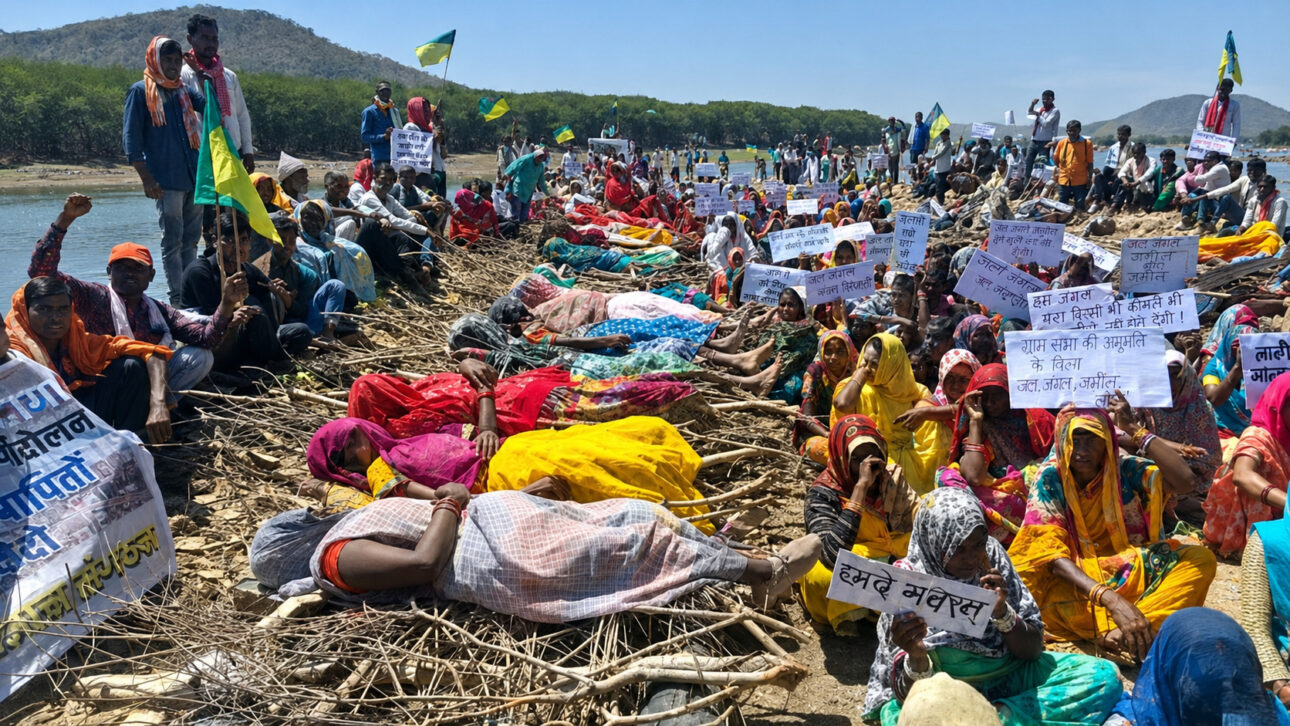
Indigenous women lay on symbolic funeral pyres, some with children in their arms, to protest against the Ken Betwa project in India. The scene drew attention because it transformed the fear of losing villages, homes, and lands into an extreme image of resistance.
The information was released by Times of India, an Indian newspaper of general and regional news. The protest took place on April 9, 2026, in the Chhatarpur district of Madhya Pradesh, and gathered hundreds of indigenous farmers, mostly women.
At the center of the dispute are the Daudhan dam, a 221 km canal, and a river linking project that promises to bring water to dry regions. For the communities, however, the advancement of the project could mean displacement, loss of lands, and risk to entire villages.
-
When Do Brazil and Japan Face Off in the World Cup?

-
Three-Year-Old Fulfills Dream of Joining Garbage Collectors in Brazil, Captivates Thousands Online with Heartwarming Video

-
Nikon Project Uses Dog’s Heartbeat to Capture Photos, Revealing What Truly Makes Dogs Happy

-
In Los Angeles, Young Adult Opts for Garage Living with Bed, Kitchen, and Bathroom to Avoid Rent, Highlighting Comfort and Organization Challenges in Compact Housing



Women lay on funeral pyres to transform fear into protest
The act was named chita andolan, an expression used for the protest on symbolic funeral pyres. Instead of common posters, the women used their own bodies to show that the loss of land can represent a kind of death for the community.
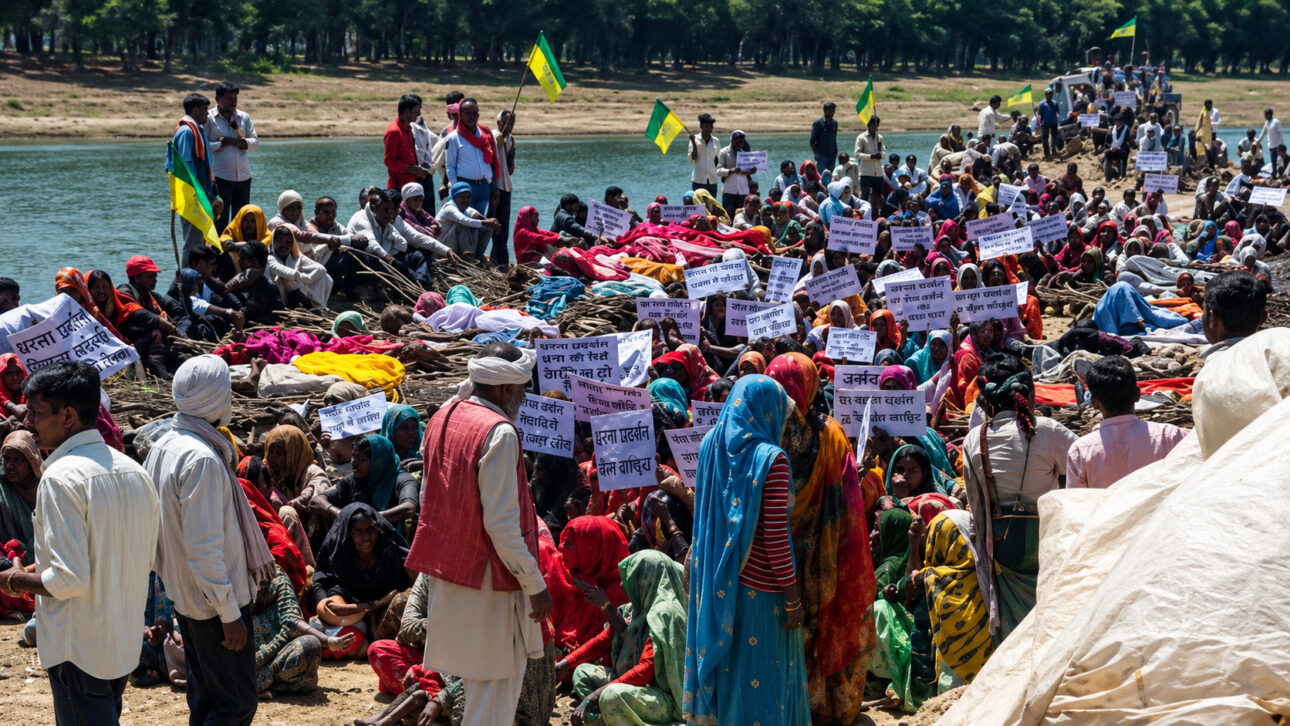
The image gained strength because there were children in the arms of several protesters. The message was simple and heavy: the future of families is also at stake.
The phrase linked to the protest was translated as justice or death. It summarizes the feeling of those who fear being removed from an area where they live, plant, raise children, and maintain ties with the community.
The visual impact explains why the case gained repercussion. It is not just a water project, but a dispute involving villages, memory, territory, and survival.
Ken Betwa Project plans giant dam and canal to transfer water between rivers
The Ken Betwa project aims to transfer water from the Ken river basin to areas connected to the Betwa basin. The promise is to serve regions suffering from water scarcity, especially in parts of Madhya Pradesh and Uttar Pradesh.
The project includes the Daudhan dam, a network of canals over 200 km long, and structures related to irrigation and power generation. The canal mentioned in the project reaches 221 km, a number that helps demonstrate the scale of the intervention.
In practice, a project of this type functions as a large artificial pathway for water. It changes the way water circulates between regions and can supply areas that have difficulty accessing this resource.
On the other hand, when a dam grows over inhabited areas, nearby communities begin to fear flooding, displacement, and loss of land used for housing, farming, and livelihood.
Daudhan Dam became the most sensitive point for threatened villages
The Daudhan dam appears as one of the most delicate parts of the project. It is linked to the formation of a large water storage and distribution structure within the Ken Betwa project.
Times of India, an Indian newspaper of general and regional news, detailed that residents opposed to the project point to concerns about land, forest rights, and displacement. These points explain why resistance has grown among indigenous farmers.
For those living in the villages, the discussion is not limited to the size of the dam. The fear involves leaving the place where the family lives, losing farming area, and not knowing what life will be like after the project.
This type of impact is often difficult to measure with numbers alone. A house can be rebuilt elsewhere, but community ties, routine, river, forest, and family memory are not transferred as easily.
Government promises water, irrigation, and energy, but communities fear paying the price
The project is defended by authorities as a work capable of bringing water to dry regions. The promise includes irrigation, supply for the population, and energy generation.
Among the cited data are service to more than 10 lakh hectares of land and drinking water for about 62 lakh people. The word lakh is used in India to count large quantities.
These numbers show why the project is considered strategic. In drought areas, the arrival of water can change agriculture, supply, and the security of many families.
Even so, the affected communities see another side. For them, the promised benefit for a region cannot ignore the risk of villages being submerged and families being displaced.
Tension with the police increased the political weight of the protest
The mobilization gained even more attention after tension between protesters and police. Women participating in the act clashed with the police during an attempt to disperse them.
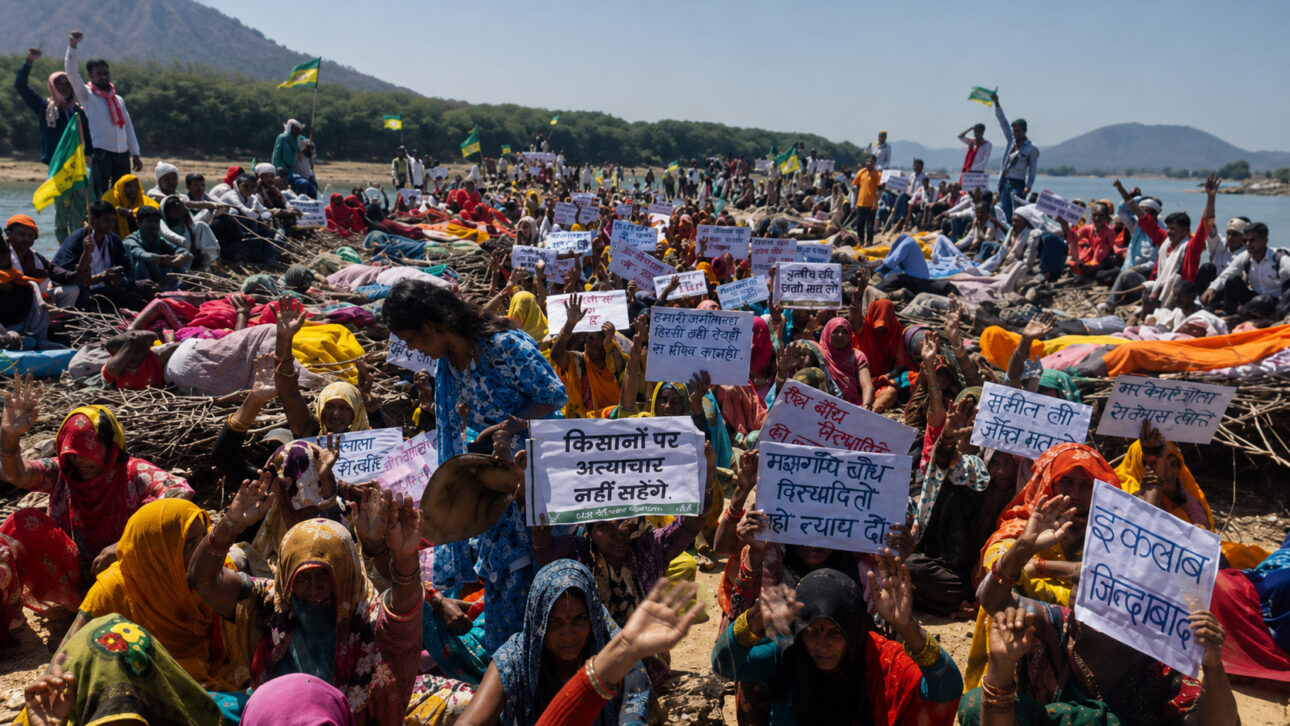
After the confrontation, the police retreated and the communities maintained their intention to continue the protest. The episode reinforced the image of resistance led by women.
There were also reports of difficulties in circulation and access to basic items during the mobilization. For the residents, these obstacles increased the feeling of pressure on the villages.
Even with restrictions near the protest sites, part of the demonstration was taken to the middle of the Ken River. This gesture reinforced the central symbol of the conflict: a dispute over water, land, and the right to remain in the territory.
Why the image of women on funeral pyres went viral
The power of the image lies in the mixture of rare elements in one scene. There are indigenous women, children in arms, funeral pyres, a giant dam, an artificial river, and the fear of villages disappearing.
This combination makes the case easy to understand even for those who have never heard of the Ken Betwa project. The visual message is direct: families believe they may lose everything with the advancement of the project.
The protest also draws attention because it puts ordinary people at the center of an infrastructure discussion. Instead of just talking about canals, dams, and promises of water, the scene shows those who live in the path of the project.
For this reason, the case crosses borders. It shows how large projects can seem like a solution for some and a threat for others, especially when traditional communities are in the affected area.
Dispute shows the human side of large water projects
The Ken Betwa project is presented as a solution for water scarcity, irrigation, and energy. At the same time, the protest by indigenous women shows that a project of this size can change the lives of entire communities.
The scene of the funeral pyres was not just a dramatic act. It summarized the fear of displacement, the insecurity about land, and the feeling that villages may pay the hardest price for a project carried out in the name of development.
When a dam promises to bring water to millions but also puts communities on alert, the question becomes inevitable: to what extent should a large project advance before ensuring real safety for those living in its path?
Do you think giant water projects should be halted until all threatened families have clear guarantees about land, housing, and future? Leave your opinion in the comments.