






 Portuguese
  Spanish


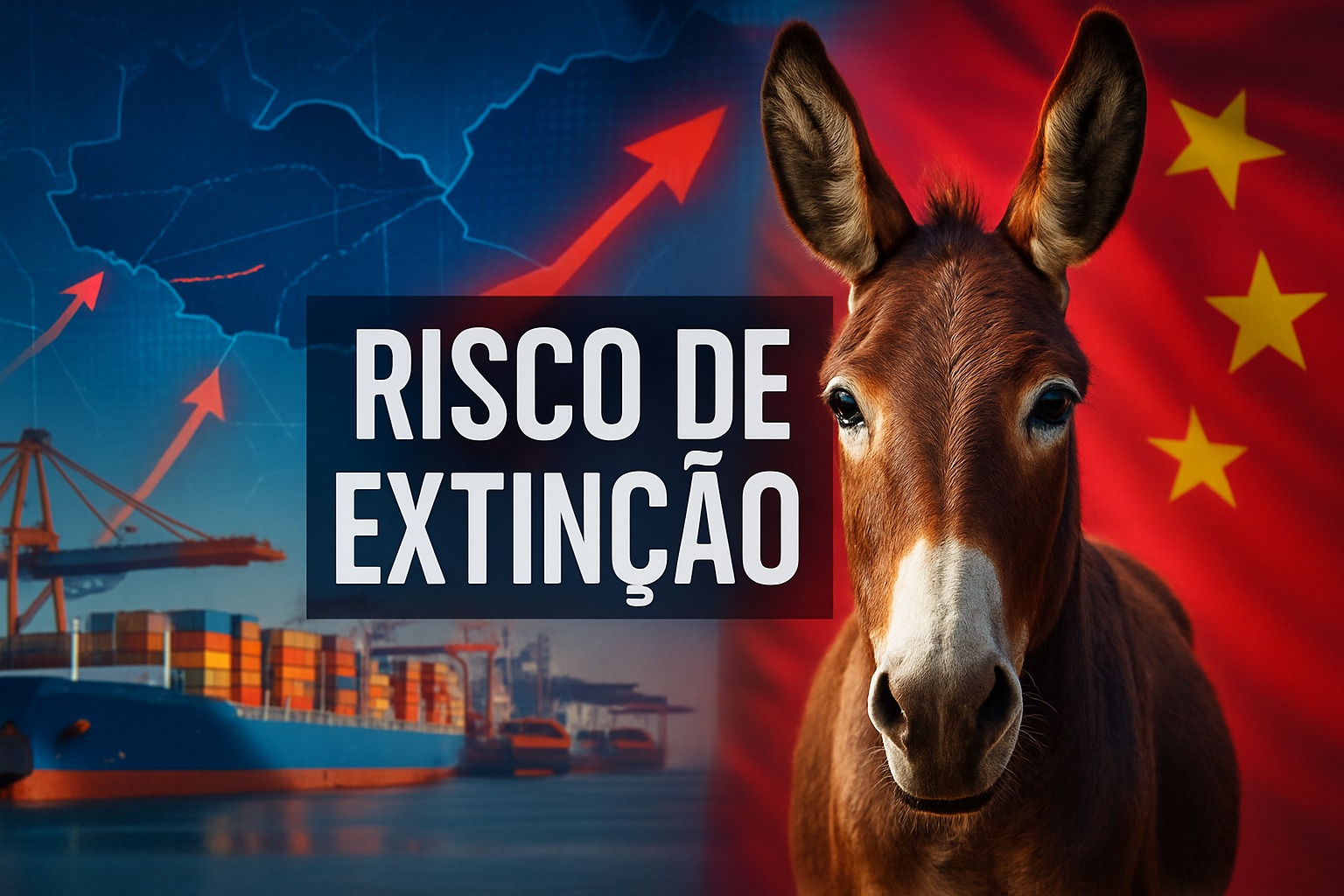


Chinese Demand for Medicinal Gelatin Ejiao Accelerates the Slaughter of Donkeys, Threatens Herds in Brazil and Compromises the Livelihood of Family Farmers
Animals associated with the hinterland, donkeys (Equus asinus) have coexisted with humans for millennia. Used for transport and heavy labor, they also carry strong religious symbolism because, according to Christian tradition, they were responsible for carrying Jesus Christ in his entry into Jerusalem.
This long partnership has allowed the worldwide population of these animals to grow and spread. In Brazil, there used to be millions.
However, the Chinese demand for ejiao, a medicinal gelatin produced from donkey skin, has changed this scenario. The increase in consumption threatens the species’ survival.
-
Abandoned Factory in Rio’s North Zone Becomes Urban Hazard with Standing Water and Debris

-
The U.S. Navy Conducts Submarine Tests in Idaho Lake to Detect Underwater Noises Hidden by the Ocean

-
British Factory Transitions from Mechanical Parts to Producing 420,000 Electric Power Units Annually, Supplying 70% of Ford’s Electric Cars Sold in Europe
-
France Launches Network to Recycle 20 Million Cookware Pieces by 2027, Accepting All Brands for Aluminum and Coating Separation


Drastic Decline in the Brazilian Donkey Herd
Recently, in Maceió, experts gathered at the 3rd Donkeys of Brazil Workshop warned about the severity of the situation.
The meeting, which ended this Saturday (28), highlighted that the country has lost 94% of its donkey population — a category that includes donkeys, mules, and asses — between 1996 and 2025.
This warning is not new. In 2021, a study published in the Brazilian Journal of Veterinary Research and Animal Science, from USP, had already stated that Brazil lacks farms dedicated to breeding the species.
The report emphasized that, if the pace of slaughter continued, extinction would be inevitable.
In addition, The Donkey Sanctuary, an international protection organization, reported in 2024 that the demand for skin increased by 160% between 2016 and 2021.
In 2021 alone, about 5.6 million donkeys were killed to supply the Chinese market. The forecast is that, by 2027, this number will rise to 6.8 million.
Animal Welfare Compromised
Another concerning point relates to the treatment of the animals. A study published in March of this year in the journal Animals, authored by Brazilian researchers, evaluated more than 100 donkeys.
The work showed that the absence of an organized production chain opens space for mistreatment. Signs of abandonment, malnutrition, and exploitation were observed.
The report also points out that transportation and slaughter often occur without sanitary control, which endangers not only the animals but also human health due to zoonoses.
Professor Adroaldo Zanella from USP summarized during the event in Maceió: “The situation of Brazil and the world regarding donkeys is frightening. It is a matter that raises concerns worldwide.”
Social and Economic Role of Donkeys
Besides the environmental impact, experts warn of the social damages. In several rural regions, small farmers still rely on the animal for daily work.
Veterinarian Patricia Tatemoto, who coordinates The Donkey Sanctuary campaign in Brazil, recalls that they are essential in difficult-to-access cocoa plantations.
She also emphasizes the docility and intelligence of these animals, which make them good companions.
However, the low reproduction rate complicates any attempt to maintain balance. Gestation lasts 12 months, and the time to maturity before slaughter is three years, which increases breeding costs.
Technological Alternatives
To reduce the pressure on donkeys, science is seeking pathways. Among the solutions is laboratory-produced collagen, without the need for animal exploitation.
According to agronomist and doctor in Applied Economics from USP, Roberto Arruda, techniques like precision fermentation are already proving promising.
They could sustainably generate the collagen used in medicine, while also protecting the species and reducing socioeconomic risks.
Measures Under Discussion
Mobilization is growing in different countries. In Africa, governments in Kenya, Nigeria, and Tanzania have already banned the slaughter of donkeys for export.
In Brazil, two bills are in progress. One was presented in the Chamber of Deputies and the other in the Legislative Assembly of Bahia.
Both aim to prohibit the killing of the species for meat commercialization, strengthening national protection.
Therefore, in the face of the extinction threat, the debate on the preservation of donkeys involves not only the defense of animal welfare but also ensuring the livelihood of families, public health, and the development of technological alternatives.
The future of these animals, so significant in the imagination of the hinterland and fundamental in human history, now depends on swift and effective decisions.
With information from Agência Brasil.





Enquanto continuarmos a tratar os animais como brinquedos e sem nenhum amor e compaixão, isto continuará a acontecer.
Congressistas: criem leis de proteção logo. Agora !
Aqui **** é o q mais tem , não acaba nunca, principalmente em épocas de eleições a natalidade aumenta absurdamente!!!!!
Um absurdo o Brasil permitir que pobre **** o **** seja eliminado do nosso país, cadê os direitos dos animais nesse país
.