






 Portuguese
  Spanish
  5 min of reading
  0 comments


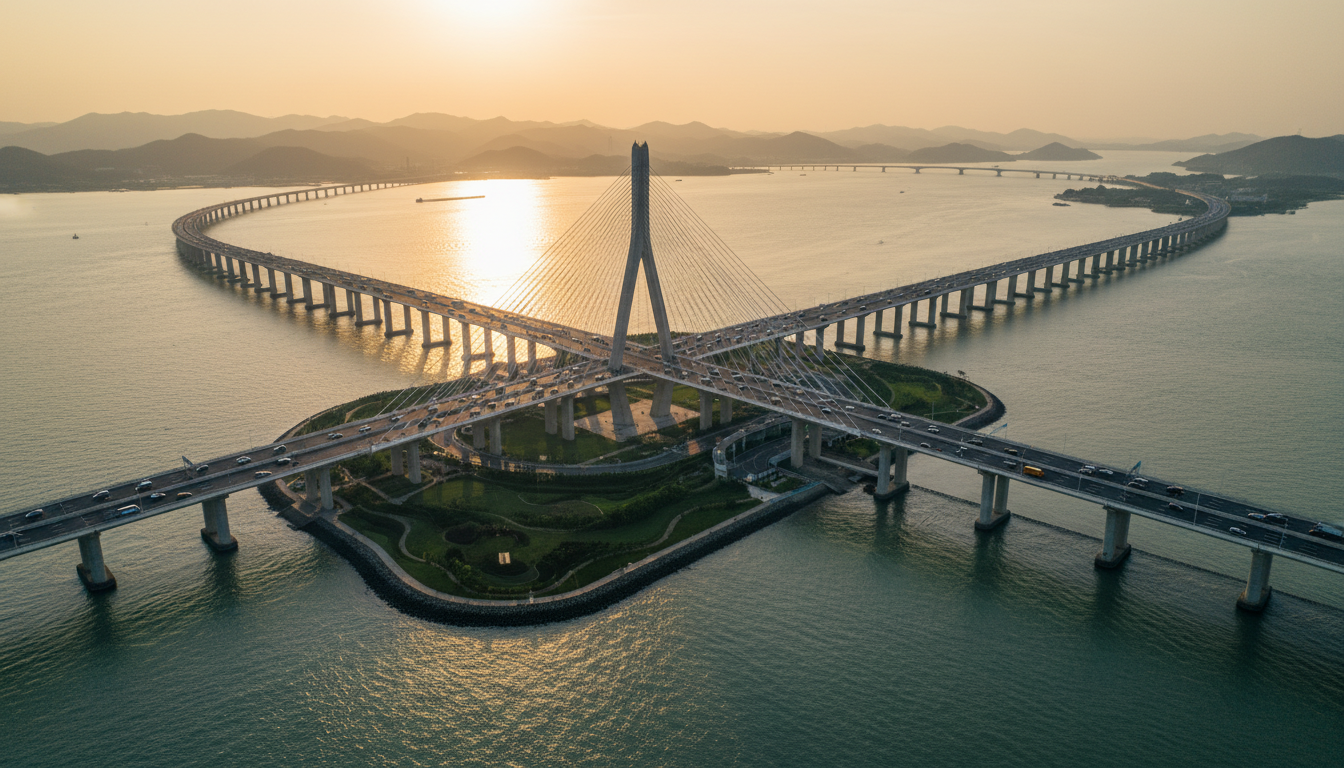
24 km Superstructure in Guangdong Connects Shenzhen to Zhongshan with the World’s Widest Undersea Tunnel, 270-Meter Tower, and 14 Robots Monitoring Traffic
China has inaugurated the Shenzhen-Zhongshan Marine Highway, a 24 km superstructure in Guangdong province. The project has set 10 world engineering records, according to a report from Xataka Brasil.
The mega-structure is the first in the world to combine bridges, artificial islands, an undersea tunnel, and an underwater interchange in a single roadway complex.
Nearly 90,000 cars cross the highway every day. The volume impresses even engineers accustomed to Asian megaprojects.
-
Bolivian Female Construction Workers Form Association to Combat Discrimination and 38% Pay Gap in the Industry

-
Near Amsterdam, residents buy land and discover they must also build streets, manage drainage, handle waste, and grow food on half their plot.
-
Brazil’s WEG to Open New Factory in China by 2027, Expanding Production of Large Rotating Electric Machines and Low to Medium Voltage Motors in Rugao

-
Chinese Shipyard Secures $1 Billion in Orders for Low-Carbon Container Ships Amid Global Fleet Renewal Efforts


Before the project, the trip between Shenzhen and Zhongshan took about two hours. Now, the journey has been reduced to just 30 minutes.
The reduction in travel time has transformed the daily lives of millions of residents in the Greater Bay Area of Guangdong-Hong Kong-Macau.

The Suspension Bridge with a Tower Equivalent to a 90-Story Building
Of the total 24 km, 17 km are bridge over the sea. The structure crosses the Pearl River Delta in Guangdong.
The main suspension bridge has a clear span of 1,666 meters. It is one of the largest distances between pillars in the world.
Its main tower reaches a height of 270 meters. This is equivalent to a building of approximately 90 stories.
The navigation clearance under the bridge is 76.5 meters. Large ships can safely pass beneath the structure.
Those familiar with the Danyang-Kunshan Bridge, the longest in the world at 164 km, know that China excels in this type of megaconstruction.
But the Shenzhen-Zhongshan stands out for not being just a bridge. It is an unprecedented multimodal complex.
World’s Widest Undersea Tunnel: 46 Meters Wide at 30 Meters Deep
The submerged section is 6.8 km long. It is the widest immersed undersea tunnel in the world, with 46 meters in width.
Inside the tunnel, there is space for up to 8 traffic lanes. The speed limit is 100 km/h.
The structure passes 30 meters below sea level. Engineers used unprecedented techniques to ensure watertightness.
The Fehmarnbelt tunnel in Europe, with its 73 thousand ton blocks, uses similar immersion technology.
However, no immersed tunnel on the planet has the same width as that of the Chinese highway.

The 10 world records in a single project
The Shenzhen-Zhongshan highway has set 10 world records during its construction. Here are the main numbers.
- Total length: 24 km (17 km of bridge + 6.8 km of tunnel)
- Tunnel width: 46 meters — the widest in the world
- Span of the suspended bridge: 1,666 meters between pillars
- Tower height: 270 meters (equivalent to 90 stories)
- Tunnel depth: 30 meters below the ocean
- Lanes in the tunnel: up to 8 traffic lanes
- Allowed speed: 100 km/h in the submerged section
- Navigation clearance: 76.5 meters under the bridge
- Daily traffic: nearly 90 thousand vehicles
- Toll: approximately R$ 60
The numbers place the project among the greatest civil engineering achievements of the 21st century.
14 robots monitor traffic in real time
The operation of the highway includes 14 robots that continuously monitor traffic.
The equipment operates in real time. They automatically detect accidents, congestion, and anomalies on the road.
This automation reduces response time to emergencies. Safety in the underwater tunnel requires constant surveillance.
The investment in technology reflects the scale of the project. Nearly 90 thousand vehicles per day require intelligent management.
3 million passengers and a 160% increase at the airport
The Zhongshan-Shenzhen bus line has already transported 3 million passengers since its inauguration.
The Shenzhen Airport recorded a 160% increase in the number of users coming from Zhongshan.
There are 40 thousand people using the highway daily to access the airport. The flow has changed the regional dynamics.
The economic integration between the two cities has accelerated. Technology companies from Shenzhen are now looking towards Zhongshan.
The lower cost of living in Zhongshan attracts workers. The highway has enabled commuting.

A 2,200 m² museum in the middle of the sea
On the west artificial island of the highway, there is a 2,200 square meter museum.
The space tells the story of the construction and showcases technologies used. It has already become a tourist attraction in the region.
The artificial island serves as a transition point between the bridge and the tunnel. It is there that vehicles dive towards the underwater section.
The experimental tourist operation has already attracted visitors. The combination of engineering and culture impresses those who pass by.
How it compares to the Hong Kong-Zhuhai-Macau bridge
The neighboring Hong Kong-Zhuhai-Macau bridge has a 55 km length. It is significantly larger in total length.
However, its underwater tunnel is only 6.7 km. Almost the same length as the Shenzhen-Zhongshan tunnel.
The difference lies in the width. No other submerged structure in the world reaches the 46 meters of the new highway.
Both are part of the Greater Bay Area Guangdong-Hong Kong-Macau. The region concentrates the most ambitious works on the planet.
In Brazil, the Salvador-Itaparica bridge will be 12 km long and cost R$ 10 billion. It will be the largest in Latin America.
However, on a Chinese scale, it is on a different level. The Shenzhen-Zhongshan is twice the length of the future Bahia bridge.
Toll of R$ 60 to cross the 24 km monster
The toll to cross the entire highway costs approximately R$ 60. This amount is considered affordable by Chinese standards.
With 90,000 vehicles per day, the daily revenue is significant. It helps to offset the billion-dollar construction cost.
The maximum speed of 100 km/h in the tunnel ensures a constant flow. Traffic jams are rare, thanks to monitoring robots.
The work impresses, but environmental and maintenance challenges remain
The Shenzhen-Zhongshan highway is an undeniable achievement of engineering. Its 10 world records speak for themselves.
However, structures of this magnitude face long-term challenges. Marine corrosion requires constant and costly maintenance.
The environmental impact on the Pearl River Delta also deserves attention. Marine ecosystems have inevitably been affected by the construction.
The dependence on a single roadway corridor for nearly 90 thousand daily vehicles is another point of concern.
Still, the project redefines what is possible in transportation infrastructure. The world is watching — and taking notes.
Information about the Shenzhen-Zhongshan Expressway has been compiled from reports by Xataka Brasil and CN Bay Area. The data reflects the current operational scenario and may be subject to updates.





Be the first to react!