






 Portuguese
  Spanish
  3 min of reading
  0 comments


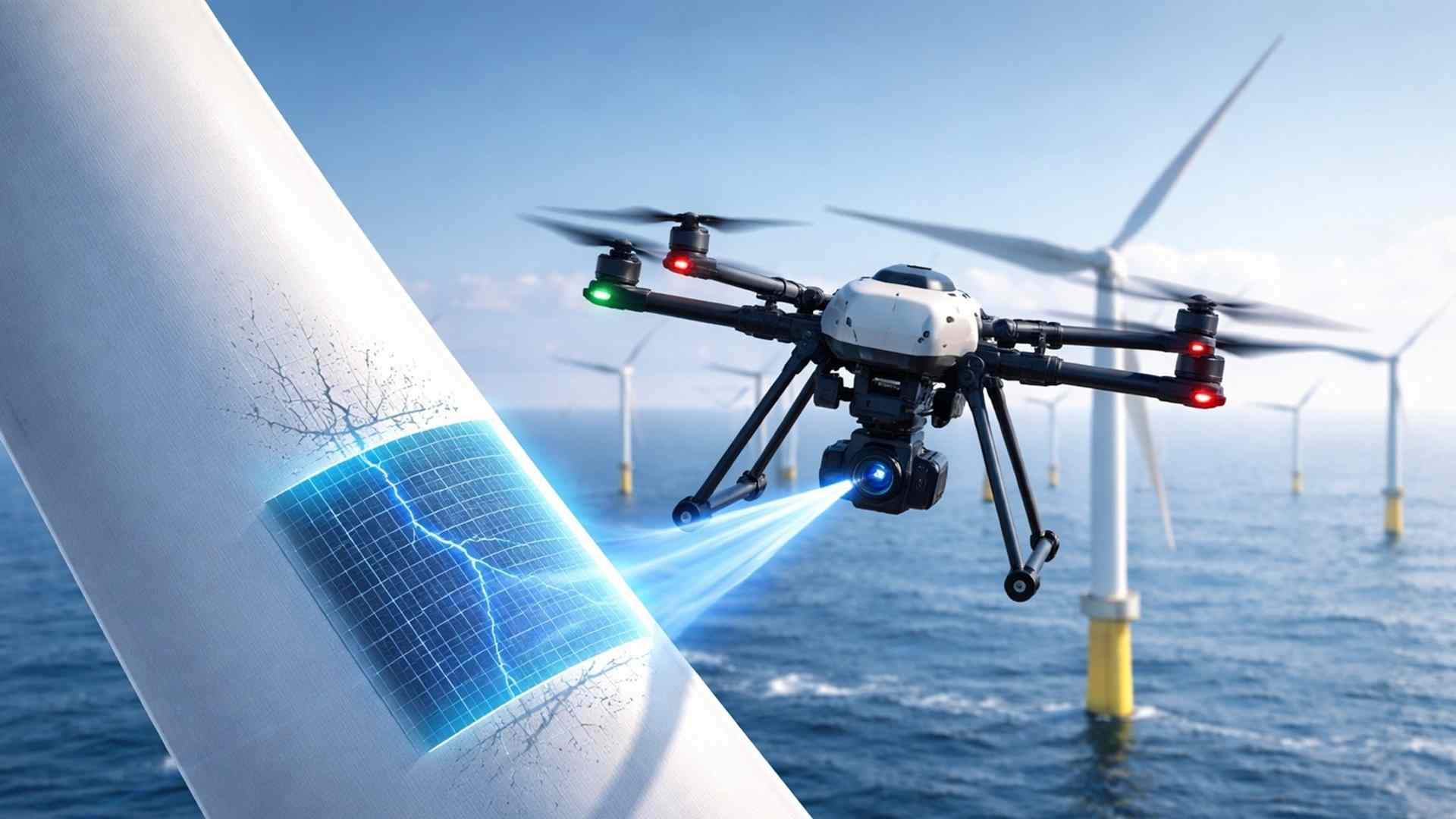
The Unprecedented Demonstration Conducted at the Offshore Wind Farm Rødsand 2 Showed That Autonomous Drones Equipped with Artificial Intelligence Can Inspect Turbine Blades While in Full Operation, Reducing Maintenance Costs, Risks to Workers, Downtime, and CO2 Emissions Associated with Traditional Inspections at Sea
The technological advancement occurred when a Danish startup completed the first autonomous, contactless inspection of an offshore wind turbine blade in operation, allowing for the assessment of structural damage without shutting down equipment, reducing risks, operational costs, and emissions associated with the process.
Unprecedented Inspection with Turbines in Full Operation
The initiative was led by Quali Drone, based in Hadsund, in partnership with RWE and other energy sector participants. The demonstration marked the first fully autonomous offshore inspection without direct contact with rotating blades.
In addition to RWE, the project involved Statkraft, TotalEnergies, DTU, and Energy Cluster Denmark, bringing together industrial and academic expertise.
-
Elon Musk Plans $25 Billion Chip Factory with SpaceX and xAI at Tesla’s Massive Texas Site, Visible from Space

-
Brazilian Innovator Marcelo Loureiro Sets Guinness World Record with 12,000 km Robotic Surgery from Brazil to Kuwait
-
Workers Discover 19th-Century Iron Ship and Indigenous Artifacts During COP30 Construction in the Brazilian Amazon
-
Chinese robots trained for two weeks to row a dragon boat at the Sichuan Festival in China, took full control when humans stopped rowing, and even made rice dumplings in one of the most unusual tests ever conducted with humanoids.


The drone operated safely while the turbines remained in continuous operation, proving the technical viability of uninterrupted inspections.
The procedure eliminates the need for prolonged shutdowns, traditionally required for manual visual assessments.
Impact on Costs, Safety, and Emissions
Conventional inspections of wind turbine blades require a complete shutdown of the turbines, resulting in energy production losses, high maintenance costs, and exposing workers to significant risks, especially in marine environments.
According to RWE, the new approach reduces downtime, enhances operational safety, and decreases carbon dioxide (CO2) emissions associated with inspection operations. The solution also reduces the need for vessels and specialized teams at sea.
The technology had previously been successfully tested on land. The offshore validation took place at the Rødsand 2 wind farm, operated by RWE since 2010 and located south of the coast of Lolland.
Embedded Technology and Artificial Intelligence
The drone combines advanced hardware with image analysis based on artificial intelligence, utilizing visual and infrared data. The system employs deep learning to identify anomalies, improving its performance with each new inspection conducted.
The equipment was developed at the Wind Energy Laboratory of the Technical University of Denmark, with integrated visual cameras, thermography, and computer vision capabilities into the autonomous navigation system.
During the test, the drone flew very close to the rotating blades, scanning them in real time to detect surface damage and possible underground fractures, maintaining stability and precision even in challenging offshore conditions, demonstrating its technological robustness.
Statements and Perspectives for the Wind Sector
The CEO of Quali Drone, Jesper Smit, stated that the project proved it is possible to conduct autonomous offshore inspections with drones equipped with visual cameras while the turbines continue to operate normally.
According to Xiao Chen, technical lead of the AQUADA-GO project, the AI model uses deep learning algorithms and computational vision based on thermomechanical models to identify defects on the surface and below it.
The park manager, Marcus Mejborn, highlighted that the solution can boost clean energy production, improve worker safety, and reduce operational costs. He concluded that the success of the inspection represents a milestone for the entire wind industry.


Be the first to react!