






 Portuguese
  Spanish


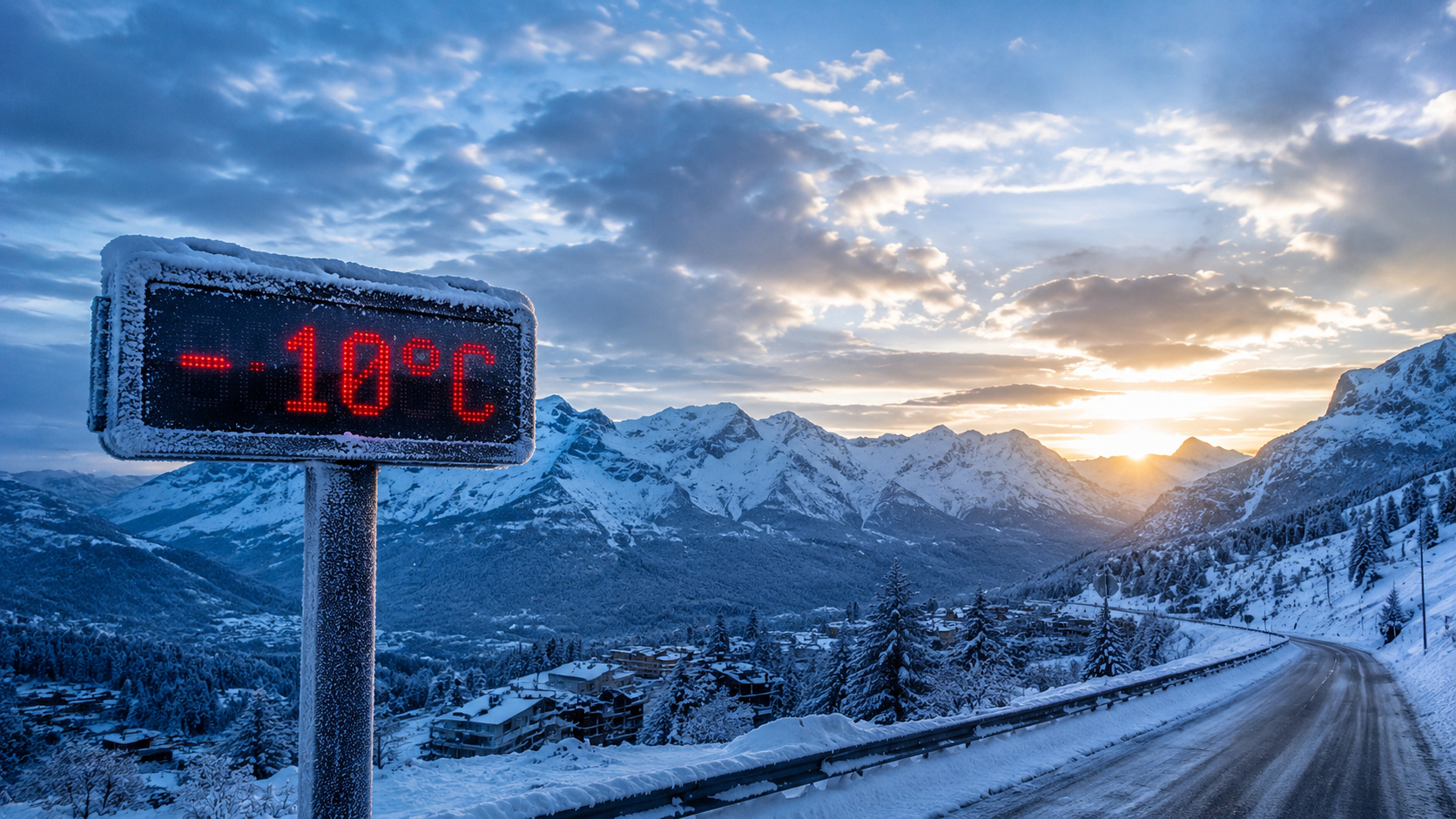

New polar air mass, driven by extratropical cyclone between Argentina, Paraguay, and Bolivia, should still maintain intense cold in the Center-South of the country until early July before the climate change
The cold wave that has marked recent days in Brazil will still persist for some time, but the end of this cold cycle already has an estimated date to occur. According to the latest meteorological forecasts, the country is expected to face a new polar air mass in the first days of July, keeping temperatures below average in much of the Center-South. However, from the second half of the month, the scenario begins to change significantly, with the gradual return of warmth.
According to meteorological models, this new cold air mass will be driven by an extratropical cyclone that begins to form between Argentina, Paraguay, and Bolivia this weekend. The system is expected to intensify from a low-pressure area, giving rise to a cold front that, starting Monday (29), will push cold air back over the Brazilian Center-South. The information was released on June 26, 2026, by the portal ND Mais, in a report by journalist Deny Campos.
Cold should still persist at the beginning of July, but loses strength throughout the month
According to projections, this new atmospheric configuration should maintain intense cold over the Center-South of the country throughout the next week, prolonging the period of negative temperatures in various locations — especially in the South and parts of the Southeast, historically more sensitive to this type of polar mass advance.
-
Brazilian Government Challenges Drug Trafficking Claims Linked to Social Program with Study by Fiocruz and Harvard

-
Resident left tap running to prevent freezing, but woke up to ice in the sink after -1.8°C cold snap in Brazil’s Serra Gaúcha region.
-
Man Inherits Old House in France and Discovers 100 kg of Hidden Gold Throughout the Property
-
Pyramid-Shaped Apartment Building in China Stands Out with 18 Floors, 45-Degree Inclined Facade, and Terraced Design Inspired by Traditional Rice Paddies




Despite this, meteorological models indicate that this intense cold scenario should not extend throughout the month of July. According to the most updated forecasts, the trend is that, after the passage of this new polar air mass, the atmospheric pattern will begin to change gradually, favoring the rise in temperatures precisely in the second half of the month.
In this sense, meteorological maps already show a significant reduction in negative temperature anomalies, which practically disappear from Brazilian territory in the second half of July. This change occurs, according to specialists, because the next cold air masses expected to hit the country will have less intensity and reduced capacity to advance over the national territory, compared to the more extreme episodes recorded in previous weeks.
In light of this new scenario, initial estimates indicate that maximum temperatures during the afternoon may once again exceed 30°C in areas of the Southeast Region still during the second half of July — a significant change compared to the intense cold scenario that has characterized the country in recent weeks.
El Niño begins to reshape the Brazilian climate starting in July
On the other hand, the main factor behind this broader climate transition is the growing influence of El Niño over Brazilian territory. According to Meteored, a source cited by the report, forecasts indicate that the phenomenon is expected to have a more significant impact on the country’s climate in the coming months.
But what exactly is El Niño? According to the World Meteorological Organization (WMO), the phenomenon is part of a natural climate pattern known as the El Niño-Southern Oscillation, or ENSO. This pattern involves the variation of ocean temperatures in the central and eastern regions of the Equatorial Pacific Ocean, combined with changes in the atmosphere covering this area. ENSO has two opposite phases: the warm phase, called El Niño, and the cold phase, known as La Niña — with an intermediate state called neutral, when ocean temperatures remain close to the historical average.
According to the WMO, El Niño is characterized by abnormally warm ocean surface temperatures in the central and eastern Pacific regions. The phenomenon usually arises when the trade winds — air currents that normally blow from east to west along the equator — weaken or even reverse direction. Without this constant wind, the natural exchange between warm surface waters and cooler, deeper waters ceases to occur in the usual way, causing heat to accumulate on the ocean surface for an extended period.
According to the entity, an El Niño episode typically develops between March and June, reaching its peak intensity between November and February — although the total duration of the phenomenon can vary greatly, extending up to 18 months in some cases. The transition between El Niño and La Niña phases, according to the WMO, usually occurs in irregular cycles of two to seven years, making each new episode relatively unpredictable in terms of intensity and exact start time.
It is worth noting that the most recent phenomenon in this category, recorded between 2023 and 2024, was classified as one of the most intense El Niños ever documented, contributing, according to international climate analyses, to making 2024 the hottest year ever recorded globally up to that point — a direct combination between the additional heat generated by the phenomenon and the ongoing human-induced global warming. After this episode, the Pacific Ocean went through a neutral phase and later a new La Niña cycle between the end of 2025 and the beginning of 2026, before signaling the formation of a new El Niño from mid-2026.
According to the latest climate models, the atmosphere is already responding to the warming of the Equatorial Pacific Ocean waters — a phenomenon that alters wind patterns and, consequently, changes the behavior of rainfall in different regions of Brazil. Furthermore, projections indicate that this specific El Niño episode has the potential to reach historic intensity, with the average of dynamic models indicating anomalies of up to 2.7°C above average in the Equatorial Pacific Ocean. Some more extreme simulations even suggest the possibility of anomalies exceeding 3.5°C.
This scenario is expected to cause distinct effects in each region of the country. In the South Region, the expectation is for intense and more frequent rainfall, as well as higher average temperatures — a pattern that, according to climatology experts, tends to repeat in almost all El Niño episodes, as the phenomenon tends to hold back cold fronts in the region, preventing their faster advance to the rest of the country. In the Southeast Region, models indicate a moderate increase in average temperatures and a greater occurrence of heatwaves over the coming months. In the Midwest, the effects tend to be less pronounced, although there are projections of above-average rainfall and temperatures, especially in Mato Grosso do Sul.
However, not all regions are expected to feel the effects of the phenomenon in the same positive way. In the Northeast, the trend is for a significant decrease in rainfall, with the possibility of severe droughts, especially during the next summer — a climatic pattern associated with the displacement of areas of higher humidity to the middle of the Pacific Ocean during El Niño episodes, which reduces the formation of heavy clouds over northern South America. In the North Region, the expectation is also for reduced rainfall, more intense droughts, and an increased risk of forest fires — a pattern that tends to worsen in more significant El Niño years, especially in tropical forest regions more sensitive to prolonged dry periods.
In light of this panorama, meteorological projections indicate that the phenomenon may favor the occurrence of severe heatwaves and the recording of new maximum temperature records between 2026 and 2027 — following, according to climatologists, a historical pattern observed in practically all major El Niño episodes of recent decades, where the year following the peak of the phenomenon usually records higher global average temperatures. Therefore, although intense cold is still expected to mark the first days of July in Brazil, the climate trend for the rest of the year points to a gradual but significant transition towards a warmer and, in some regions, drier pattern — a change that is expected to directly impact everything from agricultural planning to the routine of those living in the country’s major cities.


