






 Portuguese
  Spanish


Water that should have kept running during the night froze upon touching the sink at a farm in São José dos Ausentes, in Rio Grande do Sul. The incident occurred amid the presence of a polar air mass that dropped temperatures in the South of the country, caused frost, and led mountain towns to record negative marks this week.
The intense cold in São José dos Ausentes, in the Serra Gaúcha, turned a common measure among rural residents into an unusual scene. A resident left the kitchen tap slightly open during the night to prevent the water from freezing inside the pipes, but woke up to an ice block formed in the sink.
As reported by Terra on Thursday, June 25, the incident happened at Anápio Pereira’s house, on a farm in the municipality. The temperature recorded in the city reached -1.8ºC, but the property’s thermometers, according to the resident, showed about -6ºC at dawn.
The practice of leaving a small stream of water running is used on very cold days because moving water is less likely to freeze inside the pipes. This time, however, the water came out so cold from the plumbing that it crystallized upon touching the frozen surface of the sink.
-
Man Inherits Old House in France and Discovers 100 kg of Hidden Gold Throughout the Property

-
Pyramid-Shaped Apartment Building in China Stands Out with 18 Floors, 45-Degree Inclined Facade, and Terraced Design Inspired by Traditional Rice Paddies

-
When Do Brazil and Japan Face Off in the World Cup?

-
Three-Year-Old Fulfills Dream of Joining Garbage Collectors in Brazil, Captivates Thousands Online with Heartwarming Video



The episode drew attention because it shows, in a simple image, the effect of the polar air mass that advanced over the South of Brazil in the early days of winter. In Rio Grande do Sul, the combination of altitude, clear skies and dry air favored negative lows in parts of the Serra.
The tap was left open to protect the plumbing, but the ice appeared on the outside
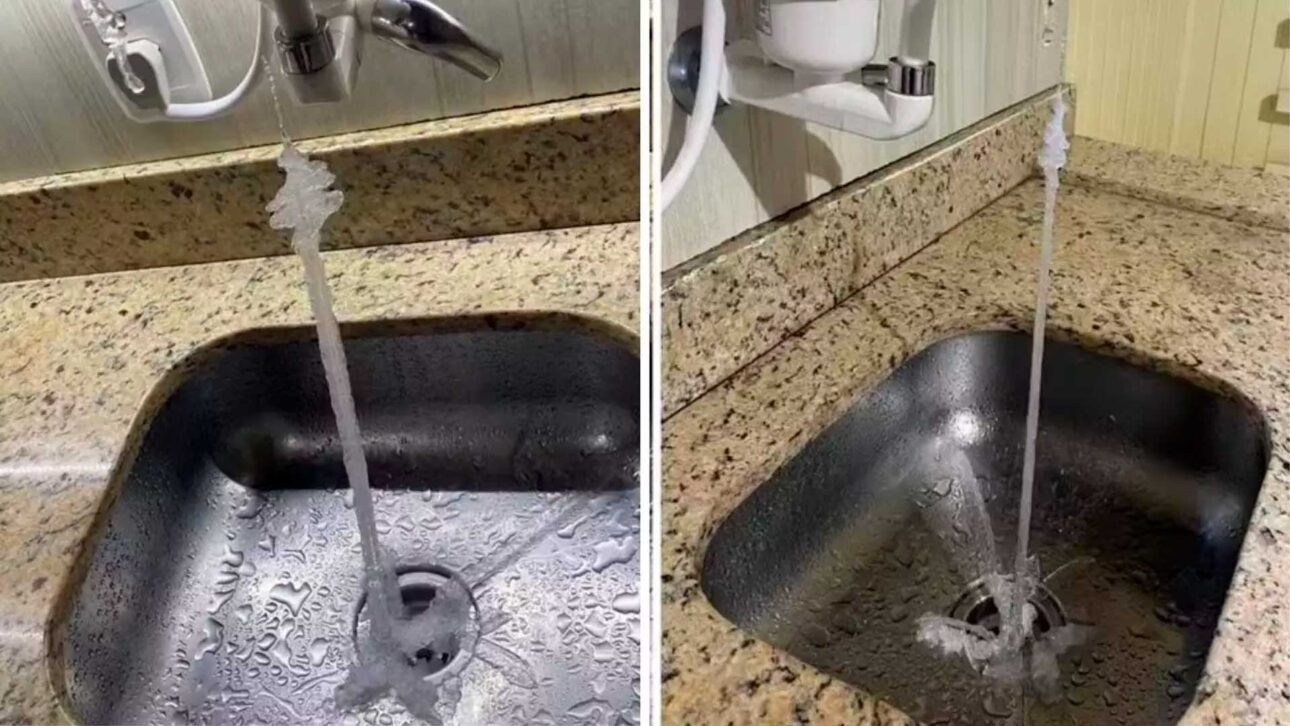
Anápio reported that he left several faucets open overnight, with low flow, to prevent the freezing from affecting the farm’s water system. In rural areas, where the piping can be more exposed and the water travels long distances, the risk increases when the temperature drops below zero for several hours.
According to him, out of 25 faucets left open, only one froze. The difference was in the location where it was installed, colder than the others. The water was already very cold coming through the pipes and froze almost immediately upon hitting the sink.
Freezing as it exits the faucet does not mean the entire water network has turned to ice. In such situations, what usually occurs is the extreme cooling of the water and the contact surfaces. When touching metal, crockery, or stone already below zero, the droplets can form layers of ice in a few minutes.
The case is not unprecedented in the region. Residents of mountainous cities in Rio Grande do Sul and Santa Catarina live with frequent frost, white pastures at dawn, vehicles covered in ice, and frozen pipes in more remote properties.
São José dos Ausentes is in one of the coldest areas of Rio Grande do Sul
São José dos Ausentes is among the municipalities most associated with cold in Rio Grande do Sul. The city is located in the Campos de Cima da Serra, in a high-altitude area, near the canyons and formations of the Serra Geral.
According to information from the São José dos Ausentes City Hall, the municipality includes areas of cliffs, springs, and high-altitude fields. This terrain helps explain why the early mornings can be so cold when a polar air mass meets clear skies and little wind.
The altitude favors lower temperatures because the air becomes thinner and loses heat more easily during the night. In open field locations, such as farms, lowlands, and areas without much protection, the drop can be even stronger than that recorded by urban meteorological stations.
Therefore, the mark of -1.8ºC reported for the city does not prevent specific points from experiencing more intense cold. On Anápio’s property, a private measurement indicated around -6ºC, a value compatible with rural microclimates on nights of strong frost.
Polar air mass dropped temperatures and brought Vacaria to -4.8ºC
The cold in São José dos Ausentes was part of a larger event. Rio Grande do Sul recorded the lowest temperature of the year this Thursday, 25th, in Vacaria, also in the Serra Gaúcha, where the thermometers marked -4.8ºC around 7 am, according to data cited by the original report.
Climatempo pointed out that a cold air mass of polar origin acted over southern Brazil between June 22 and 26. The company classified the event as the first cold wave of the winter of 2026 and highlighted that the early mornings of the 24th, 25th, and 26th had the potential for widespread frost in the southern states.
The National Institute of Meteorology also indicated the passage of a frontal system in the week of June 22 to 29, with a drop in temperature in areas of the South, Southeast, Midwest, and even in the southwest of the Amazon. In Rio Grande do Sul, the instability decreased after the passage of the cold front, making way for drier and colder nights.
This pattern usually favors frost. With few clouds, the ground loses heat quickly during the night. Vegetation, roofs, cars, and metal structures cool down before the surrounding air, creating conditions for ice formation even when the official temperature is close to zero.
Have you ever seen water freeze in a faucet, car, water tank, or road during a cold wave in Brazil? Tell us in the comments which city you are from and what was the lowest temperature you have ever faced.


