Portuguese
  Spanish


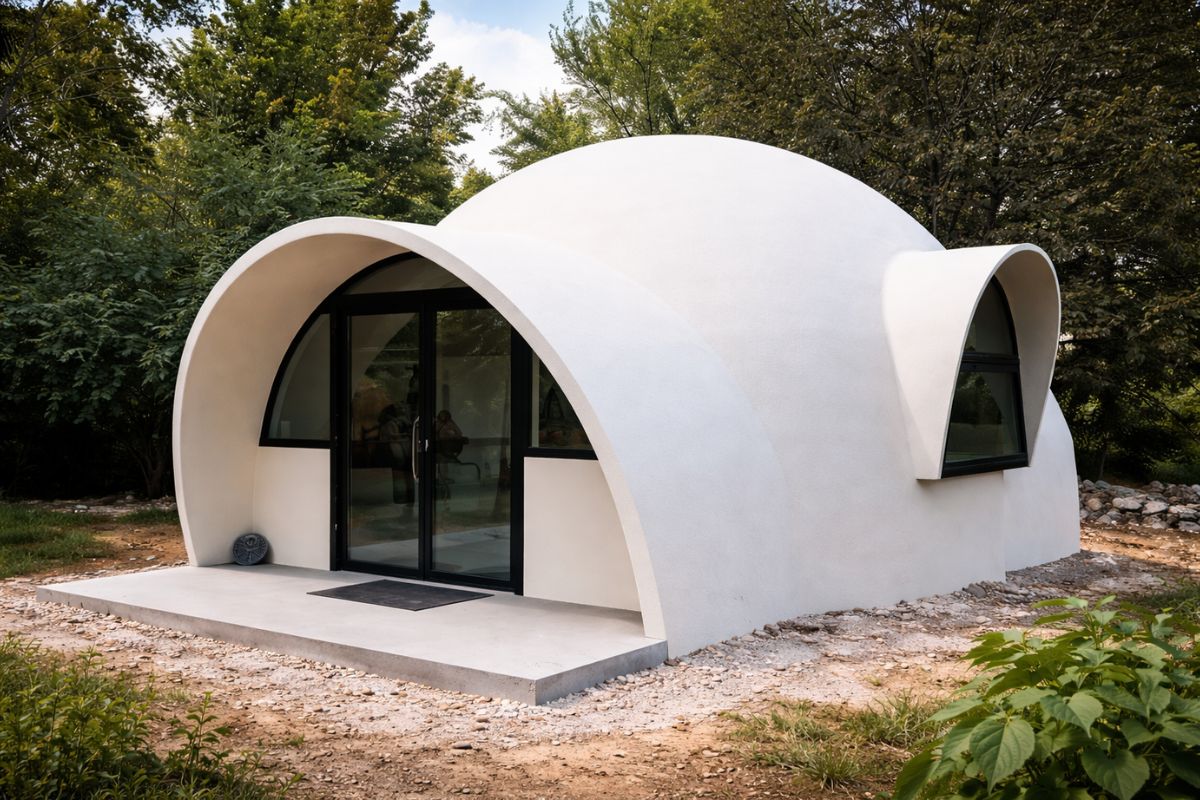


The Luxury Dome House Is Assembled in a Few Days by a Team Working with Level Foundation, Waterproof Plastic, and a Central Curved Piece; Then, Arch and Concrete Blocks Fit with Mortar Until Closure, Creating an Unexpectedly Spacious and Acoustically Remarkable Interior
The luxury dome house doesn’t start with luxury; it starts with method. A builder leads a team that chooses an open lot, levels the ground, and prepares the foundation with a layer of plastic to prevent moisture. The most discreet detail is what supports everything else: without a stable base, the dome cannot close securely.
In just a few days, the luxury dome house takes shape through steps that seem repetitive but are not. With each advance, the geometry reduces margins of error and demands precision in the alignment of the arch, in the fitting of the concrete blocks, and in the application of mortar. What appears quick on the outside depends on exact routine on the inside.
Level Foundation and Waterproofing That Become Structure

The foundation is treated as infrastructure, not as an introduction.
-
Couple Converts 1925 Detroit Bank into Home, Earns $40,000 Annually on Airbnb

-
Tired of Seeing People Sleep in the Cold, London, Canada Opens First Modular Shelter for Homeless with 60 Cabins, Heating, Meals, and Dog Area
-
Brazil’s $1.3 Billion, 870-Meter Immersed Tunnel to Be Latin America’s First of Its Kind, Featuring Special Public Facilities and Information Center
-
Brazilian Innovator Develops Concrete Blocks from Recycled Plastic, Eliminating Mortar and Reducing Construction Costs


The ground is leveled and covered with a plastic waterproofing layer, creating a simple barrier against groundwater.
In a luxury dome house, this step is where durability begins to be determined, as moisture tends to migrate into joints and mortar.
The sequence also responds to the “where” without spectacle: the work takes place on an open lot, with space for scaffolding and team circulation.
The site needs to be large enough for the curvature to dictate the pace, as the dome requires continuous assembly and small tolerances.
The Central Arch That Defines the Curvature and Dictates the Rest

The arch appears early because it defines height and angle, and therefore becomes a reference for all closure.
A curved wooden piece is raised and fixed in the center, like a living template for the luxury dome house.
Any deviation there multiplies when the concrete blocks begin to approach the top.
From the perspective of those executing, the “who” is collective: builders, helpers, and operators go up, down, and check markings continuously.
It is at this moment that the construction seems silent, but it’s full of checks, because the arch is not decoration; it is applied geometry.
Concrete Blocks and Mortar: The Puzzle That Closes the Volume
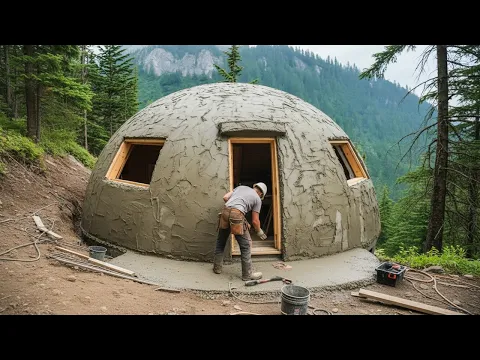
With the arch established, the concrete blocks prepared to follow the curvature come in.
The assembly is sequential: block by block, joint by joint, with mortar filling spaces to eliminate gaps.
In a luxury dome house, repetition is strategic, as each concrete block needs to work as part of a compressive set.
The team uses scaffolding to reach the top and does the final sealing with mortar, reinforcing structural continuity and interior finishing.
When the mortar disappears in the joints, the volume “locks”, and that’s when the closure stops looking like a wall and starts to function as a shell.
Inside, the Dome Changes the Perception of Space and Sound

When the interior is fully revealed, the sensation is of another space.
The circle of concrete blocks creates a spacious area, and the curvature alters how light enters and how sound behaves.
In a luxury dome house, acoustics may become more pronounced because curved surfaces tend to reflect and concentrate frequencies.
The entrance arch also becomes a visual marker, guiding the gaze and framing the passage of natural light.
The final effect does not come from an “expensive” material; it comes from a shape that organizes everything, from the foundation to the last point of mortar.
In conclusion, the luxury dome house appears less like a trick and more like a discipline of execution.
Foundation, arch, concrete blocks, and mortar become a chain of decisions that closes the space swiftly but without improvisation, leaving the main question open.
What would you do differently in a luxury dome house: strengthen the foundation, redesign the arch, change the concrete blocks, or alter the mortar? And if you lived in such a place, would the acoustics and natural light be real advantages or turn into discomfort in daily life?