






 Portuguese
  Spanish


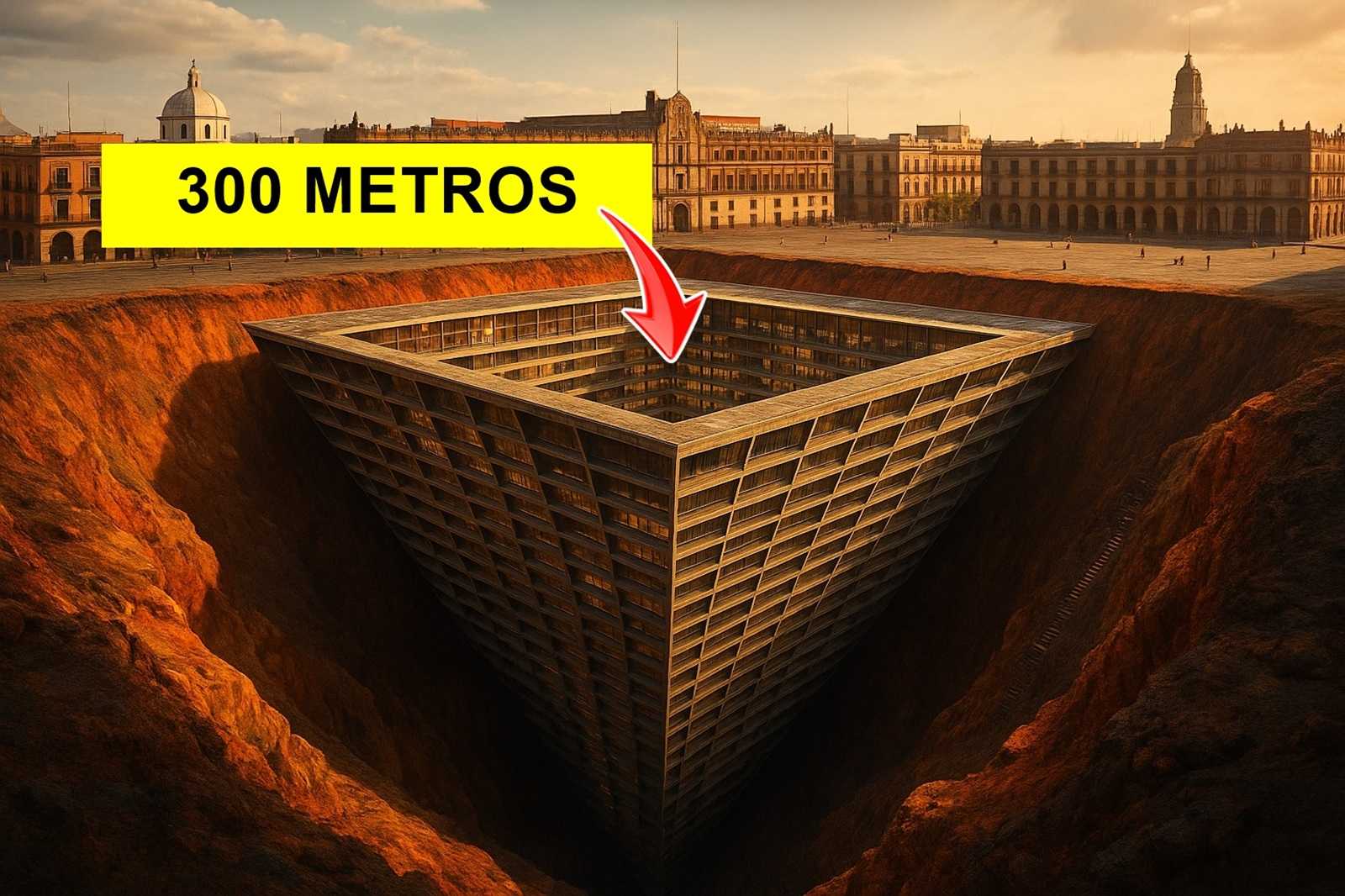


One of the Boldest Architectural Concepts in the World, the Earthscraper Promised to Create a Megastructure 300 Meters Below Mexico City, But Faced Structural, Legal, and Seismic Barriers That Buried the Project Before It Started
When the Earthscraper appeared in 2011, presented by the Mexican firm BNKR Arquitectura, the idea of buildings underground sounded so bold that it immediately caught the attention of architects, engineers, urban planners, and curious people from around the world.
Instead of reaching for the sky, as all traditional skyscrapers do, the proposal challenged logic by imagining a gigantic structure dug beneath the surface, forming an inverted skyscraper about 300 meters deep.
The inspiration came from a provocative question: in light of Mexico City’s accelerated urban growth and the restrictions imposed on the historic center, would it be possible to create additional space without compromising its cultural and architectural heritage?
-
In the Caucasus Mountains, a Community Preserves a Language So Rare Few Outsiders Can Understand It

-
Slovakia’s Ice Cave Holds Over 110,000 m³ of Frozen Wonders, Boasts Walls Up to 27 Meters Thick, and Was Among the First Electrified Caves Globally

-
Street Cleaner Accidentally Receives $200,000 Transfer, Returns Unexpected Fortune to Rightful Owner
-
Australian Space Agency Investigates Six Mysterious Metal Spheres Found on Queensland Beach, Isolating Area Over Possible Space Debris Risk


The proposal presented itself as a futuristic solution to the lack of available land in a vertically limited metropolis.
However, as the concept gained headlines, exhibitions, and debates, numerous technical, environmental, financial, and legal questions began to arise.
You will see in this article the origin of the project, the main challenges involved in its possible construction, and a complete explanation of what happened to the Earthscraper and why it never stopped being just a theoretical concept.
The Origin of the Idea of an Inverted Skyscraper
The Earthscraper emerged as a creative response to a real problem. Mexico City, one of the largest metropolises in the world, has been facing intense pressure for urban space for decades.
The historic center is a protected area, full of colonial constructions, Aztec ruins, and strict limitations imposed by preservation laws.
Tall buildings are prohibited, and deep excavations are extremely controlled, as any intervention could affect centuries-old structures and sensitive archaeological sites.
It was in this context that BNKR Arquitectura sought to stimulate public debate. Instead of proposing new towers, they imagined an inverted skyscraper beneath the Zócalo Square, one of the most symbolic regions of Mexico. The concept envisaged an inverted pyramid with several underground levels.
The first floors would be designated for exhibitions and museums about Aztec culture, the intermediate levels would house offices, residential areas, and commercial spaces, while the lower floors would accommodate technical activities, storage, and support operations.
To counterbalance the lack of natural light, the project included a system of glass skylights on top of the square, which would function as an enlarged mirror, capturing light and distributing brightness throughout the internal levels.
On paper, the combination of culture, innovation, and sustainable urbanism seemed intriguing. However, it took only a few preliminary analyses for experts to point out enormous obstacles.
The Structural Challenges of Excavating a 300-Meter Skyscraper Downward
The first and most obvious challenge of the Earthscraper relates to engineering. Digging the earth to extreme depths, the weight of the soil exerts far greater pressure than in constructions above the surface.
The stability of a void with hundreds of meters in diameter demands colossal containment systems, with continuous layers of reinforcement, constant monitoring of ground movement, and intensive use of concrete, steel, and advanced excavation techniques.
Moreover, the inverted pyramid shape reduces the usable area of the floors as one descends. This alone generates space waste and increases the proportional cost of each square meter built. In traditional buildings, the efficiency curve remains stable; in the Earthscraper, it would progressively decline.
Another critical point involves the foundation. Instead of supporting the building on columns or footings, as in common constructions, the Earthscraper would require an incredibly resilient base to support the compressed soil around it.
A structural system would need to be created that functions almost like an internal shell, protecting the building from lateral pressures that increase with depth.
In practice, the structural challenges would make the Earthscraper much more expensive and complex than any conventional skyscraper of the same scale.
The Seismic Risk in Mexico City
If engineering was already a gigantic obstacle, the chosen terrain made the challenge even greater. Mexico City was built on the bed of an ancient lake.
Its subsoil is formed by layers of soft clay, susceptible to deformations and amplification of vibrations.
The region also suffers from frequent earthquakes, originating from subduction zones near the Pacific Ocean.
A well excavated 300 meters deep would create a point of fragility in the ground. Any seismic tremor could generate internal fissures, mass displacements, partial collapse of side walls, or irreversible damage.
Rather than being a stable and protected structure, the Earthscraper would become highly vulnerable in one of the most unstable terrains in the world.
Even much smaller underground buildings already require exceptional care. Excavating tens of meters is labor-intensive; excavating hundreds would be too risky.
The Legal Limitations and the Protection of Historical Heritage
Another decisive reason for the Earthscraper never making it off the drawing board involves Mexican legislation. The Zócalo and its surrounding area are designated as national heritage. Any intervention underground requires authorization from preservation, archaeology, and culture agencies. Excavating a giant well in a region that houses Aztec ruins and colonial constructions is considered unfeasible by the authorities themselves.
Mexican legislation not only restricts the construction of towers. It also prevents deep modifications underground, precisely to avoid risks to historical and archaeological heritage. The Earthscraper’s proposal, therefore, directly conflicts with strict regulations that protect the city’s cultural identity.
Ventilation, Lighting, and the Challenge of Making an Underground Building Habitable
Even if the legal and seismic barriers did not exist, there would still be environmental challenges. A building entirely below the surface depends on artificial ventilation systems, air ducts, constant filtration, and permanent thermal control. The absence of natural light would require solar mirrors, complex skylights, reflective ducts, and continuous artificial lighting.
Besides exponentially increasing energy consumption, these solutions would create less healthy environments than conventional buildings. Research shows that windowless spaces generate feelings of confinement, increased visual fatigue, and negative psychological impact. The Earthscraper would have difficulty attracting residents or workers willing to live and work hundreds of meters underground.
Logistics and Cost: A Financially Unviable Project
If all the previous challenges already seemed difficult, the financial aspect makes the Earthscraper practically impossible. To excavate a 300-meter well in the city center, it would be necessary to remove millions of tons of earth, diverting traffic, blocking roads, installing cranes, trucks, and heavy equipment for years. The urban impact would be extreme.
Moreover, the cost to build each floor would be much higher than in traditional buildings, as each level would require additional structural reinforcements. Investors prefer safe, tested, and economically viable projects. The Earthscraper did not meet any of these criteria.
What Happened to the Earthscraper
With the sum of all these obstacles, the Earthscraper never advanced beyond the conceptual phase. It was not submitted as a real project to the Mexican authorities and never entered a pre-approval phase.
Over the years, the Earthscraper has become part of radical architecture exhibitions, frequently cited in debates about extreme urbanism and the limits of underground construction.
The BNKR firm acknowledges that the proposal was a provocation, created to stimulate reflections on urban density and limited vertical expansion. There was no real expectation of construction, and there are no plans to revisit the idea. In practice, the Earthscraper remains an architectural fiction that inspired conversations, reports, and analyses, but was never realistically capable of becoming a reality.


