Portuguese
  Spanish


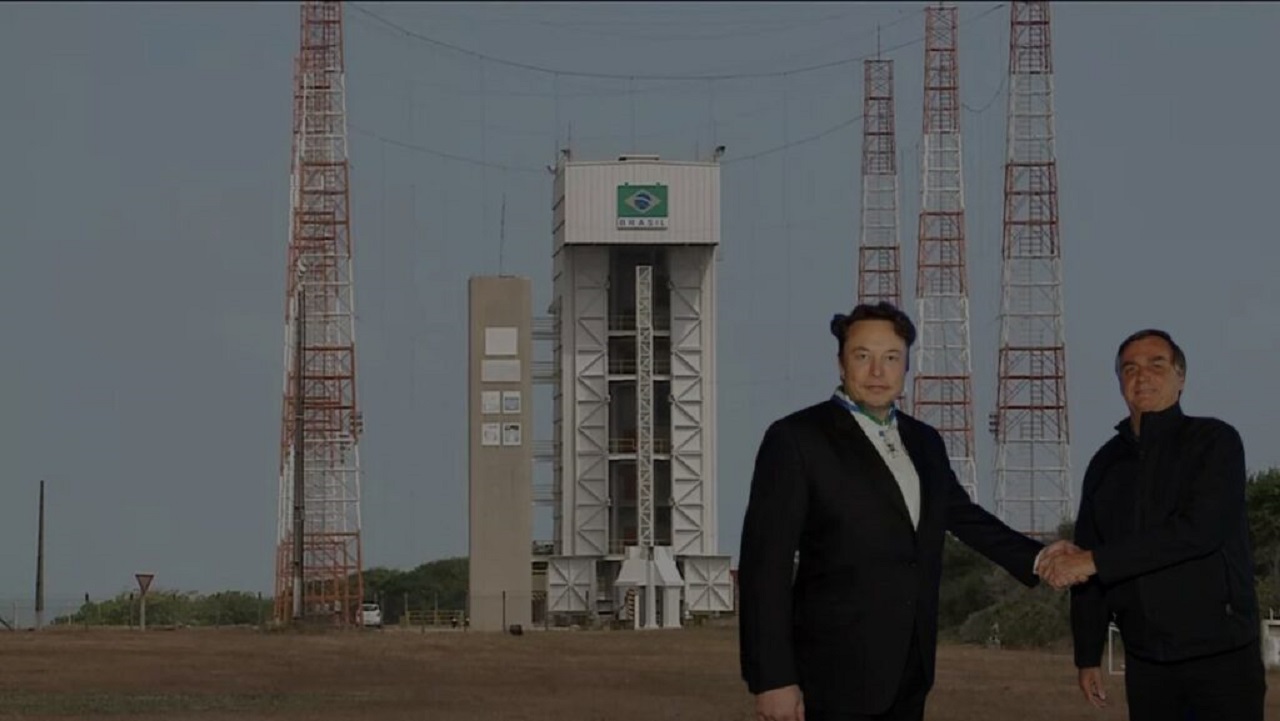

Elon Musk Plans to Invest in the Alcântara Launch Center for Rockets and Satellites, Beyond the Amazon.
The Billionaire Elon Musk visited Brazil last Friday (20) for a visit and revealed to politicians, businessmen, and authorities of the Federal Government his interest in making investments in several sectors. Thus, one of the areas that the Tesla owner plans to invest in is aerospace, especially at the Alcântara Launch Center for rockets and satellites (CLA), located in Maranhão. With an estimated worth of US$ 250 billion, Elon Musk’s portfolio includes the company SpaceX, focused on space exploration, and Tesla, an electric car manufacturer, along with high-speed train ventures, among others.
Elon Musk’s Objectives in Maranhão
One of the first partnerships announced by the Federal Government will be through Starlink, Elon Musk’s telecommunications company. The goal is to provide satellite internet from the company.
Through the company, the equipment will also be used for monitoring the Amazon rainforest and connecting 19,000 schools in rural areas. In January of last year, Musk’s company received approval from Anatel to operate in the country until 2027. A division of SpaceX, Starlink specializes in deploying satellites in low orbit and has experience in connecting deserts and forests.
-
28-meter, 156-ton titans traveled 20,000 km from China to the port of Santa Catarina: Portonave received 7 fully electric megacranes, part of a R$ 210 million package, to double container handling.

-
They exchanged the idea of a large house for a 35 m² warehouse, spent US$ 12,000 on the structure, and created a tiny house in Colorado with space to live and work.

-
A newly opened terminal in the middle of the Amazon has begun transporting soy and corn through Amapá, eyeing the queue of ships that is congesting the ports in the South.

-
Goodbye to old tiles: renovation technique without construction transforms bathrooms in a few hours, eliminates debris, and reduces costs with coverings using special paints, high-resistance adhesives, and modern finishes that completely renew the space.


Elon Musk’s interest in making investments in the Brazilian aerospace sector, especially at the Alcântara Launch Center for rockets and satellites (CLA), has received significant attention in Maranhão and national media. According to the newspaper O Estado de S. Paulo, one of the most attractive locations for investments in Brazil, for Musk, is the Alcântara Launch Center for rockets (CLA) in Maranhão. The region, close to the equator, is one of the most sought-after launch sites by companies and agencies in the aerospace sector.
The excellent conditions of the Alcântara Launch Center for rockets and satellites (CLA) include the launch trajectory and distance from Earth orbit, resulting in fuel savings. For SpaceX, which has become known for reducing the costs of space travel, a future partnership with CLA in Maranhão could be a significant advantage.
CLA Partners with South Korean Company
Earlier this month, Innospace and the Alcântara Launch Center for rockets and satellites (CLA) secured a partnership for the first suborbital launch in December of this year.
The initiative will serve as a test for a single-stage rocket that is approximately 16.3 meters tall and is named HANBIT-TLV. This test will lay the groundwork for the company’s satellite launcher, named HANBIT-Nano, designed to carry a payload platform of up to 50 kg into a polar orbit, crossing the planet’s poles at an altitude of about 500 km.
Elon Musk’s Visit to Brazil


Elon Musk was present in Brazil for a meeting with President Jair Bolsonaro in the interior of São Paulo. The focus of the meeting was connectivity and the environment, involving the Amazon region. One of Musk’s goals is to make investments in satellites for 5G internet in the state.
Such investments involve a constellation of 4,000 low-orbit satellites that will be launched at a distance of approximately 500 km above the Earth, which is quite close to the surface, compared to more common satellites that orbit at a distance of 35,000 km.