






 Portuguese
  Spanish
  4 min of reading
  0 comments


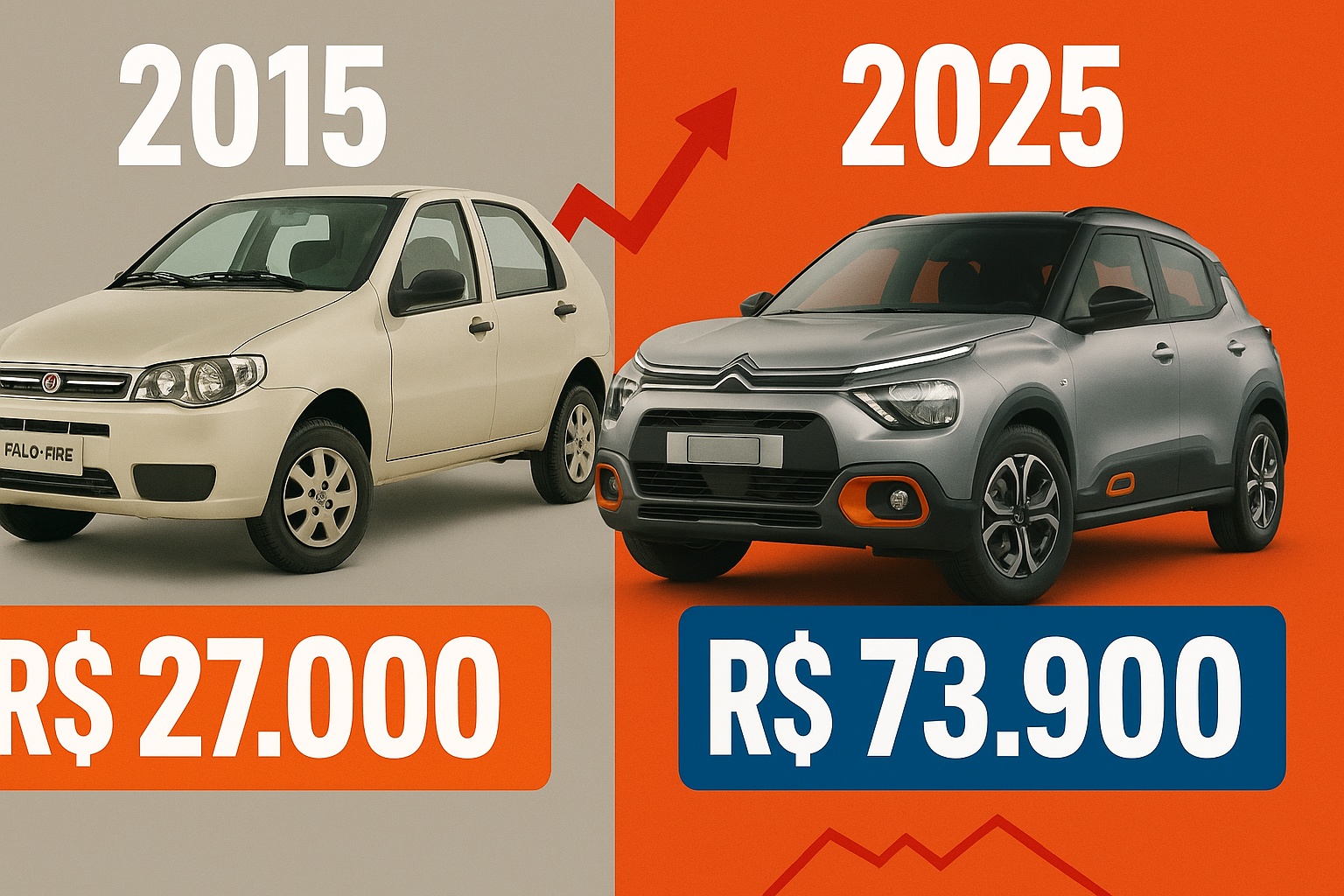
In 2015, the cheapest car in Brazil cost R$ 27 thousand; in 2025, the value exceeds R$ 70 thousand, changing access to the popular car and its concept.
The access to the popular car in Brazil underwent a radical transformation in the last decade. In 2015, the title of the cheapest car in Brazil belonged to the Fiat Palio Fire, sold starting at R$ 27,590. By 2025, the position is held by the Citroën C3 Live, which reaches dealerships for R$ 73,990. In ten years, the price has nearly tripled, altering not only the consumer’s pocket but also the concept of popular cars in the country.
Cheapest Car in Brazil Cost R$ 27 Thousand: The Example of the Fiat Palio Fire
In the 2016 line, launched in mid-2015, the Fiat Palio Fire caught attention for its affordable price and simplicity. The most basic version with two doors cost R$ 27,590, while the four-door configuration was priced at R$ 29,920.


Despite the low price, much of the equipment was offered only as optional. To have power steering, the consumer would need to pay an additional R$ 1,111. Air conditioning, locks, and power windows came in a kit of over R$ 3,100. Even the radio, with USB input, cost an extra R$ 182.
-
New Honda HooRide 125 scooter debuts in China with ADV styling, 17-inch wheels, TFT panel, Smart Key, and fuel consumption of up to 47.17 km/l, aiming to resemble an urban X-ADV with a 125 engine, CVT transmission, and an economical proposal for cities.

-
Volkswagen focuses on ethanol and tests a Saveiro 100% alcohol-powered with a recalibrated engine; the project may ensure tax reduction, targets corporate fleets, and revives technology that lost ground since the arrival of flex-fuel vehicles in 2003.

-
Keeping your foot lightly on the brake pedal while driving may seem harmless, but mechanics warn: this habit generates constant heat, wears out the pads too quickly, and can warp the discs, making braking expensive and dangerous.

-
The YouTuber Mark McCann bought a Bugatti Veyron for almost $1.2 million, but discovered that the supercar’s gearbox is so damaged that even Bugatti itself won’t accept to repair it, and the repair could cost a fortune.


In its mechanical assembly, the Palio Fire used the veteran 1.0 Fire flex engine, with up to 75 hp of power, coupled with a five-speed manual transmission. Fuel consumption was around 8.8 km/l in the city and 15 km/l on the highway when fueled with gasoline. At 3.82 meters long and a trunk capacity of 280 liters, it was a compact car without luxuries, true to the entry-level vehicle concept.
Value of Popular Car in 2025: The Era of the Citroën C3 Live
A decade later, the cheapest car in Brazil is the Citroën C3 Live, sold for R$ 73,990. The compact hatch, despite carrying the label of popular, delivers much more technology and equipment than the Palio Fire offered in 2015.
Standard items include ABS brakes, stability and traction controls, hill start assist, electric steering, air conditioning, and electric front windows and locks. The highlight is the 10-inch multimedia center, with support for Android Auto and Apple CarPlay.
Under the hood, the C3 Live comes equipped with a 1.0 Firefly engine with up to 75 hp and 10.7 kgfm of torque. In dimensions, it is noticeably larger: 3.98 meters long, 1.73 m wide, a wheelbase of 2.54 m, and a trunk capacity of 315 liters. Fuel consumption also shows efficiency, reaching 14.6 km/l on the highway with gasoline.
Inflation and Production Costs
Between July 2015 and July 2025, the Broad Consumer Price Index (IPCA), calculated by IBGE, accumulated an increase of 70.1%. This means that, if it were only inflation, the Palio Fire priced at R$ 27,590 should cost around R$ 47 thousand in updated values.
However, the value of the popular car in 2025 exceeds R$ 70 thousand, a level far above what inflation would explain. The increase also reflects other factors, such as rising input costs, a higher tax burden, and the adoption of new mandatory safety and emissions technologies.
Equipment and the Change in the Concept of Popular Car
In 2015, a consumer looking for the cheapest car in Brazil accepted a basic vehicle, without power steering, air conditioning, or electric windows. Today, the entry-level concept has changed. Even the most affordable models come with an electronic safety package, a multimedia center, and items that were unthinkable for the price range ten years ago.
This technological leap, although positive for the comfort and safety of the driver, has distanced the access to the popular car from millions of Brazilians. What was once a viable option for low-income families or young people buying their first car has now become a more elitized consumer good.
The Change in Access to the Popular Car
The price of the cheapest car in Brazil has nearly tripled in ten years, creating a greater barrier for those wishing to purchase a new vehicle. Many consumers who could previously move to the entry-level segment now turn to the used market or choose mobility apps as an alternative.
While in 2015 a worker earning close to two minimum wages could finance a Palio Fire, by 2025 it is practically unfeasible to acquire a C3 Live without compromising a large part of the family income. The result is a shift of the dream of a new car to a smaller segment of the population.
The Future of Entry-Level Cars in Brazil
The trend is that prices will remain high, especially with the introduction of new regulatory requirements and rising production costs. On the other hand, experts believe that automakers may adopt strategies such as producing simpler hybrid models or even compact electric vehicles, driven by government incentives.
Still, the challenge remains: how to offer an affordable and safe vehicle without compromising the financial sustainability of automakers? So far, the market shows that the access to the popular car has become more restricted and that the definition of “entry-level car” has completely changed in Brazil.
And you, do you believe we will see again in the Brazilian market a truly popular car, with prices compatible with the reality of most families?









-

-

-

-

10 people reacted to this.