





 Portuguese
  English
  Spanish
  5 min of reading
  0 comments


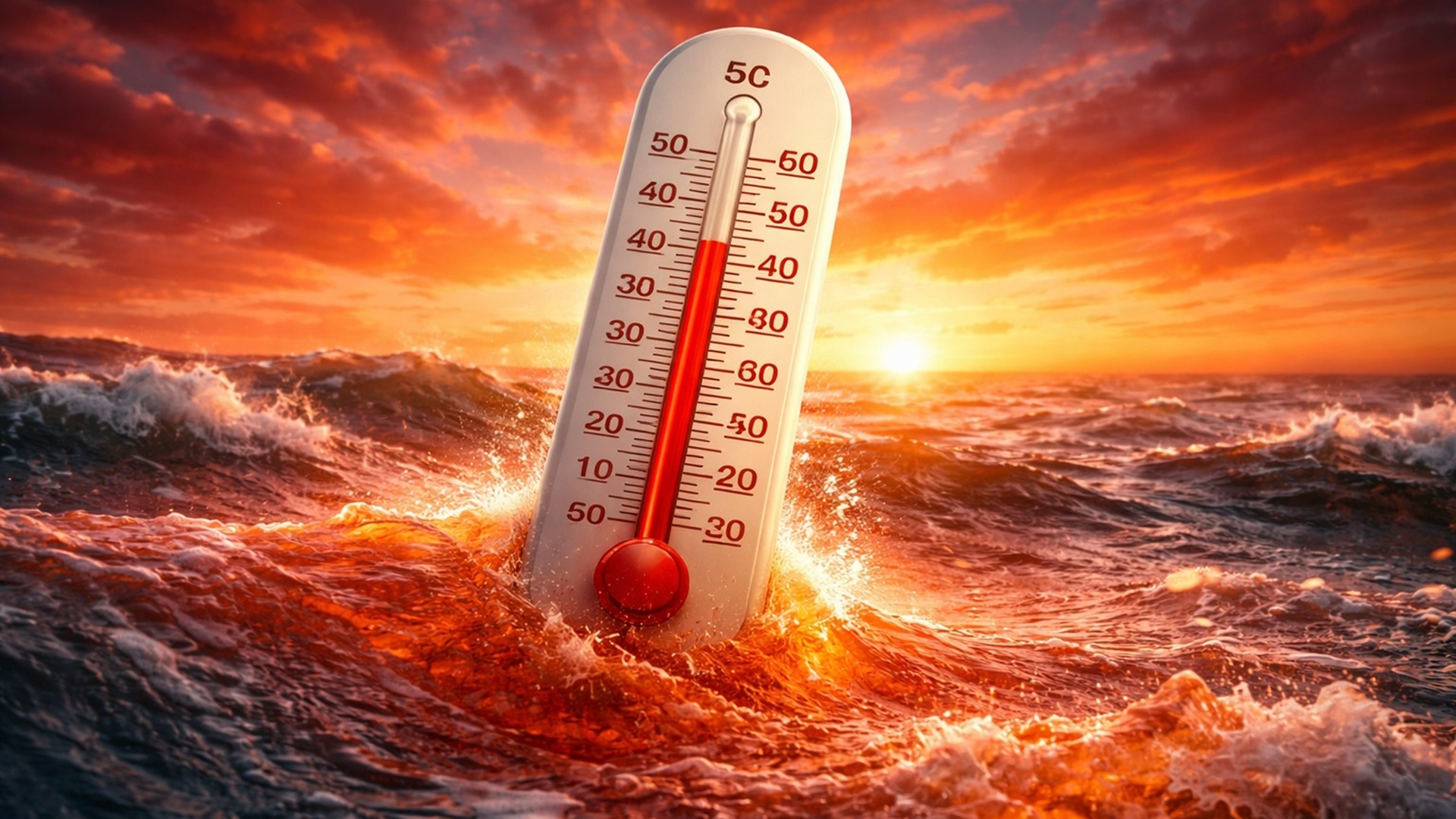
Global Analysis Confirms That Oceans Absorbed An Amount Of Energy Equivalent To 37 Years Of Human Consumption In 2025, Establishing The Ninth Consecutive Heat Record And Warning Of The Acceleration Of Extreme Climatic Events That Directly Affect Biodiversity And Global Coastal Security
A global team of scientists confirmed that oceans absorbed unprecedented levels of energy in 2025, totaling 23 zettajoules. The data, published in Advances in Atmospheric Sciences, indicate the continuation of a warming trend that intensifies extreme events and alters global patterns.
The findings were released today, January 9, and detail that the ocean heat content reached an unprecedented level. This scenario represents the continuation of a long-term warming trend observed over recent decades.
The volume of heat absorbed in 2025 is 23,000,000,000,000,000,000,000 joules. This energy magnitude is comparable to approximately 37 years of total global primary energy consumption, based on usage rates recorded in 2023.
-
A satellite from NASA and the French agency captured from space the largest wave ever measured in the open sea, a wall of water nearly 20 meters high generated by Storm Eddie in the North Pacific in December 2024, as tall as a six-story building.

-
Forget the common mining dust: BHP combines 150,000 native plants, windbreak curtains, and real-time monitoring to reduce particles in Port Hedland, where iron ore stockpiles face strong winds and even cyclone-ready systems during port operations.

-
Scientists discover that tires are releasing invisible microplastics into city air, raising concerns about what we breathe every day.

-
Scientists have discovered a hidden underwater “portal” beneath the largest glacier in East Antarctica, capable of carrying warm water to the ice base; Totten drains a colossal basin with the potential to raise sea levels by more than 3.5 meters.




In that base year, global consumption was around 620 exajoules annually. The analysis presented reflects the joint effort of more than 50 researchers linked to 31 different institutions around the globe.
The study stands out as one of the most comprehensive assessments of ocean heat conducted to date. It highlights the capacity of oceans to store thermal energy on massive scales.
Methodology And Global Data Sources
To accurately measure warming, scientists unified multiple independent data sources. This information comes from key international climate and oceanographic monitoring centers.
Among the sources utilized are three distinct observation products. They include data from the Institute of Atmospheric Physics of the Chinese Academy of Sciences, Copernicus Marine, and NOAA/NCEI.
In addition, an ocean reanalysis technically known as CIGAR-RT was used. The combination of these data sets allows for geographic coverage that includes Asia, Europe, and the Americas.
This integration provides a consistent overview of the increase in ocean temperature. All analyzed data sets confirm that heat content reached its highest recorded level in 2025.
This reinforces scientific evidence that oceans continue to absorb increasing amounts of energy year after year. The ocean is crucial in regulating climate, retaining over 90% of the extra heat generated by greenhouse gases.
For this reason, ocean heat content is considered one of the most reliable indicators of long-term climate change. It measures the accumulated amount of heat in the waters over time.
Uneven Distribution Of Warming In Basins
The warming process does not occur uniformly across the globe. In 2025, about 16% of the world’s ocean surface reached its highest heat content ever recorded historically.
At the same time, approximately 33% of the surface ranked among the three hottest years ever observed in those specific regions. Warming proved to be more pronounced in specific areas of the planet.
The most affected regions included tropical oceans and the South Atlantic. The North Pacific and the Antarctic Ocean also recorded significant thermal increases in their waters.
Overall trends indicate that ocean warming has accelerated since the 1990s. In the upper 2000 meters of the water column, heat accumulation has remained relatively stable over recent decades.
Despite this relative stability, scientists detected a slight increase in the rate of warming in that layer. The year 2025 marks the ninth consecutive year in which a new heat record has been set.
Surface Temperatures And Climatic Consequences
The global average sea surface temperature in 2025 was the third hottest ever recorded by instruments. The values remained about 0.5 °C above the average observed between 1981 and 2010.
There was a slight reduction in surface temperatures compared to 2023 and 2024. This fact is mainly due to the transition from the El Niño phenomenon to La Niña in the tropical Pacific.
Surface temperatures are crucial as they strongly influence climatic patterns worldwide. Warmer waters intensify evaporation and increase rainfall volume.
These conditions contribute to the formation of stronger tropical cyclones and extreme events. In 2025, such conditions influenced severe flooding across much of Southeast Asia.
Additional impacts were recorded, such as prolonged drought in the Middle East. Further flooding occurred in parts of Mexico and the Pacific Northwest region.
The increase in temperature also contributes to rising sea levels through thermal expansion. Furthermore, it intensifies and prolongs heatwaves, adding moisture and energy to the atmosphere.
As long as the Earth continues to generate excess energy, ocean heat content will keep rising. New records will continue to be broken as this trend persists.
Publication Details And Scientific Context
The complete results will be published in a special collection of the journal Advances in Atmospheric Sciences. The focus of the issue is specifically on Changes In Ocean Heat Content.
The cover of the collection features artistic illustrations of a shrimp and a crab with sad expressions. The idea was suggested by Lijing Cheng, the corresponding author of the study and affiliated with the Institute of Atmospheric Physics.
Cheng explains that the inspiration came from the “shrimp soldiers and crab generals” of the work Journey To The West. They were reimagined not as powerful guardians but as vulnerable creatures.
Their natural armors, composed of shells and scales, are under attack due to warming and acidification. The collection will explore multiple dimensions of ocean temperature change in detailed regional studies.
There will be a focus on the waters surrounding China, the South Pacific, and the Indian Ocean. Climate scientist Kevin Trenberth noted in the preface that the collection was designed to grow over time.
The aim is to reflect ongoing advancements in climate science. Despite the evolution of knowledge, the greatest uncertainty lies in humanity’s response to the data.
Reducing emissions and acting collectively are pathways identified to protect the climate. It is necessary to prepare for future impacts to ensure that ecosystems and people can thrive.
This article was produced based on the data and information from the study published in the journal Advances in Atmospheric Sciences, conducted by a team of more than 50 researchers from 31 global institutions and released on January 9, 2025.
This article was produced based on the data and information from the study published in the journal Advances in Atmospheric Sciences, conducted by a team of more than 50 researchers from 31 global institutions and released on January 9, 2025.







-

-

-

-

22 people reacted to this.