Portuguese
  Spanish


An Isolated Community in The Pacific Lives Without Cars, With Limited Energy and Artisanal Fishing, Preserving An Ancestral Way of Life Under Threat From The Ocean.
Imagine waking up to the sound of waves crashing on the reefs, the smell of the sea coming in through open windows, the sun illuminating handmade huts made from local wood and woven leaves. No honking, notifications, or clocks competing for your attention. Just the rhythm of nature, the song of the birds, and the noise of paddles cutting through the water. This reality, which for many seems a distant dream, is the daily life of entire communities in small archipelagos of the Pacific, such as Tuvalu and Kiribati. There, time does not run: it flows.
There are no cars. There are no shopping malls. There is no rush. The economy is based on artisanal fishing, community agriculture, and direct trade between residents. The only wealth is the land, the sea, and human connection. A world where the internet arrives late, the lights go out early, and priorities are not productivity or goals, but survival, family, and coexistence.
This scenario contrasts with the hyper-connected planet that is growing at an exponential speed. While large metropolises discuss artificial intelligence, 6G networks, and autonomous cities, these islands maintain age-old traditions, an ancestral pace, and a deep relationship with the ocean that has shaped their history, culture, and faith.
-
Brazilian Airport to Receive $2.8 Million Investment, Completion Expected Within a Year

-
UN Warns of AI’s Environmental Impact and Calls for Greater Corporate Transparency

-
Former Atacadão Employee Turns Online Cake-Baking Lessons into a Confectionery Brand with Factory, Store, Delivery, and Nearly $400,000 in Revenue
-
Brazilian Startup Sells Nearly 9 Million Surprise Bags of Near-Expiry Food, Prevents Thousands of Tons of Waste, Aiming for $42 Million Revenue by 2026



Remote Islands Where The Sea Defines Life And The Local Economy
The sea is sovereign. It feeds, protects, and threatens. Daily, men and women descend to the beaches carrying baskets and manually woven nets. There are no large industrial vessels: only canoes, paddles, and skills passed down through generations. Fish such as tuna, snapper, and grouper are not commodities; they are sustenance.


On the islands, taro, cassava, banana, breadfruit, and coconut are planted. The land is fertile and generous, but demands respect. There is no intensive farming or agricultural machinery. The cultivation is communal, and the harvest follows the seasonal cycle, not the financial calendar.
There are no supermarkets. There are no deliveries. There are no cards. Every meal requires work, patience, and local wisdom. Food comes from the sea and the soil, and what does not exist, is not consumed.
Electricity, when available, is rationed. Many communities receive electricity only a few hours a day through small diesel-powered generators or shared solar panels. During this time, families charge small radios, lanterns, and sometimes a simple fan to ease the nighttime heat. When the power goes out, the moon takes charge.
Culture, Spirituality, And The Value Of Community
Living on remote islands is not just a physical condition — it is a philosophy. Modernity has brought the world the concept of individualism, but in these communities, it does not exist. The “I” would not survive without the “we.”
Extended families live close together, share tasks, care for children and the elderly, share food, and celebrate the cycle of life together. The word “community” is not a social concept: it is a law of survival.
In the absence of technology, culture flourishes. Ancestral stories are told in the evening, when the sun hides on the horizon and the village gathers to sing, dance, and honor their ancestors. Chants, drums, and rituals celebrate the sea, the wind, the coconut trees, and the stars — ancient guides for fishermen and navigators of the Pacific.
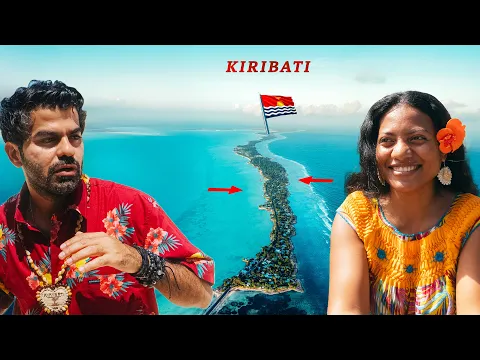
And it is precisely this tradition, this spiritual and human bond, that creates a rare and inspiring lifestyle. A model of society where progress is not measured by money, goods, or screens, but by harmony, respect, and essence.
Climate Change: The Paradise Threatened By The Rising Sea
But this paradise is at risk. The same waters that feed and embrace these islands are beginning to encroach upon them. According to UN data, countries like Tuvalu and Kiribati are among the most threatened by rising sea levels — a result of global climate change.
Small floods, once rare, have become frequent. Arable lands are invaded by salt, coconut trees topple with the tide’s advance, and homes need to be rebuilt on elevated structures. In some villages, residents have already been relocated to nearby islands.
These nations, which have contributed almost nothing to global emissions, now face the highest cost: the risk of disappearing from the map.
The Transition Between Two Worlds And The Uncertain Future Of These People
Youth face a dilemma: to stay and preserve their roots or to leave in search of opportunity and security in large foreign cities, such as Auckland or Suva. Many study technology, tourism, and commerce in neighboring countries, but carry with them fear and longing. They represent a link between past and future, between tradition and the globalized world.
When they return, they bring mobile phones and a desire for connectivity, and it is in this cultural clash that the transformation occurs. The islands begin to experience a silent transition, where modernity arrives slowly, but it arrives.
Larger solar panels emerge. Community internet networks expand. Young people begin to video record their culture so that it never gets lost. But at the same time, the internal debate grows: how to modernize without losing the soul?
A Call To Look At The World Beyond Concrete
The existence of these islands compels us to reflect on the meaning of “progress.” Will we be more evolved just because we produce more, spend more, and connect faster? Or is there something deeply valuable in simplicity, silence, and a life guided by nature?
As we celebrate technological advances, mega-cities, and artificial intelligence, these communities show us another kind of intelligence, the ancestral intelligence of living in balance, knowing that the land is not a resource, but a home.
This story is not about backwardness. It is about choice. About a way of life that resists, that enchants, and that alerts the modern world that not all evolution lies in machines. Sometimes, it lies in the sea, in the net launched at dawn, and in the fish shared at sunset.
And perhaps, in the end, it is this independence from hurry that represents the purest form of freedom.