






 Portuguese
  Spanish


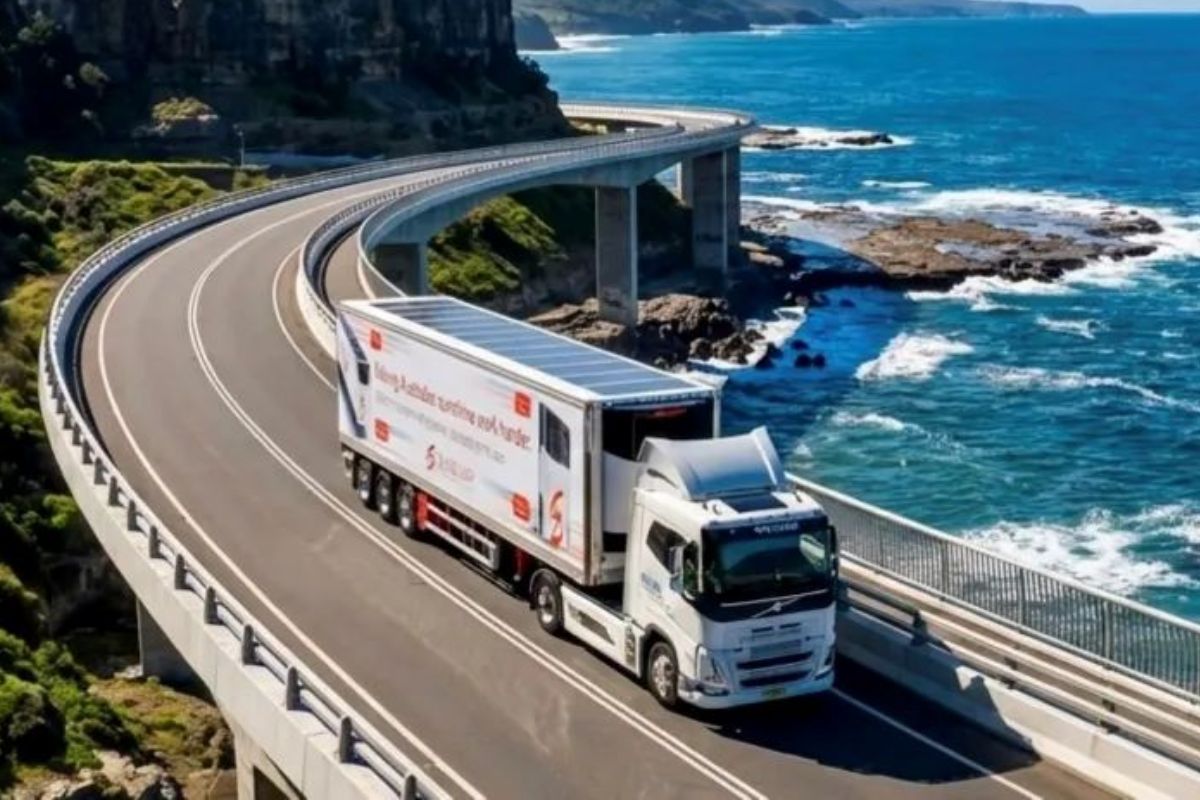


Company Tests Refrigerated Trailer With Solar Panels, Crosses 1,600 Km Between Sydney and Brisbane in 3 Days, Keeps Load Cold and Uses Zero Diesel for Refrigeration.
A very common scenario in food transport is still marked by noisy diesel generators, constant fuel consumption, and CO₂ and NOx emissions, especially in refrigerated trailers that need to keep the cold chain active 24 hours a day. In this context, an Australian company decided to reverse the logic and install solar panels on the trailer, on the roof of the semi-trailer, to directly power the electric refrigeration.
The practical result was a real road test: 1,600 km traveled in 3 days between Sydney and Brisbane, with milk, meat, and vegetables kept at controlled temperatures, silent operation, and zero diesel burned in the cooling system, showing that innovation can arise from a simple and well-applied solution.
How Solar Panels Work on the Trailer
The proposal from Sunswap Endurance, in partnership with Protran Solutions, is not to reinvent the truck, but to change the way the trailer’s refrigeration receives energy.
-
Spain Launches World’s Largest Floating Dry Dock: 56-Meter Giant Produces Massive Concrete Structures in A Coruña Using Technology Proven in Brazil

-
AI-powered toys that talk, recognize faces, and collect data face scrutiny from Brazilian government over children’s privacy concerns

-
4,000-Year-Old Child’s Skull Unveils Ancient Burial in 7,500-Year-Old Norwegian Rock Shelter, Impressing Archaeologists

-
Norway Defeats Brazil in World Cup but Invests Billions to Preserve the Amazon, Strengthens Amazon Fund, and Joins Brazil in Leading Global Effort Against Tropical Deforestation



Instead of relying on an attached diesel generator, the system integrates photovoltaic modules to the roof of the trailer to charge high-capacity internal batteries.
These batteries power the electric cooling unit throughout the entire logistics cycle: on the road, during loading and unloading stops, and even overnight.
When the vehicle is parked at a terminal or warehouse, the trailer can be connected to the electrical grid for supplementary recharging, functioning as a backup and safety system.
In practice, the solar panels on the trailer turn the “useless” roof area into a compact power plant, producing energy precisely during the sunniest and hottest hours when cooling demand is most intense.
Instead of consuming more fuel on hot days, the system gains more energy during these critical moments, enhancing the efficiency of the cold chain.
Real Test Between Sydney and Brisbane, Not Just a Demonstration
To validate the solution, the trailer equipped with solar panels on the trailer was subjected to a typical food transport route: round trip between Brisbane and Sydney, covering about 1,600 km in 3 days. No reduced route, symbolic load, or laboratory schedule.
The trailer operated with temperature-sensitive products, such as milk, meat, and vegetables, facing heat, real stops, and logistical deadlines similar to those of a conventional trailer.
In the end, the operation recorded zero diesel consumption in the refrigeration system, zero direct emissions from the cooling unit, and dramatically reduced noise. The load arrived in perfect condition, without delays and without shortcuts.
The message is clear: this is not a prototype for a fair or event, but logistics in action, with performance comparable to that of a traditional diesel-powered system.
Less Complexity, More Efficiency in the Cold Chain

Many electrification proposals in heavy transport try to draw energy from everywhere: electrified axles, regenerative braking, electric power take-offs connected to the truck.
These are interesting technologies, but they can add weight, cost, and complexity to the setup, in addition to reducing payload capacity.
By concentrating the solution on the roof and batteries, solar panels on the trailer tackle the problem with fewer moving parts and fewer points of failure.
The ongoing decline in the price of photovoltaic panels and batteries over the past decade makes this approach increasingly competitive, even without relying on subsidies.
Less maintenance, less noise, and more predictable costs position this model as a natural candidate for companies looking to decarbonize the cold chain without completely redesigning their fleets.
For the operator, the logic is simple: the same logistics as always, with a completely different environmental and acoustic impact.
Stricter Regulations and More Demanding Cities
Cities and regions around the world are tightening noise and emissions regulations, not only for traffic but also for loading and unloading operations, especially at night.
Diesel generators connected in urban docks are already seen as a regulatory and image liability.
In this context, refrigerated trailers powered by solar panels allow compliance with stricter regulations without changing routes or investing in complex infrastructure.
They fit naturally into electric or hybrid fleets, eliminating the contradiction of having a clean truck pulling a noisy and polluting trailer.
Additionally, by operating with electric energy, these systems can be charged from increasingly renewable grids, amplifying climate gains over the years.
The transition of the cold chain no longer relies solely on future promises and starts to count on a technology that is already available and tested in real routes.
Potential to Decarbonize a Blind Spot in the Energy Transition
The cold chain is a classic blind spot in the energy transition of transport. Even when the tractor truck evolves to cleaner or electric engines, the refrigerated trailer often continues burning diesel separately, keeping emissions and noise at high levels.
When applied on a large scale, systems with solar panels on the trailer can:
- Rapidly reduce the climate footprint of food and flower transportation
- Facilitate compliance with environmental standards without sacrificing deadlines or routes
- Integrate into cleaner and renewable electrical grids
- Inspire similar solutions for other mobile uses that require continuous energy, such as medical units, mobile laboratories, or special equipment
Sometimes, innovating does not mean inventing something completely new, but seeing the potential of what we already have, like the sun, a trailer roof, and a noise and emissions problem that has lingered for decades.
What do you think, do you believe that simple solutions like solar panels on the trailer will really gain space in food transportation or do you still see diesel as the inevitable protagonist of the cold chain?








This is a British company called Sunswap. They have had trailers on the road now for a while.