






 Portuguese
  Spanish


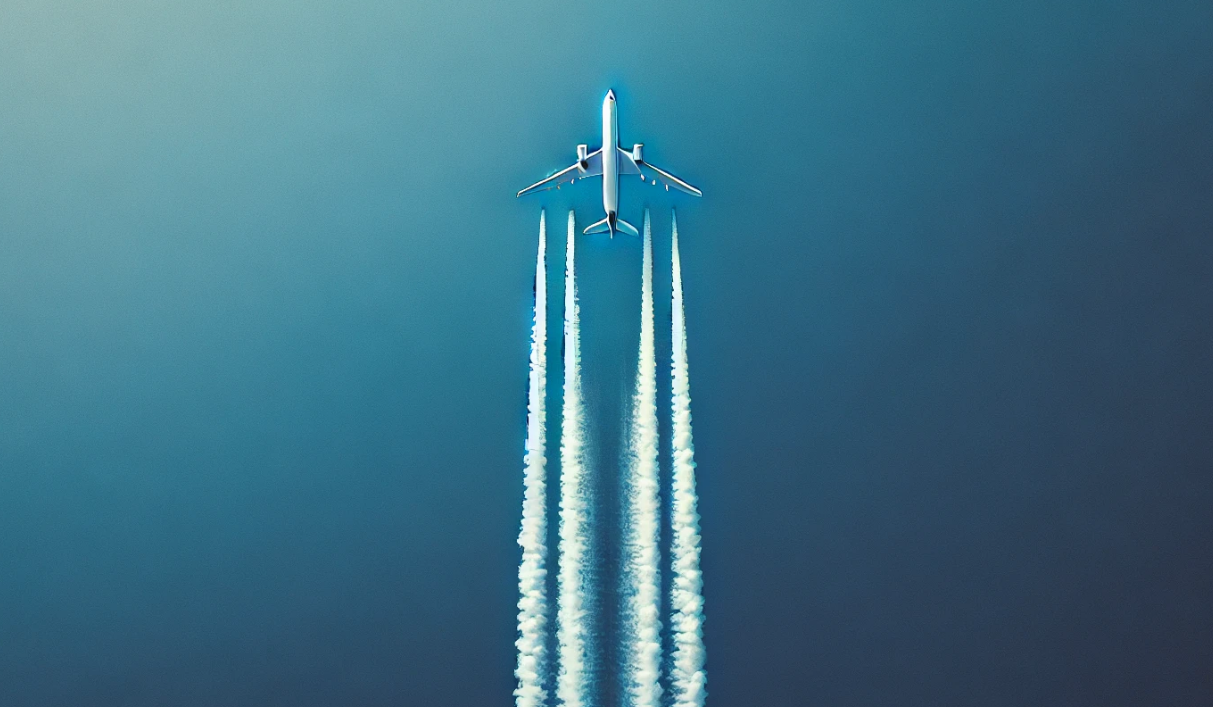

Testing Technology Promises to Reduce Aircraft Contrails, Helping to Decrease Carbon Footprint and Boosting More Sustainable Practices in Aviation.
The global aviation sector is responsible for nearly 3% of carbon dioxide (CO₂) emissions generated by humans. However, experts warn that the real impact may be even greater. In addition to CO₂, kerosene combustion releases pollutant particles that significantly contribute to global warming. Another worrying factor is the contrails left by aircraft, a physical phenomenon called cirrus homogenitus, which may play an underestimated role in the climate crisis.
Contrail: An Overlooked Climate Problem
These trails formed at high altitudes have a considerable negative effect on the climate. They disrupt the ozone layer and intensify global warming by acting as greenhouse gases.
A study published in the journal Scientific Environment revealed that these artificial clouds, which generally form at 8,000 meters above sea level, may account for more than half of the impact of air transport on the Earth’s temperature increase.
-
University of Sydney Student Creates Artificial Cosmic Dust in Lab to Help Uncover the Origins of Life

-
Table Salt Sodium Emerges as Billion-Dollar Bet for Cheaper Electric Vehicle and Energy Storage Batteries

-
Ultrasound Body Scanner Promises Full-Body Mapping in 60 Seconds Without Radiation or Contrast, Enhanced by AI for a Faster, More Comfortable Preventive Exam Experience
-
In the US, researchers attached iPhones to a $25 grabber, turning 22 homes into a database to teach robots to open drawers and handle objects like humans.


The European Federation for Transport and Environment argues that it is possible to cut the environmental impact of these trails by half. The solution? Make small changes to aircraft routes to avoid humid and cold areas, where condensation is more likely.
Flights Footprint
Seeking to tackle this challenge, the French group Thales, specializing in aerospace electronics, created the Flights Footprint. This innovative tool uses artificial intelligence and machine learning to calculate flight routes that minimize contrail formation.
According to the organization Transport & Environment, only 3% of flights are responsible for more than three-quarters of the global warming related to cirrus homogenitus. Thus, Thales aims to focus on these more polluting flights. The system suggests alternative trajectories to reduce environmental damage.
Initial Tests Show Promising Results
Since 2024, Flights Footprint has been in the testing phase in partnership with the French airline Amelia, which uses the system on routes between Paris and Valladolid, Spain.
Adrien Chabot, Director of Sustainable Development at Amelia, states that the solution can save up to 4 tons of CO₂ equivalent per flight. However, there is a 2.4% increase in fuel consumption — a cost considered acceptable by the parties involved.
Experts Call for More Data
Despite the optimism, not everyone agrees on the effectiveness of the system. Philippe Novelli, Director of Environmental Projects at the French aerospace research center Onera, warns that the available data is still insufficient to assess the real environmental benefit of the technology, especially considering the increase in fuel use.
It remains to be seen whether this innovation will make the famous white streaks in the sky cease to be a symbol of aviation’s environmental impact.
With information from NZ.


