






 Portuguese
  Spanish


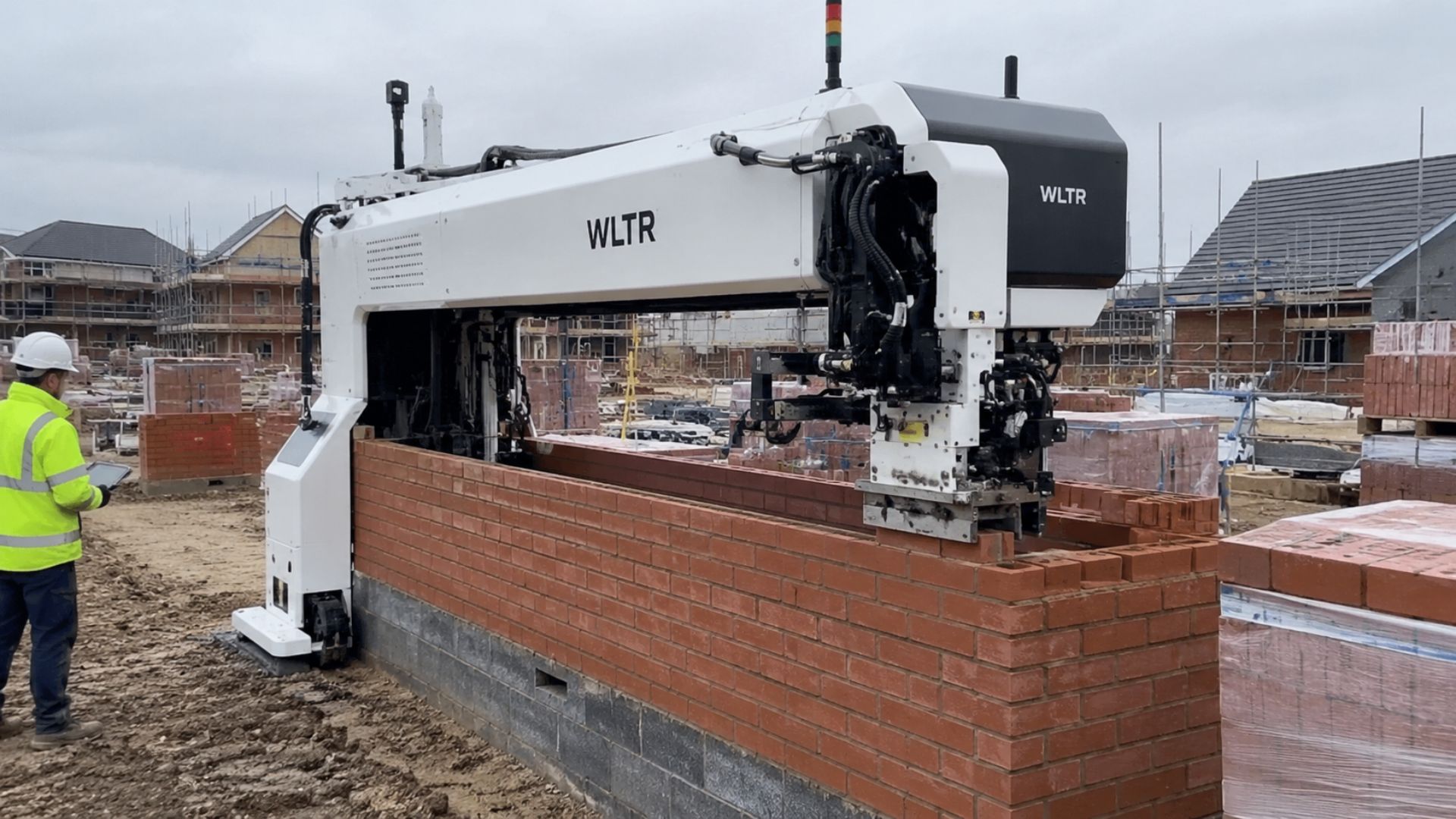

Autonomous equipment developed in the United Kingdom operates under any weather condition, eliminates scaffolding, and replaces cement mortar with special glue, significantly reducing the environmental impact of civil construction compared to traditional methods.
The civil construction sector has gained a significant technological boost with the development of the WLTR robot, pronounced “Walter,” an autonomous equipment capable of performing the work of five masons and one helper in just one hour of continuous operation.
The machine was developed to take on the heaviest and most repetitive task on construction sites, brick wall building, and represents a direct response to the growing shortage of skilled labor affecting the civil construction sector in several countries.
To operate, the WLTR requires only the command of a single human supervisor, who monitors the operation remotely while the equipment autonomously performs alignment, adhesive application, and the precise placement of each brick.
-
AI Radar Built with Old Camera and $20 Gains Attention After Alleged $317,000 Sale to Chinese Government, But Lack of Documentation and Official Confirmation Raises Questions

-
Amateur Detectorist Discovers 3,400-Year-Old Bronze Age Gold Treasure with 121 Pieces in Transylvania, Including a Unique Ring

-
Italian Designer Develops Solar-Powered Terracotta Water Purifier Producing Up to 5 Liters of Drinking Water Daily Without Electricity

-
New Hydrogel Made from Algae and Shrimp Shells Absorbs 60 Times Its Weight in Water to Combat Drought in Spanish Agriculture


The system eliminates the need for scaffolding and internally carries all architectural projects it will work with, only requiring that the brick pallets be periodically replenished and that the first layer of the structure is previously leveled on site.
The alignment precision achieved by the robot is just two millimeters of margin of error, a mark that most human professionals rarely achieve at the pace demanded by the market, making the final result technically superior to the conventional standard.
Cement Replacement and Reduced Environmental Impact

One of the most relevant innovations of the system is the replacement of traditional cement mortar with a specially developed glue for the technology, a change that radically transforms the environmental impact of the wall and structure construction process.
The production and use of conventional cement account for about 6% of global carbon dioxide emissions, making the construction sector one of the largest contributors to climate change on a planetary scale over the past decades.
By replacing this input with a more efficient adhesive with a lower carbon footprint, WLTR paves the way for more sustainable construction, aligned with the decarbonization goals that governments and companies are increasingly urgently establishing worldwide.
Besides the environmental issue, eliminating cement also reduces the total weight of structures in some applications, facilitates the assembly process, and can contribute to greater durability of walls in certain types of residential and commercial buildings.
The equipment also operates under any weather condition, which represents a significant operational advantage over human teams, who often need to halt activities due to rain, strong winds, or extreme temperatures on construction sites.
Strategic context and the interest of new generations
The innovation emerges at an especially strategic moment for the United Kingdom, where the government has announced ambitious plans to build over a million new homes to address the severe housing crisis that has affected the country since the last decade.
With the shortage of skilled bricklayers at historically high levels in the British market, the use of robots like WLTR emerges as a viable alternative to accelerate the pace of construction without relying on an immediate increase in the number of available specialized workers.
The equipment developers have also identified an additional benefit linked to the profile of new generations: the role of WLTR operator attracts interest among young people due to the similarity of the control interface with the experience of modern computer games and video games.


This feature can help attract younger workers to the construction sector, which has historically struggled to renew its workforce with professionals from more recent generations, who tend to prefer occupations with greater technological interaction and less physical effort.
The format also significantly reduces the manual labor required from workers on construction sites, transforming the dynamics of construction by replacing high physical strain tasks with monitoring and control functions that require attention and logical reasoning, not muscle strength.
Robotics in construction and sector challenges
The WLTR integrates a growing trend of automation in the construction industry, a sector that until recently resisted robotization compared to industries like automotive and electronics, where mechanical arms have been replacing human workers for over forty years.
Industry research indicates that the construction industry is responsible for a significant share of the global GDP, but still operates with productivity levels far below potential, largely due to the reliance on manual processes and the fragmentation of the production chain.
The automation of repetitive tasks such as bricklaying is seen by experts as a fundamental first step to increase the sector’s productivity, make room for innovations in other stages of construction, and reduce workplace accidents on sites.
At the same time, the robotics sector as a whole still faces adaptation challenges, as demonstrated by cases of humanoid equipment that fail in public presentations, highlighting that the integration between autonomous systems and unpredictable physical environments requires considerable advances.


