






 Portuguese
  Spanish
  5 min of reading
  0 comments


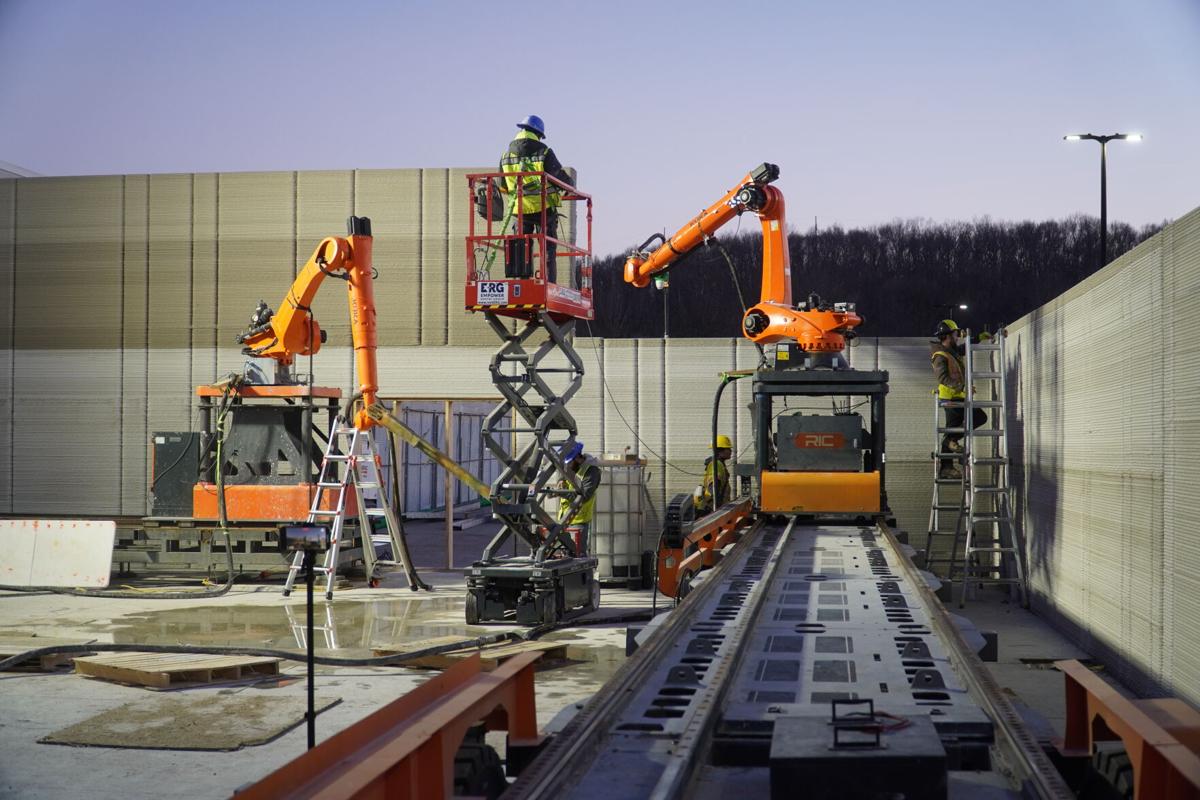
Zyrex is a 6-meter construction robot with 26 degrees of freedom, VLA AI, and automatic battery exchange that promises to replace multiple teams on the construction site.
According to RIC Robotics, the Zyrex is the first general-purpose construction robot designed to replace not just an isolated task, but the set of activities that currently require several specialized teams and various equipment on the site. Developed by the American company based in Fontana, California, the system was announced on April 29, 2025, with a functional prototype expected in early 2026.
The Zyrex is 6 meters tall, has a 7-meter wingspan, 26 degrees of freedom, interchangeable tool module, and autonomous battery exchange. According to the company, it can perform welding, cutting, carpentry, handling heavy materials, 3D concrete printing, and external finishing, with an estimated price of less than $1 million for purchase and less than $20,000 per month in leasing.
Zyrex bets on giant construction robot because humanoids were not made for construction
Most autonomous robots making headlines have a human form, with arms, legs, and sensors organized like a human body.
-
Bolivian Female Construction Workers Form Association to Combat Discrimination and 38% Pay Gap in the Industry

-
Near Amsterdam, residents buy land and discover they must also build streets, manage drainage, handle waste, and grow food on half their plot.
-
Brazil’s WEG to Open New Factory in China by 2027, Expanding Production of Large Rotating Electric Machines and Low to Medium Voltage Motors in Rugao

-
Chinese Shipyard Secures $1 Billion in Orders for Low-Carbon Container Ships Amid Global Fleet Renewal Efforts


The logic is simple: if the world was built for people, a humanoid robot can circulate and operate in this environment without major adaptations.


But civil construction does not function as an environment made for human comfort. Sites are dominated by scaffolding, heavy machinery, high-weight materials, high-torque tools, uneven terrain, and varying heights, which complicates the efficient performance of humanoid robots in heavy construction tasks.
The proposal of RIC Robotics is to solve this with another architecture. Instead of mimicking a human worker, the Zyrex operates as an elevated structure with articulated arms, covering large areas without needing to move the base at each step. For the company, this design makes the system more suitable for strength, reach, and precision in construction environments.
26 degrees of freedom give Zyrex reach and precision beyond human limits
In robotics, degrees of freedom are the independent movements that a mechanical structure can perform.
A human arm has about 7 degrees of freedom, while a conventional industrial arm typically operates with 6. According to the company, the Zyrex reaches 26, greatly enhancing the tool’s positioning capability in space.
In practice, this means the robot can place the tool in much more varied three-dimensional orientations, including in positions difficult or impossible for a worker to sustain for long periods.
The statement cites examples such as welding above shoulder height for long periods and external finishing at height with uniform pressure, tasks that require extreme effort when done manually.
VLA AI allows Zyrex to understand tasks and act without detailed manual programming
The core technology of Zyrex is the VLA model, which stands for Vision Language Action. This type of system integrates computer vision, natural language understanding, and physical action generation in a single architecture, allowing the robot to interpret the environment and transform commands into concrete movements.
The robot uses LiDAR and high-resolution cameras to create a three-dimensional map of the site in real-time.
When it receives instructions such as welding a joint or applying finish to a wall, the VLA locates the target on the 3D map and calculates the necessary sequence of movements, without the operator needing to program each angle or position individually.

According to the company, the operation will be divided into two phases. In Phase 1, the system works with human supervision via VR and simulators, while collecting real execution data. In Phase 2, after being trained with this data, Zyrex would move to autonomous operation, with passive monitoring instead of continuous active supervision.
Labor shortage in the US opens space for construction robots like Zyrex
The appeal of Zyrex does not rely solely on technology. According to the Associated Builders and Contractors, the US construction industry needs to hire more than 439,000 skilled workers by 2025 to meet existing demand, highlighting the labor bottleneck in the sector.

The text highlights that the American construction workforce is aging, while younger generations show less interest in manual professions.
At the same time, there is growing demand for data centers for AI, housing, renewable energy infrastructure, and reconstruction after climate disasters, putting pressure on a market already operating with a shortage of professionals.
There is also a critical safety factor. In 2023, construction recorded 1,075 fatal deaths in the United States, more than any other sector of the American economy. In this scenario, automation is being marketed not only as a productivity solution but also as a response to labor shortages and the high risk of work on site.
Price below US$ 1 million is a central piece of RIC Robotics’ commercial strategy
RIC Robotics designed the business model of Zyrex for construction companies that cannot invest in multi-million dollar industrial systems. According to the company, the robot will be offered for less than US$ 20,000 per month in leasing and for less than US$ 1 million in purchase, a range considered more accessible for medium-sized companies.

The economic logic is straightforward. Many construction companies would already spend a similar amount on the monthly remuneration of three or four specialized workers, but they face increasing difficulty in finding these teams in the market.
The commercial pitch of Zyrex aims precisely to convert this cost of scarcity into an argument for adopting the robot.
Thus, the construction robot from RIC Robotics is not being positioned as a futuristic showcase for large conglomerates, but as a potentially viable machine for a broader market, provided it proves in practice the reliability promised by the company.
RIC-PRIMUS paved the way, but Zyrex still needs to prove it works on a real construction site
The Zyrex did not emerge from scratch. RIC Robotics itself already operates the RIC PRIMUS, a 3D concrete printing robot with a reach of up to 32 feet, almost 10 meters, on commercial sites. According to the text, this system has already demonstrated that the company can bring mobile robotic platforms to real construction conditions.
The new robot expands this base by moving from a single function, 3D concrete printing, to a proposal of multiple functions with interchangeable tools and decision-making AI. It is precisely this expansion that makes the project more ambitious, but also much more difficult to validate commercially.
The critical point remains the performance of the VLA model in real construction site environments, where dust, rain, materials changing places, and alterations in the sequence of work happen all the time. The prototype expected for 2026 will have to prove that the Zyrex can handle this variability without losing precision, safety, and operational reliability.





-

1 person reacted to this.