





 Portuguese
  English
  Spanish
  6 min of reading
  0 comments


An experimental 4.4-millimeter microrobot, developed in Singapore, combines surgical functions activated by magnetism and is still undergoing laboratory tests before any clinical use in humans.
Researchers from Nanyang Technological University, in Singapore, have developed an experimental 4.4-millimeter surgical microrobot capable of combining, in a single structure, five functions studied for precision medical procedures.
The device can move, cut biological tissues, release substances, grasp and store samples, and generate heat remotely, according to information released by the university.
The robot is not yet used in patients.
-
Scientists want to deploy 6 spacecraft spraying barium, lithium, or sodium into Earth’s magnetic field to slow down solar storms.

-
Japan places a giant humanoid up to 12 meters tall on a rail truck to replace dangerous high-altitude work: the robot uses colossal mechanical arms to cut branches, paint structures, and work alongside energized cables without exposing workers to risk.

-
Russian researchers found in a volcanic crater in Kamchatka a new mineral with a crystalline structure that had never been observed in a laboratory, and petrovite has a molecular architecture that battery scientists want to replicate synthetically to create more efficient electrodes.
-
Antarctica hides the deepest terrestrial abyss on the planet beneath the Denman Glacier, a canyon buried 3,500 meters below sea level that only appears by radar and reveals a colossal geography invisible beneath the polar ice.




So far, the tests described by the institution have taken place in a laboratory environment, with materials that simulate soft tissues, biological models, and human cells evaluated outside the body.
The project is part of a research line in magnetically activated medical robotics, an area that investigates devices small enough to operate in narrow and hard-to-reach regions.
The proposal is to concentrate different tasks in a single miniaturized equipment.
Instead of relying on batteries, wires, or embedded electronic components, the robot responds to external magnetic fields.
This type of control allows for a reduction in the device’s size, an important characteristic in research focused on minimally invasive technologies.
How the surgical robot works without a battery
The operation of the microrobot combines flexible materials and microscopic magnetic particles.
According to NTU, the structure was made with soft materials used in soft robotics, capable of deforming in a controlled manner when subjected to external commands.
Inside the device, magnetic microparticles allow different parts to react to the applied field.
When the external magnetic field changes direction or intensity, specific regions of the robot can perform distinct movements.
Thus, one part can activate a blade, another can act as a clamp, and another can participate in the release of substances.
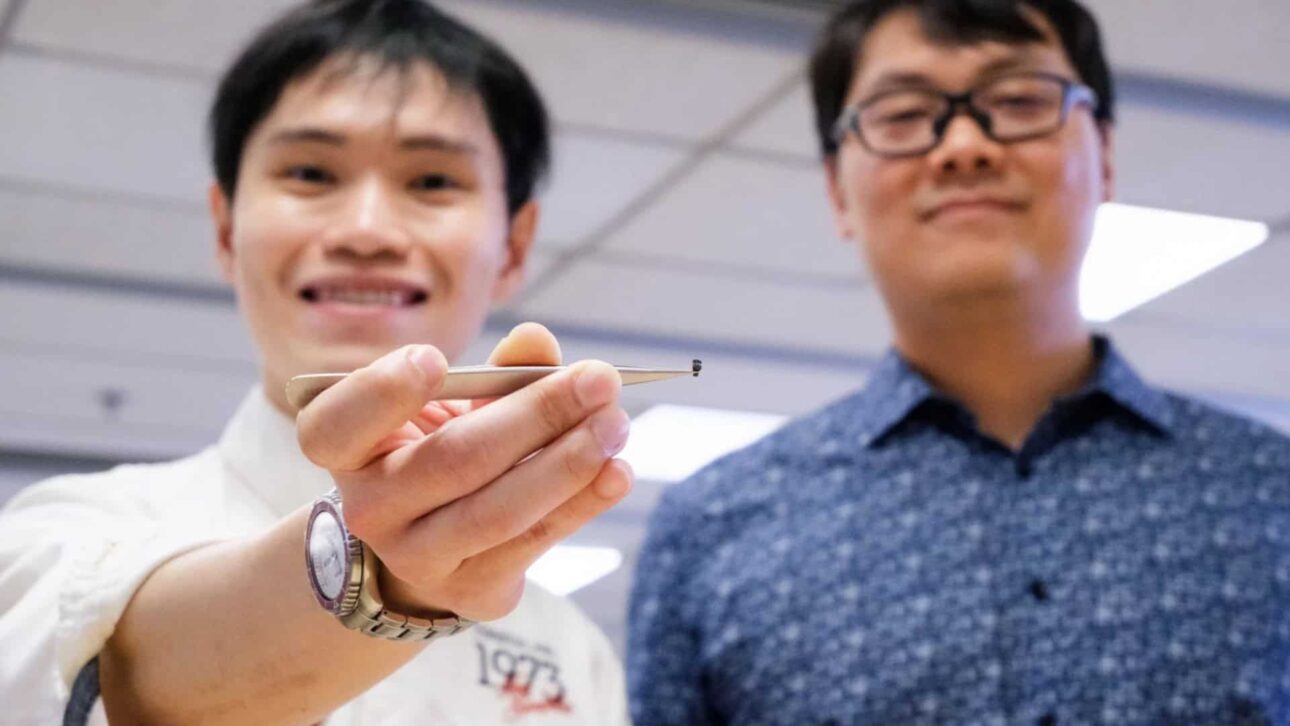
The university reported that switching between functions can occur in less than a second.
This feature aims to address a common limitation in magnetic microrobots: the tendency for the entire piece to respond as a single block to the same command.
In the model presented by the team, the magnetic module can be configured in different orientations, allowing specific areas of the device to be controlled without activating all parts simultaneously.
The internal reconfiguration of magnetism is one of the technical points highlighted in the study.
According to the researchers, this solution allows the same magnetic field to activate different functions depending on the programmed orientation in the robot.
The goal is to enhance control precision and reduce the need for multiple instruments in different stages of a procedure.
Five medical functions in a 4.4-millimeter microrobot
The first function described by the researchers is locomotion.
The robot can be guided by external magnetic fields on surfaces that simulate soft and irregular tissues.
This capability is important in studies that aim to adapt microsystems to environments similar to those found inside the human body.
The second function is cutting biological tissue.
In laboratory tests, the device activated a small blade to make cuts in materials used in the experiments.
The third function is the targeted release of substances, demonstrated with particles used as a model for drug delivery.
The fourth function involves grasping and storing tissue samples.
In future applications, this capability could be studied for procedures such as collecting biological material in hard-to-reach areas, provided safety and efficacy are demonstrated in new research stages.
The fifth function is the remote heat generation, activated by a high-frequency alternating magnetic field.
In the study, localized heating is associated with investigations into therapies that depend on heat at specific points.
The technology, however, should not be interpreted as a ready treatment.
This is an experimental prototype evaluated under controlled conditions and not yet validated for clinical use.
The integration of these functions into a single body is the main focus of the research.
The device was designed to perform actions that, in conventional procedures, might require different instruments.
Nevertheless, its application in medicine depends on technical advances, additional tests, and regulatory evaluation.


Magnetism allows external control of the robot
The use of magnetism helps to overcome a recurring difficulty in the miniaturization of robots: the lack of space for motor, battery, and electronic circuit.
At millimeter scales, these components can increase the volume of the equipment or limit its ability to operate in narrow environments.
By transferring the control source outside the body, researchers keep the robot small and without internal power.
External magnetic fields guide the movement and activate the programmed functions.
According to the university, the system also explores movements in different directions, including rotation along its own axis.
This rotation expands the forms of movement observed in the laboratory.
In simulated biological environments, irregular surfaces and narrow channels require more than linear movement.
Therefore, the ability to roll or adjust its own position can facilitate navigation in experimental models.
Even with these results, control remains dependent on operators and external equipment.
For potential medical application, it would be necessary to integrate the robot with real-time imaging and monitoring systems.
This step is essential to allow doctors to accurately track its position and movements.
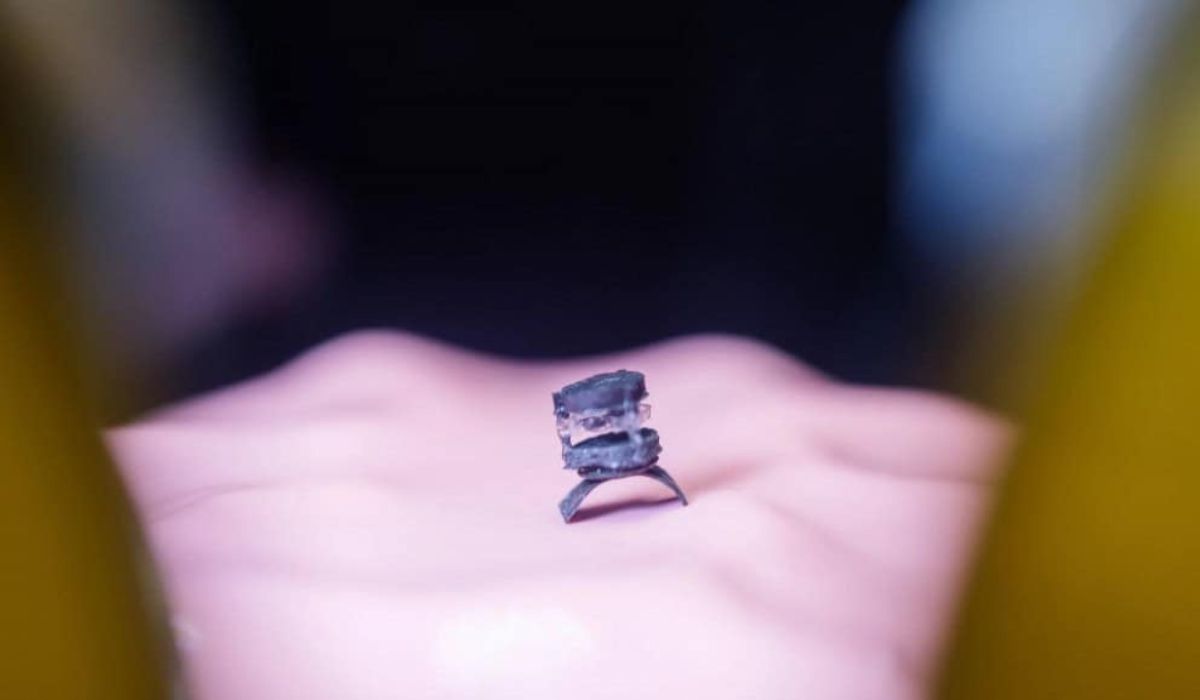
Tests of the surgical robot are still restricted to the laboratory
The tests released by NTU involved gelatin materials simulating soft tissues and biological samples, including chicken liver.
In these trials, the microrobot performed actions such as cutting, particle release, sample retention, and localized heating.
The university also reported biocompatibility assessment with human skin cells in the laboratory.
According to the institution, more than 99% of the cells remained viable after exposure to the robot’s materials, a result similar to that observed in the control group.
This data indicates a favorable initial behavior of the materials in the experiment, but does not replace tests in more complex biological systems.
Cellular assays are just one of the initial stages in research of this type.
Before any use in people, it would be necessary to evaluate safety, precision, stability, response in real organs, risk of device retention in the body, and safe ways of removal or conduction to the end of the procedure.
Another open point is the use of medical imaging during navigation.
In a clinical environment, the robot would need to be monitored in real-time so that doctors know its exact position and can interrupt or adjust the operation when necessary.
Without this integration, the technology remains limited to the experimental phase.
Research points to paths for minimally invasive medicine
The microrobot is part of a line of studies on less invasive procedures.
The idea investigated by researchers in the field is to use very small devices to access internal regions with less need for rigid instruments or larger incisions.
In the case of the NTU robot, this possibility is still in the research field.
The team led by Associate Professor Lum Guo Zhan from the School of Mechanical and Aerospace Engineering at NTU is working on future versions of the system.
The university reported that researchers are studying integration with imaging technologies, sensors, and artificial organ models closer to real human body conditions.
The research also seeks collaboration with surgeons to evaluate how such a system could fit into medical procedures in the future.
This step is relevant because the transition from a laboratory prototype to a clinical device requires not only technical performance but also compatibility with hospital routines and safety protocols.
So far, no timeline has been disclosed for human testing or clinical authorization for the use of the microrobot in patients.
What exists is an experimental demonstration that a millimeter-sized device, controlled by magnetism, can perform multiple functions under laboratory conditions.
For medical science, research shows a development direction in microrobotics: smaller systems, battery-free and with multiple externally driven functions.
The technology still needs to overcome validation stages before leaving the experimental environment.





Be the first to react!