






 Portuguese
  Spanish


Published in the journal Geophysical Research Letters, the study by the Potsdam Institute used direct observations and concluded that the cold patch extends up to a thousand meters deep, which points to weaker currents, not the atmosphere. Even so, scientists disagree about the proximity of a tipping point.
While almost the entire planet has warmed since the 19th century, an area of the North Atlantic has gone the opposite way and has been nicknamed the cold patch by scientists. A new study published in the journal Geophysical Research Letters in 2026 provides additional evidence about the phenomenon and points to the weakening of a major ocean current system in the Atlantic as the most likely cause. The region is located south of Greenland and Iceland, in the so-called subpolar Atlantic.
The work was conducted by researchers from the Potsdam Institute for Climate Impact Research in Germany, led by climatologist Stefan Rahmstorf. Instead of relying solely on models, the team used direct observations made by satellites, buoys, and ships. The main novelty is that the cooling is not limited to the surface and reaches about a thousand meters deep, which changes the interpretation of what is behind the cold patch.
Where is and what is the cold patch of the North Atlantic
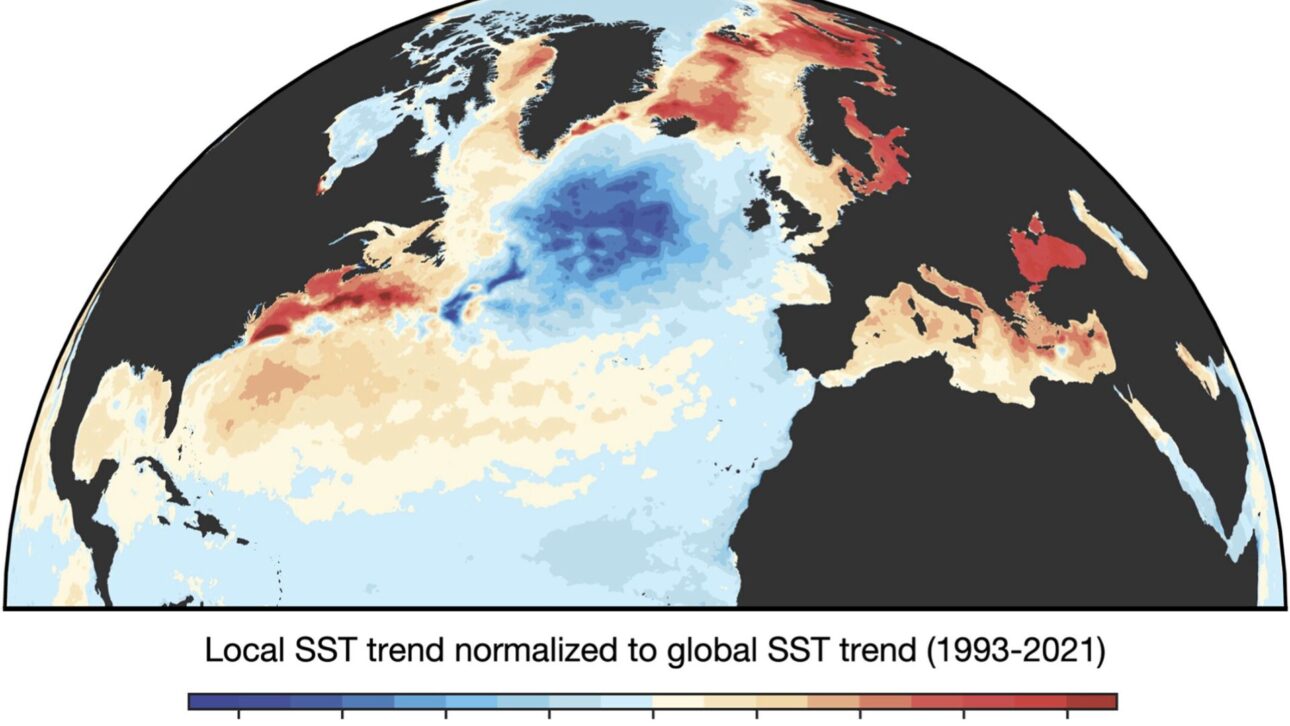
It is located in the subpolar Atlantic, just south of Greenland and Iceland.
-
Brazilian Students Develop Process to Turn Styrofoam Waste into Water-Purifying Charcoal

-
Study Warns: Wi-Fi Routers Can Act as Invisible Radars, Identifying People with 99.5% Accuracy Without Cameras or Wearable Devices

-
Brazilian Researchers Develop Cost-Effective Method for Key Component of Green Hydrogen Electrolyzers, Enhancing Energy Efficiency and Equipment Longevity

-
1,700-Year-Old Roman Mosaic Discovered by Farmer Planting Cherry Trees in Turkey




The cooling has been recorded for about 150 years, since the pre-industrial era, and therefore stands out so clearly from the global warming trend observed on the planet.
In recent decades, the center of this region has cooled by about one degree Celsius, according to the temperature data used in the study.
The contrast becomes evident in the sea surface temperature maps, where the area appears as a blue mark surrounded by warming waters.
It is precisely this contrary behavior that has turned the cold patch into one of the most studied enigmas in climate science.
The AMOC and why ocean currents matter
The most likely explanation, according to the study, lies in the weakening of the Atlantic Meridional Overturning Circulation, known by the acronym AMOC.
This is a system of ocean currents that functions like a conveyor belt, carrying warm and salty waters from the tropics towards the North Atlantic.
Upon reaching near the Arctic, this water cools, becomes denser, sinks, and returns south through the depths, in a cycle that distributes heat, carbon, and nutrients.
This same movement helps regulate the climate of Europe and North America, making any alteration significant.
Various studies have been pointing to signs that the AMOC may be losing strength, and one of the central hypotheses is the accelerated melting of Greenland’s glaciers, caused by human-induced global warming.
The melting ice releases fresh water into the ocean, reduces salinity, and disrupts the density balance that keeps ocean currents functioning, which may be behind the cold patch.
What the new study found


To test the competing explanations, the authors compared the ocean’s heat content between 1955 and 2024 with the surface heat flux between 1955 and 2022.
There were two competing hypotheses for the cold patch.
One attributed the cooling to heat loss to the atmosphere, driven by changes in wind and clouds.
The other pointed to weaker currents, which would bring less heat to the region.
The data favored the second explanation.
Heat loss from the surface did not increase during the period, and even decreased slightly, while the cooling deepened to about a thousand meters.
For the team, this pattern indicates that the problem lies in the heat transport by ocean currents, not in what occurs at the surface.
In Rahmstorf’s words, winds and clouds explain only a modest fraction of the phenomenon, reinforcing the hypothesis of a slower AMOC.
Why There is Still Caution Among Scientists
Despite the weight of the new evidence, the study itself does not state how close the circulation is to a tipping point.
There are recognized limitations, starting with the fact that the surface heat flow was not measured directly but estimated by models.
Furthermore, a 2021 study, which used some of the same databases, attributed most of the cold patch to the strengthening of winds, showing that the topic remains open.
Researchers who did not participate in the work urge caution in interpreting the results.
David Thornalley, from University College London, considers the study useful but believes it will not be the final word on the causes of the cold patch. Neil Fraser, from the Scottish Association for Marine Science, notes that the data is still limited and alternative explanations cannot be completely ruled out.
The message is that the result adds evidence without closing the debate.
The Possible Impacts of a Weakening
If the AMOC weakens extremely or collapses in the future, the effects would be felt far beyond the North Atlantic.
Among the consequences cited by science are the cooling of parts of Europe, changes in rainfall patterns in various regions of the planet, and rising sea levels along the east coast of the United States.
Rahmstorf also highlights the subpolar gyre, a smaller circulation that, if it surpasses its own tipping point, could affect Western Europe as early as the 2040s.
The topic reached popular culture with the film The Day After Tomorrow, starring Dennis Quaid and Jake Gyllenhaal.
In the plot, a sudden halt of ocean currents plunges the planet into a new ice age in just a few days.
The speed shown in fiction is greatly exaggerated, but the underlying concern about the climate system’s sensitivity to changes in currents is based on real research like those investigating the cold patch.
The new study does not declare an imminent collapse but reinforces the idea that the North Atlantic is undergoing transformations that deserve attention.
By showing that the cold patch deepens in the ocean, the research strengthens the hypothesis of a slower AMOC and focuses on the role of ocean currents in the climate crisis.
At the same time, the remaining uncertainties remind us that science is built on the accumulation of evidence, not hasty conclusions.
And you, had you heard about the North Atlantic cold blob and the role of the AMOC in the planet’s climate? Do you believe that the topic receives the attention it deserves, or does it go unnoticed amid other environmental issues? Leave your opinion in the comments, respecting different opinions, and share this article with those interested in science and climate.








So in brief: climate change causing melting of the glaciers in Greenland is causing a glacial melt in addition to slowing the North Atlantic Engine such that the Atlantic just adjacent to Southern Greenland is being chilled and the chilled zone is not being diluted by the warm waters. Totally caused by climate change with no other mechanism proposed. The only argument is not “who or what is causing climate change?”, but it is, “do we want to slow climate change for our own good.?”