





 Portuguese
  English
  Spanish
  3 min of reading
  0 comments


Virginia Tech Experiment Shows That Designed Surfaces Can Propel Melting Ice Disks, Revealing New Possibilities in Energy and Thawing.
A simple experiment in a Virginia Tech laboratory revealed a discovery that surprised the scientific community. Professor Jonathan Boreyko’s team managed to make a melting ice disk move on its own on a specially designed surface.
The phenomenon, unexpected at first glance, opens possibilities for different technological applications.
The Initial Observation
The starting point was a common scene. An ice disk was placed on a metal plate.
-
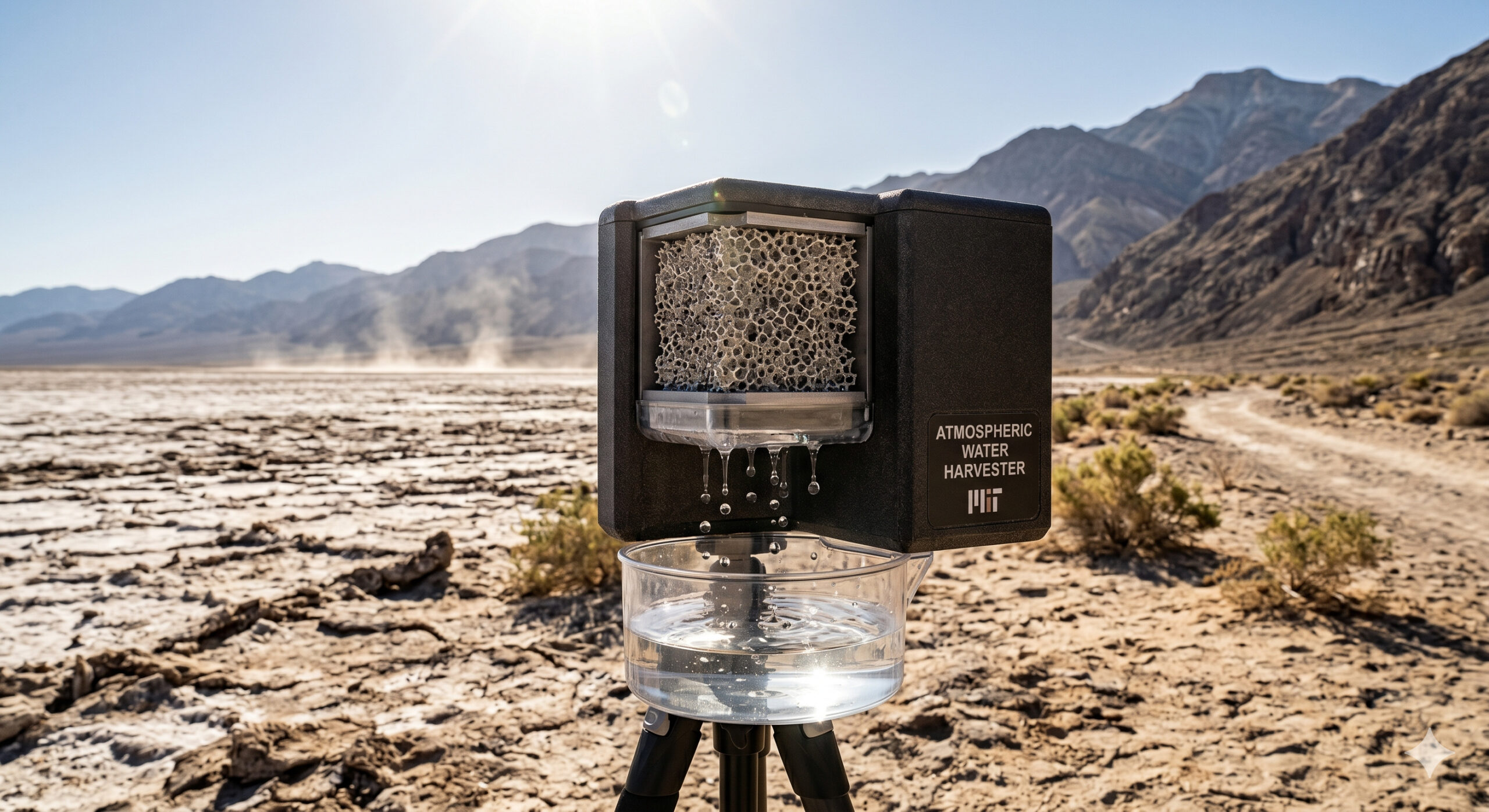
Scientists from MIT create an origami-inspired hydrogel panel that captures invisible vapor and produces drinking water even in one of the driest deserts on the planet without battery, without outlet, and without solar energy, using only the temperature difference between day and night.

-
Belgium will sink 23 giant concrete caissons, each weighing 22,000 tons, in the North Sea to build the world’s first artificial energy island 45 km off the coast, forming offshore electrical walls.

-
The Pacific seafloor is breaking apart near Canada, and the silently cracking plate may reveal deep secrets about tsunamis, earthquakes, and methane hidden in the ocean.

-
Oyster cement surprises scientists by sticking even underwater, becoming 10 times more adhesive, and promising a stronger, faster, and less environmentally burdensome concrete.



Initially, as it melted, the water formed stuck to the ice and the surface, without any movement. However, after about a minute of being still, the disk suddenly shot across the plate, as if it had been propelled by an invisible force.
This reaction surprised the researchers. The behavior was not the result of wind, vibration, or external contact. It was something intrinsic to the melting itself combined with the surface.
Inspiration from Death Valley
To better understand, the team sought inspiration from a natural mystery at Racetrack Playa in Death Valley. In this location, heavy rocks appear to move on their own, leaving long trails across the flat ground. For decades, many attributed the phenomenon to inexplicable forces.
Only in 2014 did Professor Richard Norris from the Scripps Institution of Oceanography manage to explain it.
He showed that a rare combination of rain, impermeable soil, ice, and wind pushes the stones. When water freezes on the ground, it forms ice blocks that, when melting, move with the action of the wind and drag the rocks.
While Norris solved a natural riddle, Boreyko and his team decided to advance. They attempted to artificially reproduce a similar mechanism but without relying on wind.
The Designed Surface
The group created asymmetrical grooves in the shape of arrowheads, etched into aluminum plates. These grooves were organized in a fishbone pattern to direct the melting water.
As a result, the ice not only melted but began to be propelled. PhD student Jack Tapocik compared the process to buoys moving down a river, guided by the current.
The difference, he explained, is that in the experiment the flow is not due to gravity but by the geometry of the channels created on the plate.
The Slingshot Effect
The experiment took a leap when the researchers decided to apply a water-repellent spray to the surface. The result was the opposite of expected. Instead of sliding faster, the ice became stuck on the crests.
This locking generated what the scientists called the “slingshot effect.”
The melted water continued to flow, but the ice remained fixed until it accumulated enough tension to be propelled forward.
According to Boreyko, when the water forms a flat puddle on one side of the disk, a difference in surface tension is created. This mismatch is sufficient to displace the ice, launching it suddenly.
Compared to the stones in Death Valley, which move slowly, this process revealed a much faster ice, even being described as “the fastest ice on Earth.”
Possible Applications
The study, published in the journal ACS Applied Materials & Interfaces, suggests various applications. Boreyko believes that this type of propulsion could be explored in energy harvesting.
Additionally, the researchers point out that the discovery may inspire advancements in de-icing systems, self-cleaning surfaces, and fluid transport at a microscopic scale.
All of this without relying on engines or external energy sources.
The observation of a simple block of ice in the laboratory has thus transformed into a promising step for engineering.
An example of how natural phenomena still hold secrets capable of generating new technologies.




Be the first to react!