Portuguese
  Spanish


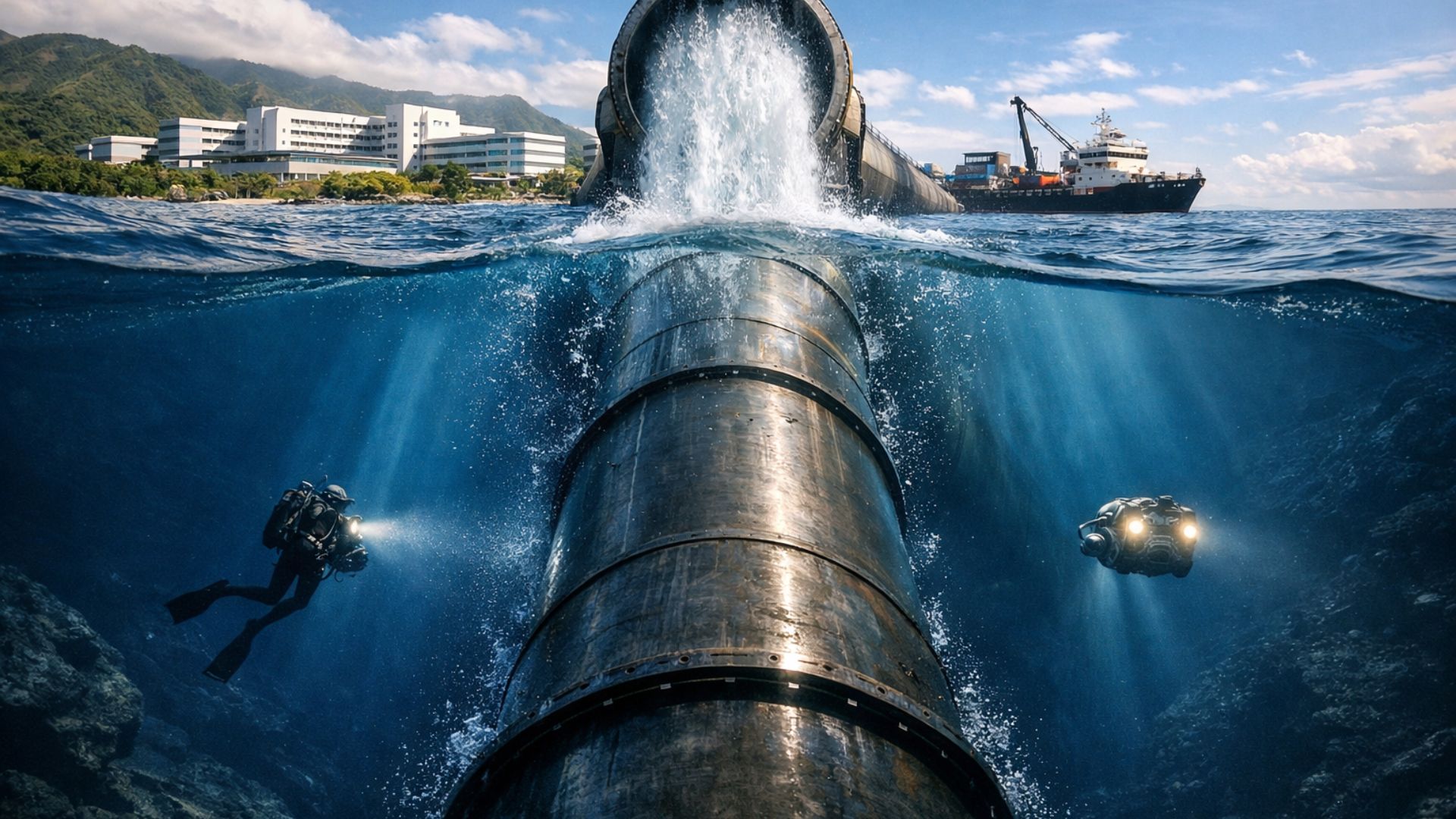


System using deep ocean water transforms hospital cooling into an efficient energy solution, reducing electricity consumption and emissions with technology already in operation in the Pacific, based on submarine capture and natural thermal exchange.
The cold water from the deep ocean layers has ceased to be an experimental bet in Tahiti and has started to operate as a permanent climate control infrastructure in the main hospital of French Polynesia.
In Pirae, in the urban area of Papeete, the French Polynesia Hospital Center uses technology known as SWAC, which stands for Sea Water Air Conditioning, to cool the complex with water captured at about 5 °C and taken from approximately 900 meters deep.
In practice, the system replaces much of the traditional logic of air conditioning units with engineering that takes advantage of the natural cold of the deep sea.
-
Floating Solar Panels Aim for Rougher Seas with Norwegian Rope Mesh Technology, Following DNV Review, Opening New Clean Energy Opportunities in Coastal Areas

-
Olympus Mons: The Solar System’s Tallest Volcano, Over Three Times the Height of Mount Everest, Puzzles Scientists with Its Prolonged Volcanic Activity
-
Alaska’s 1,287 km Pipeline Built on 78,000 Metal Supports to Prevent Thawing, Survives Earthquakes and Remote Forests, Highlighting the Challenge of Hot Oil in a Harsh Environment
-
Brazilian Student Innovates Sustainable Ceramic Tableware Using Rice Husks and Recycled Glass, Achieving Up to 60% Waste Composition and Comparable Performance to Conventional Materials


Instead of producing chilled water with conventional chillers, the hospital pumps ocean water through a submarine pipeline to a station on land, where heat exchangers cool a secondary circuit used for internal climate control, without direct contact between the seawater and the building’s network.
How the SWAC system works at the hospital in Tahiti

The thermal principle is simple, although the operation depends on a highly complex construction.
The chilled water captured from the bottom of the Pacific transfers its cold to another closed and separate circuit, which feeds the hospital’s chilled water network.
After that, the ocean water is returned to the marine environment under conditions defined in the project, while the building’s climate control is sustained by a natural and stable source.
This stability is one of the central points for a health building, where thermal control needs to function without abrupt fluctuations throughout the day.
The public documentation of the inauguration states that, since it came into service, the climate control of the CHPF has been fully ensured by SWAC, with continuous cold supply for the hospital complex.
Submarine structure and scale of engineering involved
The numbers help explain why the project gained international visibility.
The installation operates with about 3.8 kilometers of piping, reaches over 910 meters in depth, and delivers 6 MW of cooling capacity, a level presented by institutional sources and VINCI Energies itself as the largest of its kind in operation in the world.
The implementation required nearly three years of work and mobilized both building engineering teams and marine installation specialists.
The total cost reported by sources linked to the project was around 31 million euros, with financing shared between the French government, French Polynesia, and public credit institutions.

This scale dismisses the idea of a one-off or merely demonstrative solution.
What was built in Tahiti combines pumping, deep water intake, underwater piping, thermal exchange, monitoring, and integration with the hospital network into a single operational chain, something that requires long-term planning and not just adaptation of existing equipment.
Energy savings and environmental impact of SWAC
The energy gain is one of the strongest arguments behind the system.
At the inauguration, the Polynesian Energy Directorate reported that the SWAC of CHPF could save up to 11 GWh of electricity per year, a volume equivalent to about 2% of the entire island of Tahiti’s electricity needs.
The presidency of French Polynesia also associated the operation with an annual reduction of about 5,000 tons of CO2. These figures gain more weight when placed in the local context.
Projects from the European Investment Bank indicated, even in the financing phase, that air conditioning accounted for half of the hospital’s electricity consumption, while the territory was already dealing with high generation costs and strong energy dependence.
By shifting part of the cooling effort to pumping and thermal exchange, the SWAC reduces the need to produce cold through more electricity-intensive means.
In tropical islands, where heat and humidity push air conditioning use to high levels for much of the year, this difference has a direct impact on operations.
The system does not eliminate the engineering of air conditioning but replaces the most expensive step of the process with a thermal source available in the marine environment itself, as long as the geography allows relatively feasible access to deep waters.

Why French Polynesia Became a Reference in Seawater Cooling
The adoption of SWAC in Tahiti did not happen by chance.
French Polynesia has bathymetric conditions considered favorable, with access to cold waters at sufficient depths to enable this type of infrastructure, which is not always the case in other coastal areas.
Public reports on energy in the territory indicate that this geographical configuration helps explain why the technology advanced there in both hotels and public facilities.
The local experience also did not start at the hospital.
Before the CHPF, similar systems had already been implemented in private ventures in French Polynesia, which provided the technical basis for expanding the model.
Still, the scale of the hospital raised the project standard, as the cooling began to serve a critical facility, in continuous use and with a much higher reliability requirement than that of a common commercial building.
This history helps explain why the technology is often pointed out as more suitable for structures with high and permanent cooling demand, such as hospitals, hotels, airports, and large coastal complexes.
In these situations, the benefit is not only in the energy bill but in the combination of lower consumption, thermal predictability, and continuous operation in regions where cooling environments is a structural necessity, not an occasional one.
Ocean as Thermal Infrastructure for Buildings
The experience of the CHPF shows that the ocean can function as a kind of natural thermal reservoir incorporated into urban infrastructure.
When the cold stored in the depths begins to cool hospital wings, technical areas, and circulation spaces, the sea ceases to be just a backdrop and becomes an active part of the building’s operation, with measurable effects on electricity consumption and emissions.
It also becomes clear that the adoption of the model depends less on futuristic appeal and more on objective conditions, such as available depth, distance from the intake, implementation cost, and the building’s demand profile.
Where this combination exists, SWAC tends to move from the realm of technological curiosity to practical discussions about infrastructure, energy efficiency, and long-term planning for warm coastal areas.