Portuguese
  Spanish


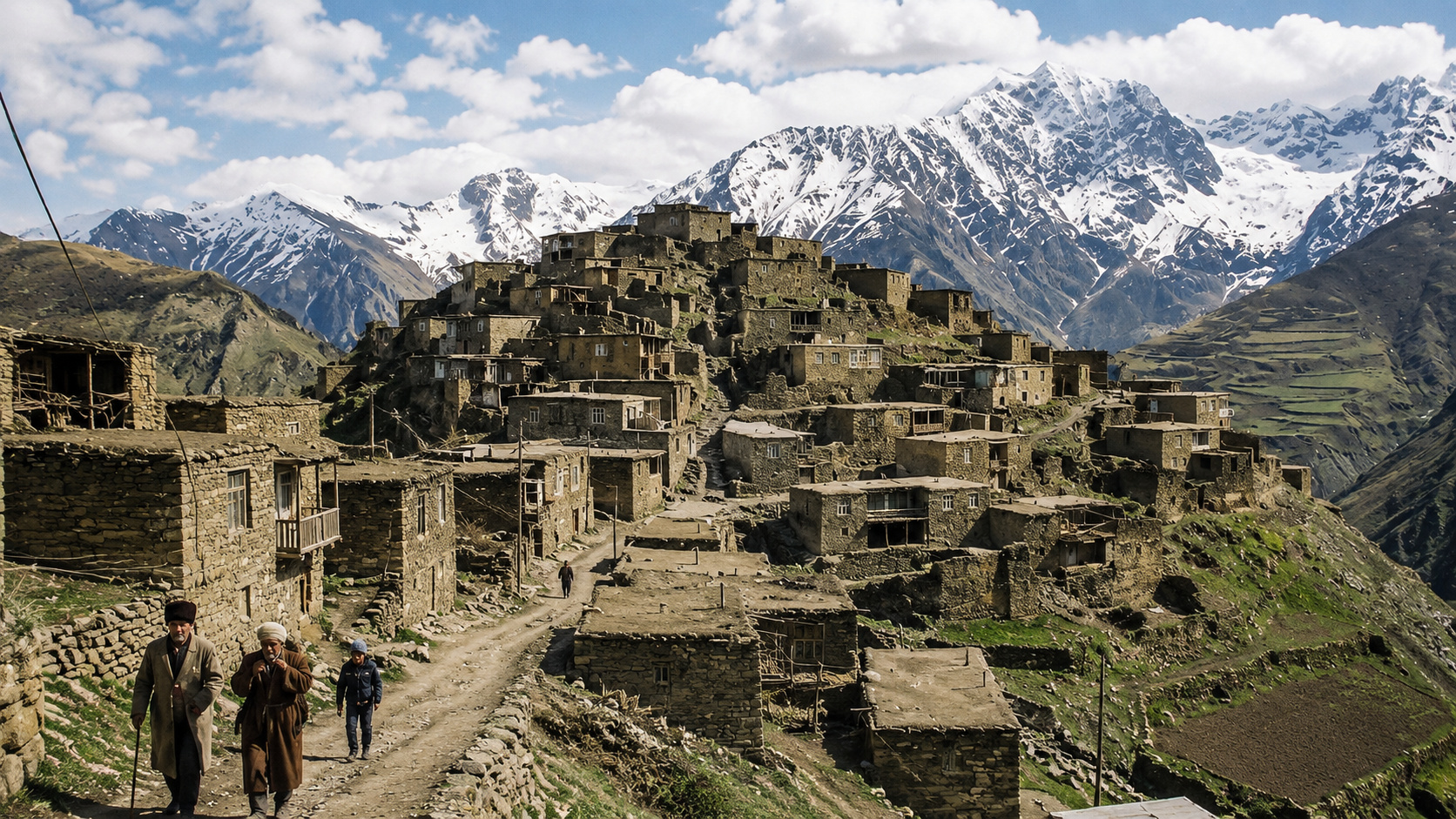

High in the mountains of Azerbaijan, the Khinalig people maintain their own language, stone houses, and ancient herding routes.
In the mountains of the Greater Caucasus, in northern Azerbaijan, the village of Khinalig stands out for preserving a rare way of life.
Also written as Xinaliq or Khinalug, the community is known for its own language, stone houses, and ancient traditions linked to the cold, the terrain, and herding.
International recognition came in 2023, when Unesco included the cultural landscape of Khinalig and the transhumance route Köç Yolu in the World Heritage list.
-
Slovakia’s Ice Cave Holds Over 110,000 m³ of Frozen Wonders, Boasts Walls Up to 27 Meters Thick, and Was Among the First Electrified Caves Globally

-
Street Cleaner Accidentally Receives $200,000 Transfer, Returns Unexpected Fortune to Rightful Owner

-
Australian Space Agency Investigates Six Mysterious Metal Spheres Found on Queensland Beach, Isolating Area Over Possible Space Debris Risk

-
Transform Your Kitchen in a Day: New Flooring Solution Offers Quick Renovation Without the Mess or Noise




Khinalig is isolated in the mountains of northern Azerbaijan
Firstly, Khinalig is situated in a high, mountainous region that is difficult to access.
The isolation has helped preserve customs, forms of housing, and community practices passed down through generations.
Moreover, the village is marked by compact stone constructions, adapted to the steep terrain and harsh climate.
In some areas, even, the roofs of lower houses function as patios for upper dwellings.
Thus, space is intelligently utilized in a mountain environment.


Khinalug language became a symbol of cultural identity
The local language, called khinalug, belongs to the group of northeastern Caucasian languages.
Even so, it has its own characteristics and may sound incomprehensible to speakers of neighboring languages.
According to studies on endangered languages, khinalug is spoken by a small isolated community in Azerbaijan.
Consequently, its preservation depends heavily on family transmission, daily use, and appreciation within the village.
At the same time, formal schooling, the internet, and the use of Azerbaijani make this process more delicate among the youth.
Herding traditions connect village, animals, and territory
Besides the language, Khinalig preserves a historical relationship with herding.
The practice of transhumance involves seasonal movements of herds between high areas and lower regions.
According to Unesco, the Köç Yolu route connects summer pastures and winter areas, maintaining an ancient community tradition.
Among the main cultural elements are:
- everyday use of the Khinalug language;
- stone houses adapted to the cold;
- seasonal herding routes;
- oral memory linked to the territory;
- customs preserved by geographical isolation.
Unesco recognized Khinalig as a living heritage
Unesco’s recognition does not only consider the beauty of the mountains.
In fact, it values the integration between village, ancient paths, pastures, animals, architecture, and traditional practices.
Icomos describes the landscape as a living testimony of a transhumance tradition practiced from medieval times to today.
Therefore, Khinalig represents more than an isolated village.
It shows how a community can transform altitude, cold, and distance into cultural identity.
Khinalig shows that a language also holds a world
Finally, the history of the Khinalig people impresses because it reveals the strength of a culture preserved among mountains.
The local language is not just a form of communication.
It also carries memory, kinship, landscape, work, and way of life.
Thus, protecting Khinalug means preserving a rare way of seeing the world, built between isolation, tradition, and cultural resistance.