Portuguese
  Spanish


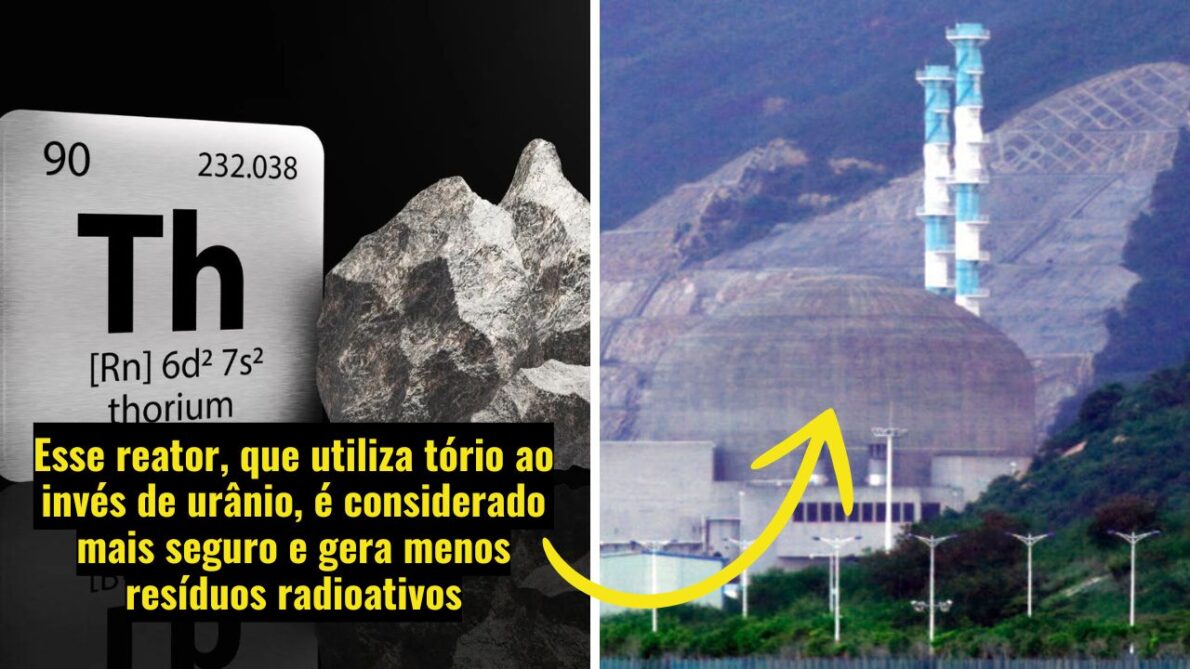

China Doesn’t Waste Time and Announces the Commissioning of the World’s First Thorium Nuclear Reactor, Specifically a Molten Salt Reactor.
The China has taken a historic step by announcing the launch of the world’s first thorium nuclear reactor, an innovation that promises to change the course of global nuclear energy. This reactor, which uses thorium instead of uranium, is considered safer and generates less radioactive waste, representing a significant advancement in terms of sustainability and energy security.
The world’s first thorium nuclear reactor, in China, emerges in a context where uranium, traditionally used in nuclear reactors, has been a source of concern due to associated risks, such as the possibility of catastrophic collapses, exemplified by disasters like Fukushima and Chernobyl. Additionally, uranium is also the primary material for the manufacture of nuclear weapons, which adds a layer of taboo and discomfort around its use.
Why Is the World’s First Thorium Nuclear Reactor Special?
But what makes thorium so special? It is a material that, although it has fascinated scientists for decades, had not been widely explored as an alternative to uranium. Thorium is about three to four times more abundant in the earth’s crust, produces less radioactive waste, and is easier to control in nuclear reactions, which significantly reduces the risk of collapses. It is much more difficult to turn thorium into nuclear weapons, making it a safer option for peaceful use.
-
Angra 3 becomes Brazil’s R$ 24 billion dilemma: finishing the 66% complete plant costs almost the same as abandoning it, right in the race for energy in the AI era.

-
Nvidia Secures Billion-Dollar Deal to Supply Up to 170,000 AI Accelerators to a 360 MW Data Center in Indonesia, Aiming to Transform Batam into an Advanced Computing Hub

-
NuScale proposes revised plan for six VOYGR SMR reactors in Poland after ending U.S. project
-
Holtec and EDF Submit Joint Proposal to Install Four SMR-300 Reactors in England with Combined Capacity of 1.3 GW


New Reactor in China
The new reactor in China is a molten salt plant, a technology that, although it was tested in the United States in the 1960s, has never been commercialized until now. In molten salt reactors, the fuel and coolant (a mixture of molten salts) are mixed and continuously circulate through the system, reducing the risks of overheating and explosions. Another advantage is that these reactors can be refueled without needing to be shut down, which is a costly and time-consuming process in conventional reactors.
20,000 Years
The China not only leads the development of this technology, but also has enough thorium reserves to meet its energy needs for the next 20,000 years. The first experimental molten salt thorium reactor, the TMSR-LF1, began construction in 2018 and was completed in 2021. It is located in a remote area of the Gansu desert, highlighting another advantage of these reactors: they do not need water for cooling and can be installed in sparsely populated regions, minimizing risks to the population.
Operational in 2029
This reactor, which initially operates in a closed system, is expected to be fully operational by around 2029. Although still an experimental project, it represents an important milestone in the race for safe and sustainable nuclear energy. The China plans to rapidly expand this technology, and there are already plans for the construction of new reactors with higher capacity in the coming years.
China as One of the Leading Suppliers of Clean Energy
With this innovation, China positions itself as a global leader in thorium nuclear technology, an achievement that could transform the country into one of the main suppliers of clean and safe energy for the world. The expectation is that this new approach will not only help the country achieve carbon neutrality by 2060 but also provide a significant strategic advantage in the global energy landscape.
This technological advance places China ahead of other nations, which now must consider whether to follow the same path or fall behind in the search for safer and more sustainable energy alternatives. In the long term, the world’s first thorium nuclear reactor could very well be the beginning of a new era for nuclear energy.