






 Portuguese
  Spanish


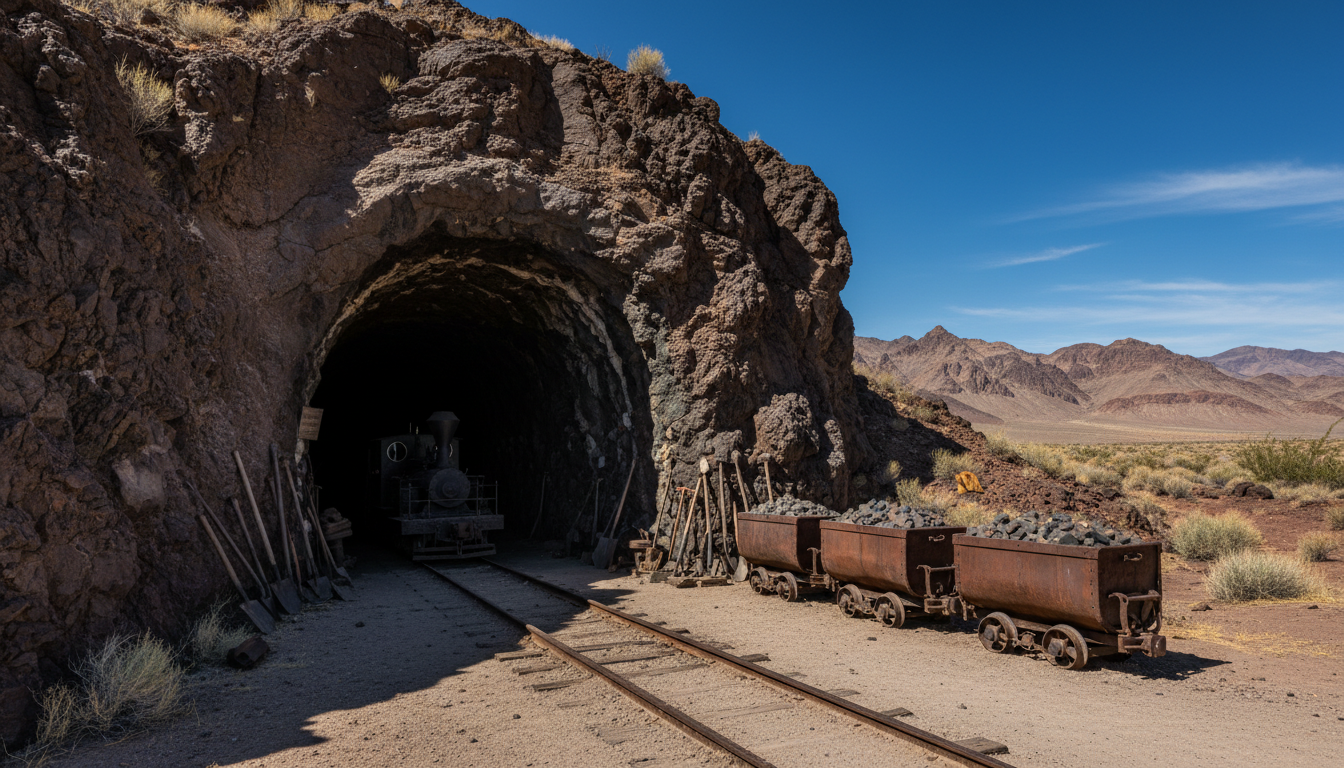

The United States excavated 8 kilometers of tunnels inside a volcanic mountain in the Nevada desert to create the world’s safest nuclear waste repository — and then abandoned it all for political reasons
Between 1987 and 2008, the American government invested the equivalent of US$ 15 billion (in updated values) to build the Yucca Mountain Nuclear Waste Repository — an underground complex designed to store nuclear waste for at least 1 million years. According to the United States Department of Energy, the project planned to store 70,000 tons of used nuclear fuel in tunnels excavated 300 meters deep inside a mountain in the Nevada desert.
However, despite two decades of work and billions invested, the nuclear waste repository never received a single barrel of radioactive waste.
In 2010, President Barack Obama cut funding for the project due to political pressure from the state of Nevada — and since then, 90,000 tons of nuclear waste remain scattered across 75 decommissioned power plants nationwide.
-
Three-Year-Old Fulfills Dream of Joining Garbage Collectors in Brazil, Captivates Thousands Online with Heartwarming Video

-
Nikon Project Uses Dog’s Heartbeat to Capture Photos, Revealing What Truly Makes Dogs Happy

-
In Los Angeles, Young Adult Opts for Garage Living with Bed, Kitchen, and Bathroom to Avoid Rent, Highlighting Comfort and Organization Challenges in Compact Housing
-
Brazil Faces Crisis as New Data Reveals Alarming Rates of Youth Unemployment and School Dropouts, with Joblessness More Than Double the National Average and High Informality Among Teens


Why the world needs a place to store nuclear waste
Furthermore, nuclear waste is one of the most dangerous materials ever produced by humanity. Fuel used in nuclear reactors remains radioactive and lethal for hundreds of thousands of years.
In practice, this means that any storage solution needs to function for longer than the entire history of human civilization.
To understand the scale, the pyramids of Egypt have existed for 4,500 years. Nuclear waste needs safe storage for at least 200,000 years — 44 times longer. Therefore, burying the material in stable, dry, and isolated rock seemed like the safest solution.
Indeed, Yucca Mountain meets these criteria. The mountain is composed of volcanic tuff — a porous rock formed from ash from eruptions that occurred millions of years ago.
The mountain is located 130 kilometers northwest of Las Vegas, on federal land adjacent to the former Nevada Test Site — where the U.S. tested hundreds of nuclear bombs during the Cold War.
Moreover, the region is one of the driest in the United States, with less than 15 centimeters of rain per year. Consequently, the risk of water infiltration — the biggest enemy of nuclear waste storage — is minimal.
The engineering behind the tunnels: 8 km excavated inside the mountain

According to Bechtel, which led the construction, engineers excavated an 8-kilometer main tunnel through the mountain, 300 meters below the summit.
Similarly, side chambers were planned to receive the nuclear waste containers, each sealed in stainless steel cylinders designed to resist corrosion for 10,000 years.
In comparison, the Angra 3 nuclear power plant in Brazil — which has been under construction for almost 40 years — cost R$ 26 billion and has also never generated a single watt of energy.
In this sense, both Yucca Mountain and Angra 3 are examples of nuclear megaprojects that consumed billions without delivering on their promises.
The exploratory tunnel alone cost US$ 9 billion in contemporary values — and only served to prove that the site was geologically suitable.
Without Yucca, nuclear waste is scattered across 75 sites nationwide

Equally concerning is what happened after the project was abandoned. Without a central repository, the United States keeps its nuclear waste in temporary storage — scattered across more than 75 decommissioned or active nuclear power plants in 35 states.
Each power plant stores its own waste in temporary cooling pools that were never meant to be permanent.
To give an idea, approximately 90,000 tons of used nuclear fuel are stored in cooling pools and outdoor concrete containers.
Especially in states like Illinois, South Carolina, and New York, local communities live with tons of radioactive material that should be buried 300 meters deep in the desert.
Despite this, the GAO (Government Accountability Office) concluded that the government canceled the project for political, not technical or safety, reasons.
Why Nevada said no — and what it cost the country
According to the Nevada Attorney General, the state opposed the project from the beginning, citing risks of volcanic activity, earthquakes, water infiltration, and the transport of radioactive material on the state’s highways.
However, Senator Harry Reid of Nevada — who became Senate Majority Leader — made opposition a legislative priority. In turn, Obama fulfilled a campaign promise and cut funding.
In other words, US$ 15 billion in investment and 20 years of engineering disappeared because of a decision that the GAO itself classified as political.
Still, proponents of the cancellation argue that no community should be forced to accept nuclear waste from across the country.
The result is a stalemate that has lasted more than 15 years: nuclear waste exists, needs to go somewhere, but no state wants to receive it.
The whole world faces the same problem — and almost no one has solved it

The issue transcends the United States.
Across the planet, only Finland has managed to move forward with a permanent nuclear waste repository. The Onkalo project, excavated in granitic rock 430 meters deep, is expected to start receiving waste in 2025.
In comparison, countries like France, Sweden, and Canada are still in the planning phase for their repositories. Thus, the United States is not alone in the dilemma.
According to a CBS News report, nuclear fusion — which promises energy without long-lived waste — could make the problem obsolete in the future. However, this technology is still decades away from commercial viability.
The world will continue to produce nuclear waste for a long time. Therefore, the question remains: if not in Yucca Mountain, where?
Ultimately, Yucca Mountain is a monument to the paradox of nuclear energy: capable of generating clean electricity for decades, but unable to solve what to do with the leftover waste — a problem that will last longer than any government, any constitution, and possibly any language we speak today — even after spending US$ 15 billion trying.




Love how you consistently create content that brings out the best in people