






 Portuguese
  Spanish


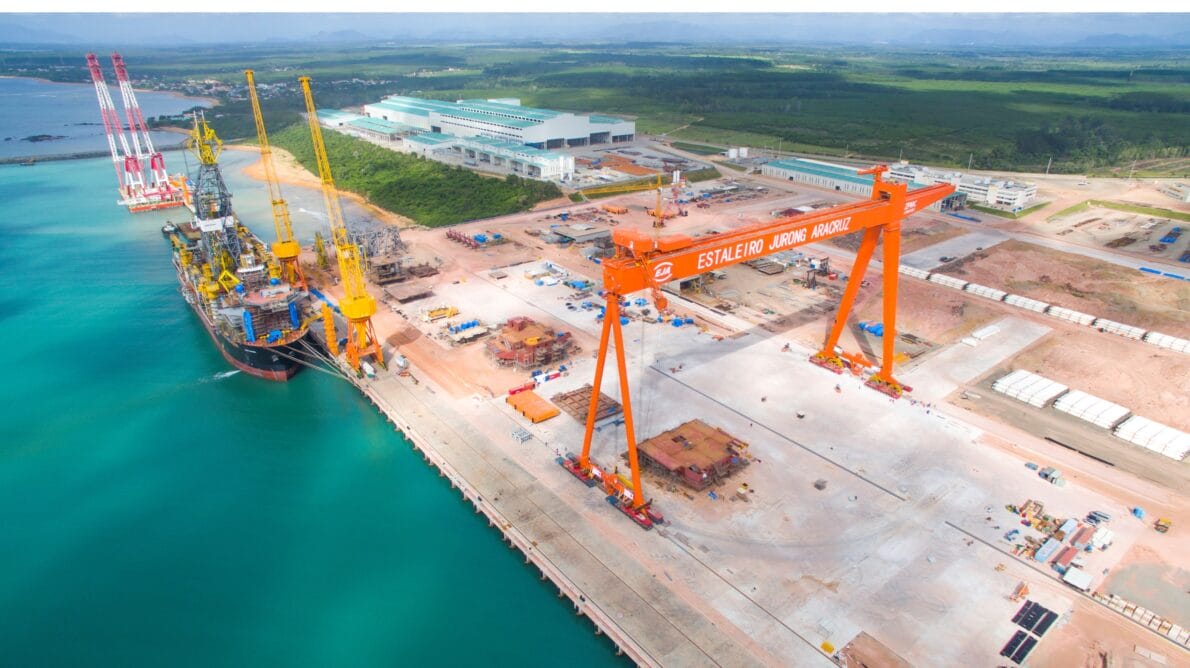

The Jurong Aracruz Shipyard Wants to Sign an Agreement with Petrobras for the Construction of Two Vessels. The Expectation is That More Than 3 Thousand Jobs Will Be Created and Benefit Brazilian Shipbuilding.
The Seatrium, which operates the Jurong Aracruz Shipyard, is close to signing a contract with Petrobras to build two drilling ships that will be installed in the Atapu and Sépia fields, both located in the pre-salt layer of the Santos Basin. The initiative promises to generate more than 3 thousand new jobs.
The Jurong Aracruz Shipyard has not officially commented until the edition closed with Petrobras, however, industry entrepreneurs confirm that the negotiation exists and are already excited about the business outlook, estimating that up to 3 thousand jobs could be created in the State.
According to business consultant Durval Vieira de Fretas, this is great news for the State, and the expectation is that negotiations will conclude soon. Jurong has 3 thousand employees, so they could even double the workforce. The base will likely be made in Singapore and completed here. However, there is no guarantee that both would go to the shipyard, since one could be in Aracruz and the other in Angra dos Reis.
-
Abandoned Factory in Rio’s North Zone Becomes Urban Hazard with Standing Water and Debris

-
The U.S. Navy Conducts Submarine Tests in Idaho Lake to Detect Underwater Noises Hidden by the Ocean

-
British Factory Transitions from Mechanical Parts to Producing 420,000 Electric Power Units Annually, Supplying 70% of Ford’s Electric Cars Sold in Europe
-
France Launches Network to Recycle 20 Million Cookware Pieces by 2027, Accepting All Brands for Aluminum and Coating Separation


Jurong Aracruz Shipyard and Petrobras
Fausto Frizzera, a member of the board of the Capixaba Center for Metal-Machinery Development (CDMEC), emphasizes that part of these hires would come from direct suppliers. He also agreed that the trend is for the hull to arrive with the shell ready from Singapore or another supplier.
Petrobras began talks with Seatrium after another competitor withdrew from the bidding process. The China Offshore Oil Engineering Corporation (COOEC) was competing for the contracts; however, it found itself compelled to withdraw from the deal, which involves the construction of the modules for its platforms.
Petrobras Vessels Will Reduce 30% of Emissions Per Barrel of Oil
The future P-84 (Atapu) and P-85 (Sépia) platforms manufactured at the Jurong Aracruz Shipyard will each have a daily production capacity of 225 thousand barrels of oil and processing millions of cubic meters of gas.
The expectation is that production will begin in 2028, generating thousands of jobs. The project stands out for its projection of a 30% reduction in the intensity of greenhouse gas emissions per barrel of oil equivalent produced.
The purpose of Petrobras’s negotiation with Seatrium is the construction of the drilling ships (FPSOs) P-84 and P-85. These vessels, built at the Jurong Aracruz Shipyard, will be strategically installed in the Atapu and Sépia fields, respectively, both located in the pre-salt layer of the Santos Basin.
Seatrium, in Brazil, operates the BrasFELS shipyard in Angra dos Reis (Rio de Janeiro) and Jurong Aracruz in Espírito Santo, which means that at least one of the ships could be built in Aracruz.
Another Ship Built at the Jurong Aracruz Shipyard
In addition to negotiations with Petrobras, the Brazilian Navy recently celebrated a historic milestone with the keel-laying ceremony of the first polar ship developed in Brazilian territory.
The event, which symbolizes the official start of the ship’s construction, took place at the Jurong Aracruz Shipyard and was attended by Defense Minister José Múcio Monteiro. With a budget of approximately 692 million reais, the polar ship Almirante Saldanha will be the jewel of the Brazilian polar fleet, designed to replace one of the two vessels of the same type currently in operation.
The estimate is that the ship will become operational in October 2025. According to information from the Brazilian Navy, the vessel will be equipped with one of the most advanced icebreaker technologies in the world. This capability will allow the ship to break ice layers up to one meter thick, even those formed in less than one year.








