Portuguese
  Spanish


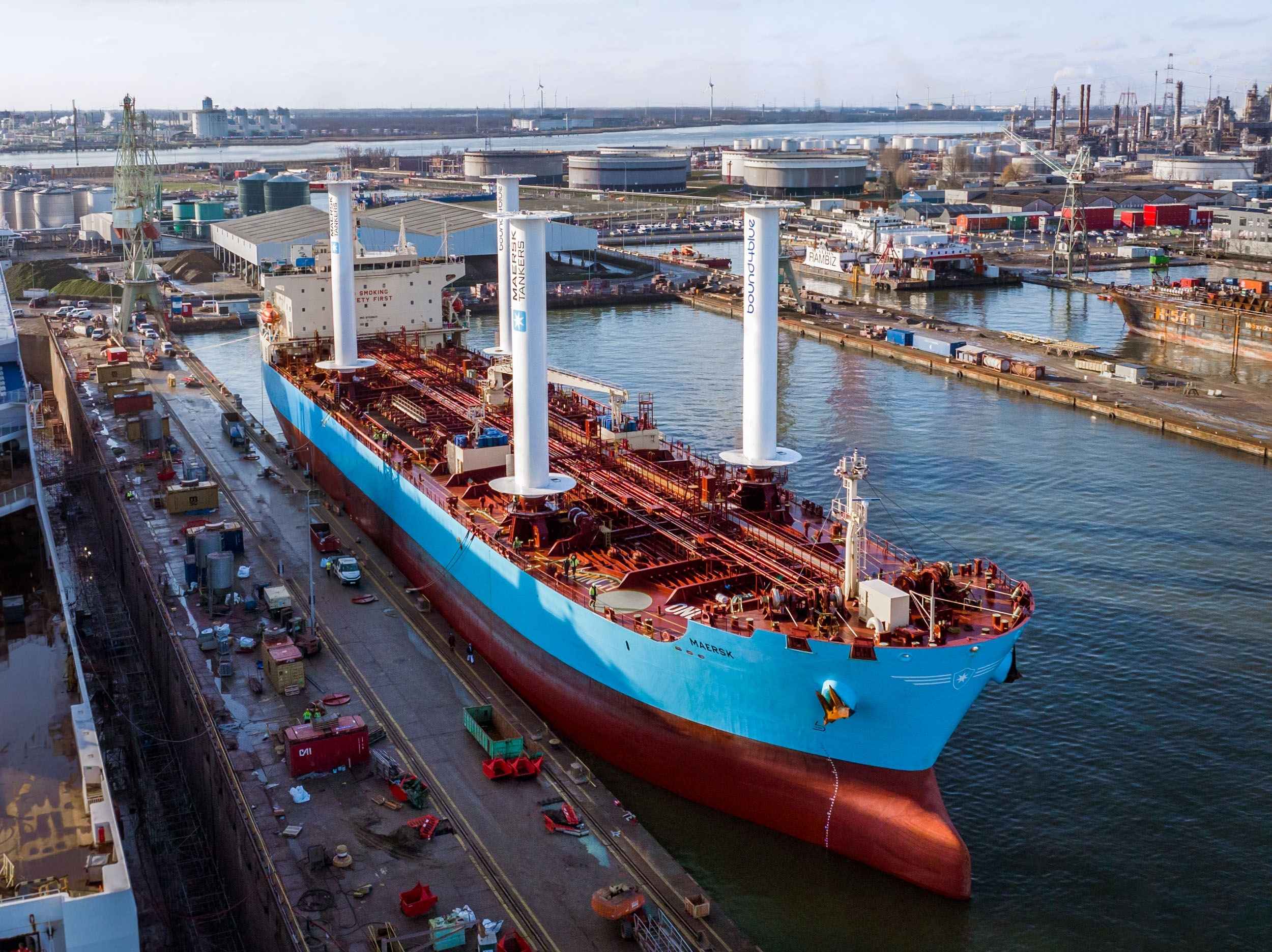

Oil tanker with 24m suction sails reduces fuel by up to 20% and already saves 5.4 tons/day, marking a new phase in global navigation.
In 2024, Maersk Tankers began implementing a technology that is changing the logic of efficiency in global maritime transport. The Maersk Trieste oil tanker received four suction sails approximately 24 meters high, known as eSAILs, developed by the Spanish company bound4blue. The initiative was reported by official communications from the company itself and by specialized maritime industry outlets, consolidating one of the first cases of commercial-scale application of this type of system.
The project is part of a broader agreement that foresees the installation of up to 20 sails on different vessels in the fleet. The goal is to reduce fossil fuel consumption and emissions without altering the logistical operation of the ships, maintaining routes, cargo, and speed.
The relevance of the project lies in the fact that it does not depend on alternative fuels still under development, but rather on a free, abundant energy source available on almost all ocean routes: the wind.
-
The U.S. Navy Conducts Submarine Tests in Idaho Lake to Detect Underwater Noises Hidden by the Ocean

-
Nuclear Submarine USS Alexandria Retired After 35 Years, Having Completed Over 1 Million Miles in Missions

-
MODEC Introduces New Hull Design for FPSO Gato do Mato to Produce Up to 120,000 Barrels of Oil Per Day in Brazil’s Pre-Salt Region
-
This Massive 12-Meter, 21-Ton Underwater Drone Can Operate Autonomously for Up to Five Days


eSAIL technology uses suction effect to multiply aerodynamic efficiency
The sails installed on the Maersk Trieste do not function like conventional sails. The system utilizes an aerodynamic principle known as the Coandă effect, in which air is drawn along the surface of the sail, significantly increasing the pressure difference between the sides.

This mechanism allows the structure to generate up to 6 to 7 times more lift than traditional sails, according to technical data released by bound4blue. In practice, this means that the force generated by the wind is amplified, directly contributing to propelling the ship.
The sails are rigid, constructed with lightweight and durable materials, and operate fully automated. Sensors and digital systems continuously adjust the position and operation to optimize performance in different wind conditions.
This automation eliminates the need for a dedicated crew, making the system viable for large-scale use without increasing operational complexity.
Real fuel savings already reach up to 5.4 tons per day
The initial operational data shows concrete results. Tests conducted with the technology indicate an average savings of about 1.7 tons of fuel per day, with peaks that can reach 5.4 tons daily in favorable wind conditions.
This level of savings represents a significant reduction in the total consumption of the vessel, especially on long routes. Annually, depending on the operation, the volume saved can reach thousands of tons of fuel.
This reduction not only decreases operational costs but also directly reduces carbon dioxide emissions, one of the main environmental challenges in the maritime sector.
Reduction of up to 20% in consumption occurs without changing routes or cargo
One of the main differentiators of the system is its ability to operate without interfering with the traditional logic of maritime transport. The reduction in consumption, which can reach up to 20% depending on the route and weather conditions, occurs without the need to change routes, speed, or cargo capacity.
This means that the ship continues to operate within the already established logistical standards, but with greater energy efficiency. This characteristic is essential for large-scale adoption, as it avoids structural changes in the operations of companies.
Additionally, the system can be automatically turned off in unfavorable conditions, ensuring flexibility and safety.
Retrofit allows application on existing ships
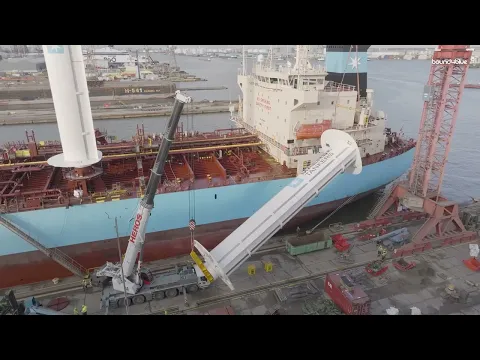
Another factor that accelerates the adoption of the technology is the possibility of retrofit. The Maersk Trieste was not originally designed with suction sails, but received the system later, demonstrating that the technology can be applied to ships already in operation.

This adaptability significantly reduces the cost of implementation and broadens the reach of the solution, allowing thousands of vessels to be upgraded without the need for replacement. The agreement between Maersk Tankers and bound4blue, which provides for installation on multiple ships, reinforces this trend.
Regulatory pressure accelerates the search for low-carbon solutions
The maritime sector faces increasing pressure to reduce its emissions. The International Maritime Organization has set ambitious targets to significantly cut greenhouse gas emissions by 2050.
In this context, technologies that offer immediate reductions in consumption and emissions gain prominence. Wind-assisted propulsion emerges as a practical and already available solution, unlike alternative fuels that still face challenges of scale and infrastructure.
Companies that adopt these technologies also position themselves better in the face of future stricter regulations.
Operational savings can reach millions over the vessel’s lifetime
Fuel represents one of the largest operational expenses in maritime transport. Reductions in consumption, even if relatively modest percentages, can generate significant savings over time.
With daily savings that can exceed 5 tons, the annual financial impact can reach millions of dollars, depending on the route and frequency of operation. This financial return makes the investment in suction sails attractive not only from an environmental perspective but also from an economic one.
Integration with other technologies enhances energy efficiency
Suction sails do not replace the main engine of the vessel but work as a complementary system. They can be combined with other solutions, such as more efficient engines, alternative fuels, and route optimization systems.
This hybrid approach allows for maximizing energy efficiency by utilizing different energy sources in an integrated manner. The trend is that, in the coming years, vessels will begin to operate with multiple technologies simultaneously, progressively reducing dependence on fossil fuels.
Wind-assisted navigation returns with high precision engineering
Although the use of wind in navigation is ancient, modern application represents a significant evolution. Digital systems, automation, and advanced materials have transformed an old technique into a high-precision engineering solution. The difference lies in the ability to operate at an industrial scale, with predictable performance and full integration with modern navigation systems.

This advancement marks the return of wind as a relevant component in maritime propulsion, now with technology compatible with the demands of global trade.
Maritime sector enters gradual and irreversible energy transition
The adoption of suction sails on commercial ships indicates that the maritime sector is entering a phase of energy transition. Instead of a sudden change, the process occurs through the incorporation of solutions that gradually reduce fossil fuel consumption.
Wind-assisted propulsion is one of the first technologies to offer concrete results in this process, acting as a bridge between the current model and future zero-emission solutions. This movement is expected to intensify as new technologies become viable and economically competitive.
Leave your opinion in the comments and say whether technologies like suction sails can redefine the way the world moves billions of tons of cargo every year.