






 Portuguese
  Spanish


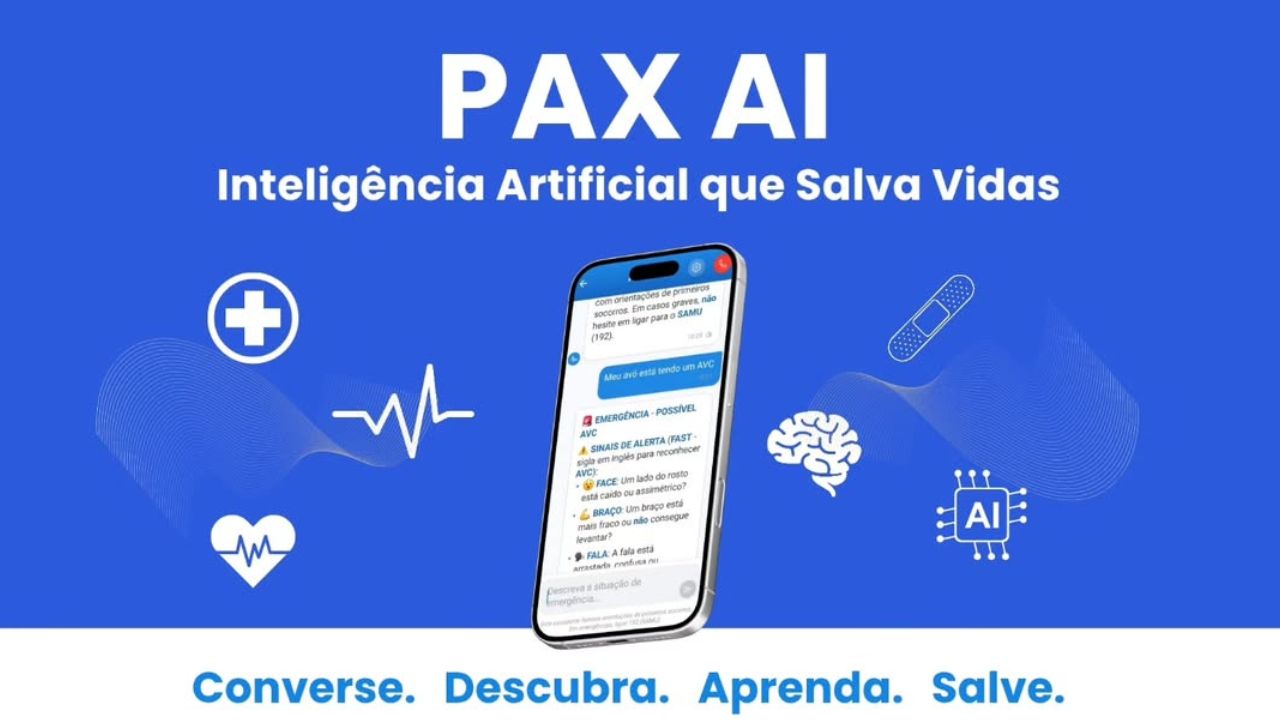

Students From Etec de Leme Create App (Pax AI) With Artificial Intelligence That Guides First Aid, Sends Automatic Alerts, and Helps to Speed Up Service in Medical Emergencies.
Instead of searching for generic answers online in moments of despair, victims and witnesses of medical emergencies can rely on a artificial intelligence application developed by students from the São Paulo public education system. Created by students from Etec Deputado Salim Sedeh in Leme (SP), Pax AI was designed to guide first aid responses with straightforward instructions while waiting for rescue to arrive on the scene.
The project originated in the technical course of System Development and was developed by João Masculi, Felipe de Souza, and Arthur Ferreira, under the guidance of professor Andre Candido. The central proposal is simple but ambitious: transform medical information into practical action, especially in the first minutes of a serious incident.
Emergency Does Not Combine With Overload of Information
The students’ motivation arose from a common realization. In critical situations, such as a potential stroke or sudden fainting, search engines and virtual assistants tend to deliver long texts, technical explanations, and content that is not very useful for those who need to act immediately.
-
Ancient Ritual Circle, Hidden for 5,000 Years, Discovered in Scotland’s Machrie Moor Using Sensors, Revealing a “Phantom Stonehenge”

-
Engineers Develop Fridge-Sized Machine to Produce 95-Octane Synthetic Fuel from Air and Water, Aiming to Sustain Combustion Engines Without Oil
-
Two-Armed Robot Uses AI to Reassemble Destroyed Pompeii Frescoes, Solving an “Impossible” Puzzle
-
New Law in Brazil Requires Breaks for Type 1 Diabetes Management at Work, School, and Public Exams


“In a stroke situation, for example, you need to be very quick to help that person. You don’t need to become a professional in the subject to help at that moment; you need access to detailed information, with step-by-step instructions. We realized that there was a lot to be desired in the market,” explains João Augusto, one of the project’s creators.
With this in mind, the group decided to build a tool that prioritized clarity, speed, and direct guidance, without overwhelming the user.

Pax AI: Evolution of the Project to Become First Aid App
Pax AI did not start as an app. The first version functioned as a chatbot on WhatsApp, was then adapted into a website, and later transformed into a mobile app.
The format change had an essential reason: to allow use even when there is no internet connection, which is common in emergency situations.
The system’s foundation is a generative AI chatbot, created based on DeepSeek and trained with a focus on short, correct, and accessible responses. In offline mode, the functions are limited, but the app can still recognize frequent scenarios and guide first aid.
Functions That Help Save Time
In addition to first aid instructions, Pax AI includes features designed to facilitate calling for help.
The app can send automatic messages to pre-registered contacts and utilizes the device’s geolocation, helping emergency teams find the location more quickly.
The reliability of the answers was treated as a priority during development.

“We had the support of several health professionals in this process to understand which information would be added to the database. We also thought about how to provide the best possible response for the user to understand clearly and objectively,” states Arthur Ferreira.
Next Step Is to Reach Official Stores
Currently, Pax AI is only available in APK format for Android, installed outside the Play Store.
The group’s goal now is to raise financial investment to launch the app in official stores and expand the tool’s reach.
“We want a basic investment to publish the app. This way, we will have more access, greater visibility, and be able to refine it, making it increasingly sophisticated and better for the audience,” highlights Felipe de Souza.
By uniting technical education, artificial intelligence, and social impact, the project of the Etec students demonstrates how technology can leave the academic environment and transform into a real ally in protecting life, especially when time is the most decisive factor.
With information from CanalTech






