






 Portuguese
  Spanish


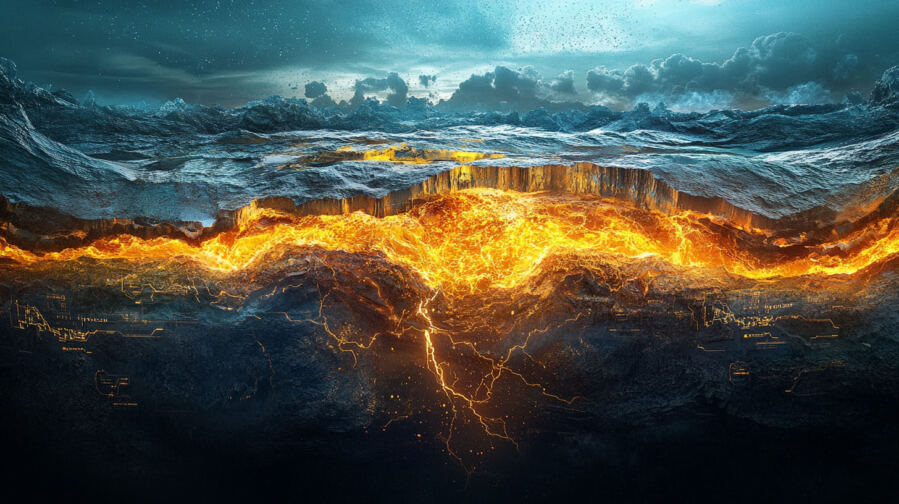


Scientists Reveal How Gold, Formed in the Depths of the Earth, Is Brought to the Surface by Unique Geological Processes.
Researchers from various parts of the world, including a scientist from the University of Michigan, have identified a new mechanism that explains how gold deposits form.
The discovery provided more details on a topic that has intrigued the scientific community: how gold, common in the Earth’s mantle, is transported to the surface of the Earth.
The Role of Gold in the Interior of the Earth
Although gold is a relatively common metal in the overall composition of the planet, most of it remains deeply trapped in the Earth’s mantle.
-
China could reduce iron ore imports from 80% to 50% of consumption by 2030, while its share in global steel production falls from 52% to 46%, in a shift that could reshape the global market, says CMRG.

-
Brazil is sitting on one of the largest lithium reserves in the world, in the Jequitinhonha Valley, but national mining has almost become an appendage of China: 97% of the metal’s export goes to a single country, which also dominates refining.
-
Iron ore falls to 762 yuan in China as real estate sales decline and steel production hits lowest level since 2018
-
Brazil has minerals, clean energy, and a waiting market, but it could miss a billion-dollar opportunity if it doesn’t speed up the race for green minerals, while the steel industry seeks to reduce emissions.


At the surface, it is found in specific concentrations in volcanic or magmatic rocks. The process that brings this gold to the surface, however, was poorly understood.
The recent study revealed that a specific form of sulfur, under precise conditions of pressure and temperature, promotes the transfer of gold from the mantle to magmas that eventually reach the surface. These conditions occur between 50 and 80 kilometers deep, beneath active volcanoes.
Gold-Trisulfide Complex
Pure gold, inert in the Earth’s mantle, only becomes mobile when in contact with sulfur-rich fluids.
Under these conditions, it forms molecular bonds with three sulfur ions, creating a complex known as gold-trisulfide.
This complex shows high mobility in the molten regions of the mantle, known as magma.
Scientists already knew that gold could form bonds with sulfur atoms, but this is the first study to present a robust thermodynamic model regarding the importance of the gold-trisulfide complex.
Simulations and Experiments
The advancement was made possible thanks to numerical simulations and laboratory experiments. In the lab, researchers rigorously controlled pressure and temperature to recreate artificial magma and validate the thermodynamic model.
The developed model can now be applied to real Earth conditions, helping to explain the formation of large gold deposits.
Subduction
One highlight of the study is the role of subduction zones. These regions, where one tectonic plate slides under another, create the ideal conditions for gold deposit formation.
When the subducting plate dives into the mantle, it releases sulfur-rich fluids. These fluids interact with the magma, forming gold-trisulfide complexes and allowing gold to ascend to the surface.
“In the subduction zones around the Pacific Ocean, from New Zealand to Chile, we have many active volcanoes. These volcanoes are directly linked to the processes that also form gold deposits”, explained Adam Simon, professor of Earth and Environmental Sciences at the University of Michigan and co-author of the study.
Impact on Exploration
The research offers a deeper understanding of why some subduction zones produce extremely rich gold deposits. This can have positive impacts on mineral exploration, allowing for more precise strategies to find new deposits.
Simon emphasized: “Combining the results of this study with existing ones significantly enhances our understanding of gold deposit formation”.
The study, titled Mantle oxidation by sulfur drives the formation of giant gold deposits in subduction zones, was published in the journal Proceedings of the National Academy of Sciences.








Muito bom este avanço!
Maravilha, isso para extrair ainda não produzem, próximo dos vulcões também encontra se diamantes.
Então porque não tem ouro em lavas expelida por vulcões,ja que ela vem do manto da terra!
Não é expelir lava e encontrar ouro. O ouro vem em veios junto a rochas magmáticas de quartzo… Locais pedregoso. Vêm em lamelas, linhas de encontro e não como uma panela de rochas com ouro. É preciso aguardar um tempo rochoso de configuração. Entrar no processo a água q sempre estará ligada ao quartzo. O ideal é buscar em zonas de subducao antigas,não em locais de magnas ativos atuais…
Subida do Magma: Quando o magma começa a subir em direção à superfície, ele carrega consigo vários elementos e ****. No entanto, devido à alta densidade do ouro, ele tende a se separar do magma principal durante essa ascensão. Elementos mais leves e menos densos são mais facilmente transportados até a superfície